Bonjour! Welcome back to your French course.
Introduction
In our last lesson, you learned how to use prepositions of place like à, dans, sur, and en to describe where things are. This was a crucial step in being able to form descriptive sentences.
Today, we'll build on that by learning to conjugate and use four of the most important and common verbs in French: aller (to go), faire (to do/make), prendre (to take), and venir (to come). These are all "irregular verbs," meaning they don't follow the standard conjugation patterns you'll learn for other verbs. Mastering them is essential for daily conversation, as they appear constantly.
By the end of this lesson, you'll be able to combine these action verbs with the prepositions you already know to say things like Je vais au bureau (I'm going to the office) or Nous prenons un café (We're having a coffee).
1. The Verb Aller (to go)
Let's start with aller. It means "to go" and is one of the most irregular verbs in the language. Its conjugation in the present tense is unique and must be memorized.
To get a feel for the pronunciation and usage, please watch the first part of this video.
Aller (to go) — Present Tense (French verbs conjugated by Learn French With Alexa)
The video 'Aller (to go) — Present Tense' from Learn French With Alexa provides a clear pronunciation guide and the full conjugation.
Watch from 00:50 to 03:00. Listen carefully to the pronunciation of each form and repeat after the instructor.
Here is the conjugation for aller in the present tense:
| Pronoun | Verb | Translation |
|---|---|---|
| Je | vais | I go / I am going |
| Tu | vas | You go / You are going (informal) |
| Il / Elle / On | va | He / She / One goes / is going |
| Nous | allons | We go / We are going |
| Vous | allez | You go / You are going (formal/plural) |
| Ils / Elles | vont | They go / They are going |
Notice how the forms vais, vas, va, and vont don't look anything like the infinitive aller. The nous and vous forms, however, do resemble it.
Examples in Context:
Combining this with what you learned in the last lesson:
Je **vais** au bureau en bus.(I go to the office by bus.)Tu **vas** à la réunion de 10h ?(Are you going to the 10am meeting?)Mon collègue **va** en France pour une conférence.(My colleague is going to France for a conference.)Nous **allons** au restaurant avec l'équipe.(We are going to the restaurant with the team.)Vous **allez** où ?(Where are you going?)Ils **vont** à la machine à café.(They are going to the coffee machine.)
2. The Verb Faire (to do/to make)
Next is faire. In French, this single verb covers both "to do" and "to make." Its meaning is determined by the context. It's used in countless expressions for activities, chores, and even the weather.
This next video will walk you through the conjugation and its many uses.
Faire (to do/make) — Present Tense (French verbs conjugated by Learn French With Alexa)
Let's watch 'Faire (to do/make) — Present Tense' from the same channel to understand its forms and common uses.
Watch from 00:39 to 05:45. Pay close attention to the conjugation and the diverse examples provided, from making a cake to doing sports or talking about the weather.
Here is the conjugation for faire in the present tense:
| Pronoun | Verb | Translation |
|---|---|---|
| Je | fais | I do/make |
| Tu | fais | You do/make (informal) |
| Il / Elle / On | fait | He / She / One does/makes |
| Nous | faisons | We do/make |
| Vous | faites | You do/make (formal/plural) |
| Ils / Elles | font | They do/make |
Pronunciation tip: The -ai- in faisons is pronounced like a short "e" sound, so it sounds like fe-zon, not fay-zon. Also, notice the form vous faites—it's highly irregular.
Examples in Context:
Je **fais** une revue de code.(I am doing a code review.)Qu'est-ce que tu **fais** ?(What are you doing?)Elle **fait** une présentation pour le client.(She is making a presentation for the client.)Nous **faisons** un point sur le projet.(We're having a check-in on the project.)Vous **faites** du bon travail.(You are doing good work.)Ils **font** des tests automatisés.(They are making/running automated tests.)
3. The Verbs Prendre (to take) and Venir (to come)
Now let's tackle prendre and venir. These are also extremely common. Prendre is particularly versatile, meaning not only "to take" but also "to have" (food/drink) and "to use" (transport).
To see the conjugations for these verbs and others in a clear format, please refer to the following guide.
Mastering Irregular French Verbs: A Comprehensive Guide
The article 'Mastering Irregular French Verbs' provides a concise list of common irregular verbs, including their present tense conjugations and examples.
Please read Section 4: Common Irregular French Verbs and Their Conjugations. Focus on the entries for 'Prendre' and 'Venir'. You can use the entries for 'Aller' and 'Faire' as a quick review.
Prendre (to take)
This image perfectly illustrates the many meanings of prendre.
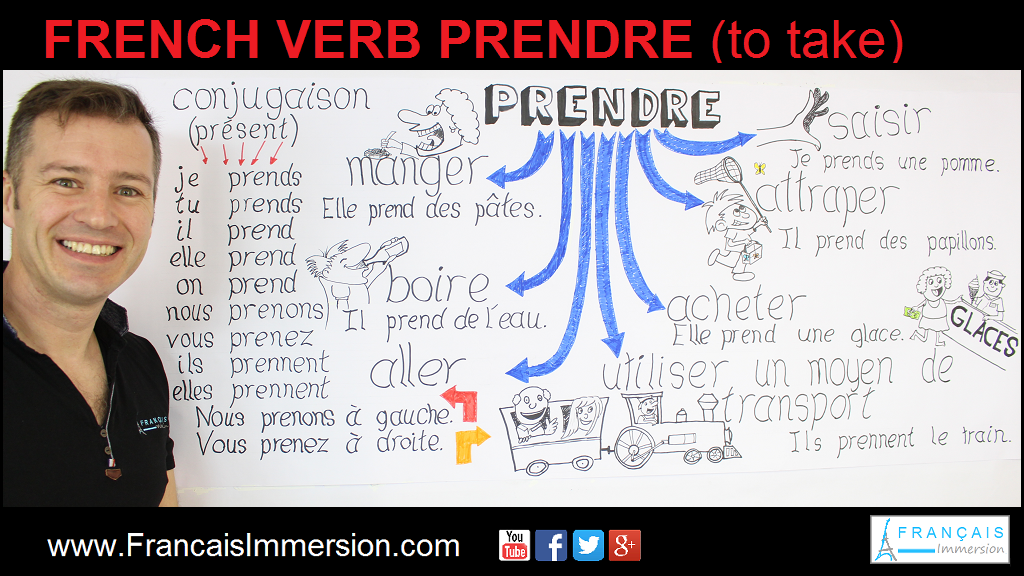
Here's the conjugation summary:
| Pronoun | Verb | Translation |
|---|---|---|
| Je | prends | I take |
| Tu | prends | You take (informal) |
| Il / Elle / On | prend | He / She / One takes |
| Nous | prenons | We take |
| Vous | prenez | You take (formal/plural) |
| Ils / Elles | prennent | They take |
Examples in Context:
- To use transport:
Je **prends** le métro pour aller au travail.(I take the metro to go to work.) - To have food/drink:
On **prend** un café ?(Shall we get a coffee?) - To take something:
Tu **prends** des notes pendant la réunion ?(Are you taking notes during the meeting?) - To make a decision:
L'équipe **prend** une décision sur l'architecture.(The team is making a decision on the architecture.)
Venir (to come)
Venir is used to describe movement toward the speaker or a destination.
Here is its conjugation:
| Pronoun | Verb | Translation |
|---|---|---|
| Je | viens | I come |
| Tu | viens | You come (informal) |
| Il / Elle / On | vient | He / She / One comes |
| Nous | venons | We come |
| Vous | venez | You come (formal/plural) |
| Ils / Elles | viennent | They come |
Examples in Context:
Je **viens** au bureau tous les jours.(I come to the office every day.)Tu **viens** de quel pays ?(Which country do you come from?)Le Product Manager **vient** nous voir à 14h.(The Product Manager is coming to see us at 2pm.)Nous **venons** de terminer le sprint.(We have just finished the sprint.) - Note:venir de + infinitivemeans "to have just done" something. A very useful construction!
4. Practice Exercise
Now, let's put it all into practice. Fill in the blanks with the correct present tense form of aller, faire, prendre, or venir.
- Nous ________ une pause de dix minutes. (
prendre) - Je ________ à la cafétéria. Tu ________ avec moi ? (
aller,venir) - Qu'est-ce que vous ________ ce week-end ? (
faire) - Ils ________ le train de 8h05 tous les matins. (
prendre) - Mon manager ________ en vacances la semaine prochaine. (
aller) - En général, je ________ les rapports de bugs le lundi. (
faire) - D'où ________ -tu ? (
venir) - On ________ au cinéma ce soir ? (
aller)
Check your answers
- Nous prenons une pause de dix minutes.
- Je vais à la cafétéria. Tu viens avec moi ?
- Qu'est-ce que vous faites ce week-end ?
- Ils prennent le train de 8h05 tous les matins.
- Mon manager va en vacances la semaine prochaine.
- En général, je fais les rapports de bugs le lundi.
- D'où viens-tu ?
- On va au cinéma ce soir ?
Conclusion
Excellent work! You have just learned the conjugations and uses of four of the most fundamental verbs in French. Memorizing them is a high-impact activity that will significantly expand the range of things you can say.
Key Takeaways:
- The verbs
aller,faire,prendre, andvenirare highly irregular and must be memorized. aller(to go) is essential for talking about movement and is also used to form the near future tense.fairemeans both "to do" and "to make" and is used in many common expressions.prendre(to take) has multiple meanings, including having food/drink and using transportation.venir(to come) is used for movement towards a location and to express the recent past (venir de).
In our next lesson, we will continue exploring verbs for daily life by learning how to use reflexive verbs to describe daily routines, such as "I wake up" (je me lève) and "I prepare" (je me prépare).
À bientôt !