Bonjour ! Welcome to your new lesson.
Introduction
In our last lesson, we covered the essential skill of asking for and giving directions, adding another practical tool for your daily life in a French-speaking environment. We focused on navigating the city to find places.
Today, we'll take the next logical step: what to do once you've arrived at your destination, specifically a store. The learning outcome is to make purchases and discuss prices in a store. We'll cover everything from asking for an item to understanding the price and completing the payment. This is a fundamental skill that you'll use constantly, whether you're buying groceries, clothes, or tech gadgets for a project.
Let's get started on making you a confident shopper in French!
1. Essential Shopping Vocabulary
Before we start a conversation, let's equip ourselves with some key nouns. Just as in a software project where you need to know the components like server, database, and API, in a shopping scenario, you need to know the basic elements of the environment.
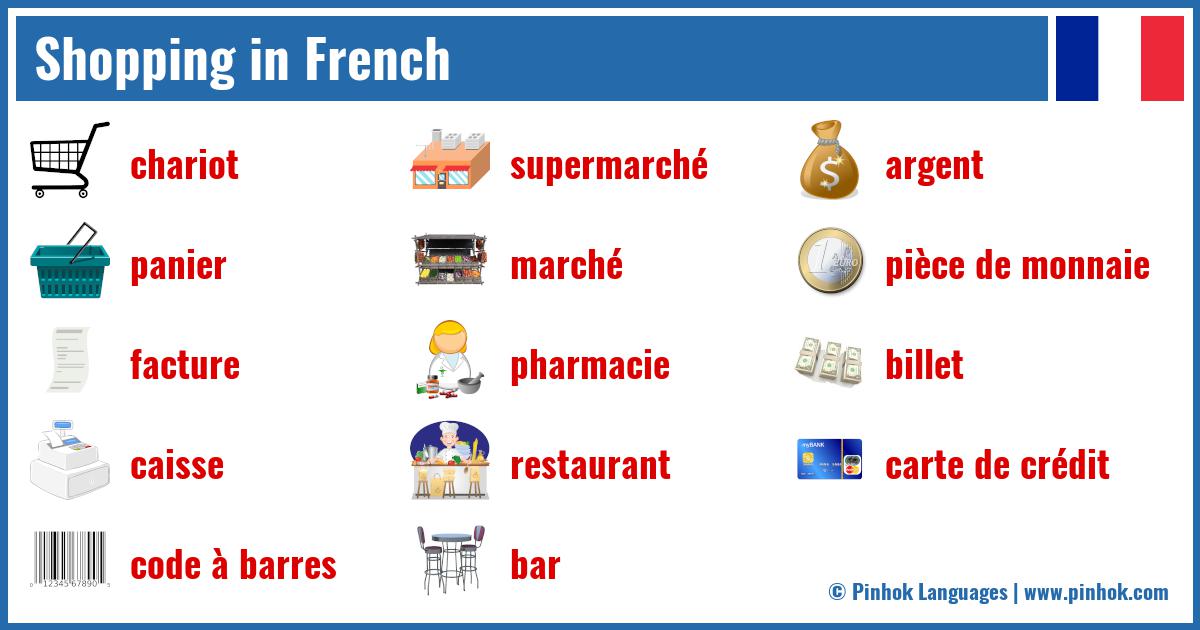
Here’s a summary of the most important terms:
| French | English |
|---|---|
le magasin |
the store |
le marché |
the market |
le vendeur / la vendeuse |
the salesperson (male / female) |
un article |
an item |
le prix |
the price |
la caisse |
the cash register / checkout |
un panier |
a basket |
un sac |
a bag |
la carte de crédit / bancaire |
the credit / bank card |
les espèces (f.) / le liquide |
cash |
la monnaie |
the change |
2. Asking for What You Want and Its Price
Now that you know the key terms, let's build the conversation. The first step is to state what you're looking for and then ask for its price. There are several ways to do this, ranging from direct to more colloquial.
To see how this works in a realistic context, let's look at a dialogue. The following resource shows a customer buying a mobile phone—a scenario that aligns well with your tech background.
Conversation in French between shopkeeper and customer
We'll read a dialogue from 'Bla Bla Français' to see how a customer interacts with a salesperson. This will show us how to politely ask for an item and then inquire about its price.
First, read the section 'Greetings', focusing on the customer's phrase: 'Je voudrais acheter un téléphone portable'. Then, skip down to the section 'Closing the sale' and find the customer's question about the price: 'et il fait quel prix ?' This is a great colloquial phrase to learn.
Key Phrases for Asking the Price
The phrase il fait quel prix ? is a great one to know. However, the most standard and versatile ways to ask for a price are C'est combien ? and Ça coûte combien ?.
This next video breaks down these essential questions very clearly.
Learn How to Ask for a Price in French | Can Do #17
Let's watch a short video from 'Learn French with FrenchPod101.com' to master the most common ways to ask for a price.
Pay close attention to these three parts: (0:00 - 1:15) Focus on the main question: Ça coûte combien ? (How much does this cost?). (4:54 - 5:25) Learn how to specify an item: Un café, ça coûte combien ? (How much does a coffee cost?). (9:46 - 10:30) Learn the slightly more informal alternative: C'est combien ? (How much is it?).
To summarize, your go-to questions will be:
C'est combien, s'il vous plaît ?(How much is it, please?) — Simple and direct.Ça coûte combien ?(How much does this cost?) — Also very common.Le [item] coûte combien ?(How much does the [item] cost?) — To be specific.
3. Understanding the Answer and Discussing Value
Once you've asked the price, you need to understand the response. This will test your knowledge of French numbers, which we covered in the first module.
Let's listen to a dialogue at a market to hear how a price is stated and how the transaction is completed.
Going to the market... an Everyday French dialogue to improve your listening and speaking skills!
This video from 'Learn French With Alexa' simulates a conversation at a market. It's excellent for training your ear to catch numbers and phrases related to payment.
Watch the analysis of the dialogue from 04:18 to 06:04. Focus on these two key moments: The Price (04:18 - 05:24): The seller says, Ça fera neuf euros quarante (That will be 9 euros 40). Notice the use of the verb faire to state the total. The Payment (05:24 - 06:04): Listen for the phrases Voici dix euros (Here are ten euros) and Voici la monnaie (Here is the change).
Sometimes you might want to know if an item is on sale or comment on its price. Here is a list of useful phrases for that.
Let's review a list of phrases from 'FluentU' that will help you discuss deals and value.
Scan through the sections 'French Phrases to Talk About Deals', 'Finding Sales', and 'Making Crucial Shopping Decisions'. Focus on these key terms: Bon marché (Inexpensive / a good deal) Pas cher (Not expensive) C'est trop cher (It's too expensive) C'est en solde ? (Is it on sale?)
4. Completing the Purchase: Deciding and Paying
You've asked for the item, you know the price, and you've decided to buy it. What's next?
- State your decision: The most common phrase is
Je le prends(I'll take it) for a masculine item,Je la prendsfor a feminine item, orJe les prendsfor plural items. - State your payment method:
Je vais payer **par carte**.(I'm going to pay by card.)Je vais payer **en espèces / en liquide**.(I'm going to pay in cash.)
The FluentU article you just looked at (LINK) also lists these payment phrases under the "Paying and Asking for Prices" section.
5. Practice Scenario: Buying a Tech Gadget
Let's put everything together. Your goal of working in a French tech environment means you might find yourself in a store like Fnac or Darty buying electronics.
Imagine you see a keyboard (un clavier, masculine) you like, but the price isn't listed. Here’s how a conversation might go. Read it aloud to practice your pronunciation.
You: Bonjour. Excusez-moi, je cherche un clavier.
(Hello. Excuse me, I'm looking for a keyboard.)
Salesperson: Bien sûr. Nous avons plusieurs modèles. Celui-ci est très populaire pour le développement.
(Of course. We have several models. This one is very popular for development.)
You: Il a l'air bien. **Ça coûte combien ?**
(It looks good. How much does it cost?)
Salesperson: Ce modèle est à 85 euros (quatre-vingt-cinq euros).
(This model is 85 euros.)
You: D'accord, c'est un bon prix. **Je le prends.**
(Okay, that's a good price. I'll take it.)
Salesperson: Parfait. Vous payez comment ?
(Perfect. How are you paying?)
You: **Je vais payer par carte**, s'il vous plaît.
(I'll pay by card, please.)
This simple dialogue covers every step of the process and uses the key phrases from today's lesson.
Conclusion
Excellent work! You can now confidently handle one of the most common daily interactions in French.
Key Takeaways:
- Ask for an item politely with
Je cherche...orJe voudrais.... - Ask for the price using
C'est combien ?orÇa coûte combien ?. - Listen for the seller to state the price, often using
Ça fait...orC'est.... - Use phrases like
C'est en solde ?orC'est trop cherto discuss value. - Finalize your purchase with
Je le/la prendsand state your payment method (par carteoren espèces).
In our next lesson, we will expand on making decisions by learning how to express likes, dislikes, and preferences using verbs like aimer, adorer, and détester. This will allow you to explain why you chose to buy that keyboard (or why you didn't!).
À la prochaine !