Bonjour! Welcome to the first lesson of your course on Professional French Communication. I'm excited to guide you on this journey.
Introduction
Today, we'll build the most critical foundation for speaking French clearly and confidently: pronunciation. Your goal is to communicate effectively in professional and daily settings, and mastering the sounds of the language is the first and most important step. Mispronunciation can lead to misunderstandings, something we all want to avoid, especially in a technical or business context.
This lesson is designed to help you pronounce French vowels, nasal sounds, and silent letters correctly. We will break this down into three parts:
- Oral Vowels: Understanding the pure vowel sounds and how accents change them.
- Nasal Vowels: Mastering the unique French nasal sounds that don't exist in English.
- Silent Letters: Learning the rules for which letters not to pronounce, especially at the end of words.
Think of French spelling-to-sound rules like a set of parsing rules. The written letters are the input, and the sounds are the output. A combination like 'an' is usually parsed as a single nasal sound, but if followed by another vowel (like in 'année'), the parsing rule changes. We'll explore these rules together.
Let's begin!
1. French Oral Vowels and Accents
The first thing to know about French is that the relationship between spelling and sound is more consistent than in English, but it follows different rules. Several letter combinations can produce the same sound.
Let's start with a quick overview of the basic vowels.
Master French pronunciation rules in 10 minutes [Easy Guide]
Watch this short segment from the 'Easy French with Umut' channel. It provides a great first look at the core vowel sounds and common letter combinations.
Watch from 00:28 to 02:04. Pay close attention to the sound of each vowel and how combinations like 'ou', 'oi', and 'eau' are pronounced. Try to repeat the words out loud.
As you just saw, sounds like 'o' can be spelled as 'o', 'au', or 'eau'. Getting used to these patterns is key.
Now, let's dive deeper. French has more vowel sounds than English. The video below by 'Learn French with Lexie' offers a more systematic breakdown, which will help you fine-tune your pronunciation.
The Right Way to Pronounce French Vowel Sounds | French Phonetics for Beginners
This video breaks down the main oral vowels one by one. It's particularly useful for understanding the precise mouth shape needed for each sound.
Watch from 01:23 to 05:43. Focus on the distinction between similar sounds, such as the two 'o' sounds and the two 'e' sounds. Pay special attention to the French 'u' sound (at 02:27), which is often tricky for English speakers. The tip—making an 'ee' sound with rounded lips—is very effective.
The Role of Accents
You may have noticed letters with marks on them, like é, è, and ê. These are accents, and they are not optional—they are part of the word's spelling and often change its pronunciation, especially for the letter 'e'.
- é (accent aigu): Makes an "ay" sound, like in "say" but shorter. Ex: télé, café.
- è (accent grave): Makes an "eh" sound, like in "bed". Ex: père, mère.
- ê (accent circonflexe): Also makes an "eh" sound, like accent grave. Ex: fête, forêt.
- ç (cédille): This isn't on a vowel, but it's important. It makes the 'c' sound like an 's' before a, o, or u. Ex: français, garçon.
Test your understanding!
Listen to the pronunciation of these words in your head. Based on the rules, which word in each pair contains the sound "eh" (like in "bed")?
-
a) répéter (to repeat)
b) algèbre (algebra) -
a) développer (to develop)
b) problème (problem)
Show answer
- b) algèbre - The
èindicates the "eh" sound. - b) problème - The
èindicates the "eh" sound. Développer has theé("ay") sound.
2. French Nasal Sounds
Nasal sounds are a signature feature of French. They are produced when air passes through both the mouth and the nose. English has nasal consonants (like 'm' and 'n'), but French has nasal vowels. There are three main ones.
A great way to hear them together is in the phrase: un bon vin blanc (a good white wine).
This image provides a helpful visual summary of the three sounds and the letter combinations that create them.
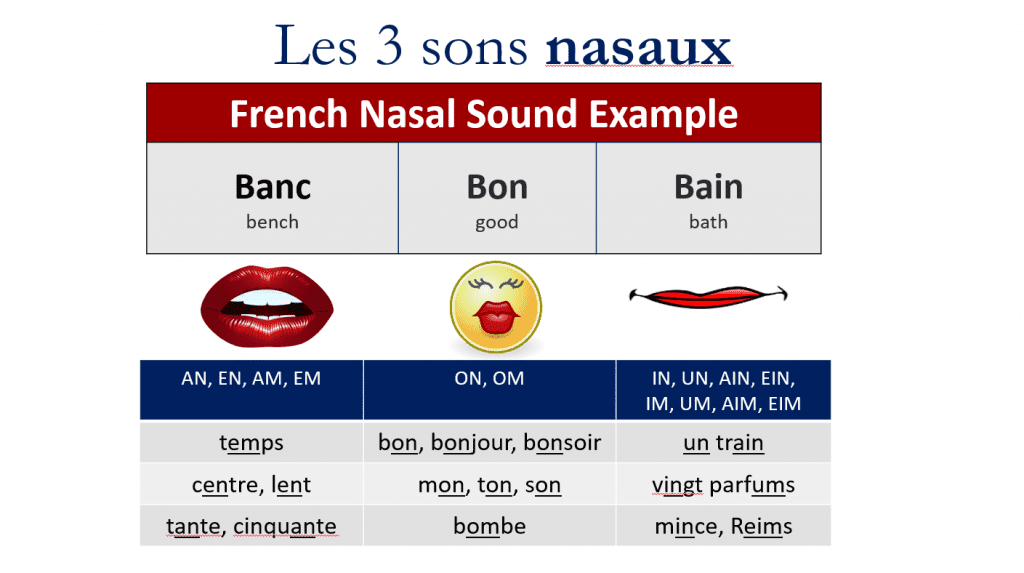
The most important rule to learn is when a vowel + n or m becomes a nasal sound.
In, On, An: The 3 French Nasal Sounds Explained 🎧
This article from FrenchToday, 'In, On, An: The 3 French Nasal Sounds Explained', provides a clear, practical guide. It explains exactly how and when to produce these sounds.
Read the sections 'The 3 French Nasal Vowels Sounds', 'When Do Vowels Followed By N or M Become Nasal ?', and 'How Do You Pronounce A Nasal Vowel In French?'. Pay special attention to the rule: a vowel + n/m is nasal only when followed by a consonant or at the end of a word. If another vowel follows, the nasal sound is 'broken'. For example, compare 'bon' (nasal) and 'bonne' (not nasal). The audio examples are excellent for practice.
Key Rule Recap:
Vowel + n/m + Consonant= Nasal (e.g., monde, enfant)Vowel + n/mat the end of a word = Nasal (e.g., bon, plan)Vowel + n/m + Vowel= Not Nasal (e.g., bonne, année)
Test your understanding!
For each word below, decide if it contains a nasal sound.
- important
- informatique (computer science)
- femme (woman)
- matin (morning)
Show answer
- Yes. Both 'im' and 'an' are followed by consonants. It has two nasal sounds: [ɛ̃] and [ɑ̃].
- Yes. The 'in' is followed by 'f'. The sound is [ɛ̃].
- No. The 'em' is followed by 'me'. In modern French, the 'e' in femme is pronounced like the 'e' in 'bed', and the two 'm's are not pronounced as a nasal. This is a common exception.
- Yes. The 'in' is at the end of the word. The sound is [ɛ̃].
3. Silent Letters
One of the biggest hurdles for beginners is knowing which letters not to say. In French, final letters are often silent.

The general rule is that most final consonants are silent. However, there's a very helpful mnemonic to remember the exceptions. The letters C, R, F, L are usually pronounced at the end of a word. You can remember this with the word CaReFuL.
Let's get the details from a more structured resource.
2.2: Silent Letters at the End of Words
This page from LibreTexts provides a systematic look at silent letters, focusing on the 'CaReFuL' rule and its own exceptions.
Read the sections 'Silent letters at the end of words', the table of silent letters, and 'The CRFL rule'. This will give you a solid framework for identifying when to pronounce a final consonant.
Key Rule Recap:
- Silent Final Consonants: Most are silent (e.g., d, p, s, t, x, z).
- trop (too much) - the 'p' is silent.
- petit (small) - the 't' is silent.
- heureux (happy) - the 'x' is silent.
- The "CaReFuL" Rule: C, R, F, L are usually pronounced.
- avec (with) - the 'c' is pronounced.
- finir (to finish) - the 'r' is pronounced (but note that in
-erverbs like parler, theris silent). - actif (active) - the 'f' is pronounced.
- animal (animal) - the 'l' is pronounced.
- Silent Final 'e': An unaccented
eat the end of a word is almost always silent.- porte (door) - the 'e' is silent.
- page (page) - the 'e' is silent.
Test your understanding!
Look at the following tech-related words. Based on the rules, which final consonant do you think is pronounced?
- un projet (a project)
- un serveur (a server)
- le code (the code)
- un bug
Show answer
- projet: The final 't' is silent.
- serveur: The final 'r' is pronounced (part of CaReFuL).
- code: The final 'e' is silent, so the 'd' sound is the last one you hear.
- bug: This is an English loanword. The final 'g' is pronounced, which is an exception to the general rules. Many tech words borrowed from English keep their original pronunciation.
Conclusion
Excellent work today! We've laid the essential groundwork for your French pronunciation. By focusing on these fundamentals now, you're setting yourself up for much faster progress in speaking and listening.
Here are the key takeaways:
- Vowels: French vowel sounds depend on letter combinations (e.g.,
ou,oi,eau) and accents (é,è,ê), which act as pronunciation guides. - Nasal Sounds: You've learned to identify the three main nasal sounds (
an,on,in) and the critical rule for when they appear: when a vowel + n/m is followed by a consonant or is at the end of a word. - Silent Letters: You now have a framework for tackling silent letters, remembering that most final consonants are silent except for C, R, F, and L (the CaReFuL rule), and that the final unaccented
eis silent.
In our next lesson, we will put these sounds into practice immediately. You will learn how to use basic greetings and farewells appropriately in formal and informal contexts. This will be your first step into real-world French conversation. À bientôt! (See you soon!)