Bonjour !
In our previous lesson, we worked on your spontaneous speaking skills by preparing for the high-stakes context of a French job interview. You learned how to structure your answers strategically to present yourself confidently and professionally.
Welcome to the final lesson of our course! Today, we shift from interactive speaking to another crucial professional skill: written synthesis. Our goal is to enable you to summarize a short technical article or blog post in your own words. This skill is vital for a software engineer, as it allows you to quickly grasp and share key information from documentation, blog posts, and technical papers with your French-speaking colleagues.
This lesson will consolidate your reading comprehension, analytical skills, and ability to write clearly and concisely in French. Let's begin this final step in your journey toward professional fluency.
1. What Makes a Good Summary? The Core Principles
A summary, or un résumé, is more than just a shorter version of a text. It's a reconstruction of the original author's core message, written in your own words. A high-quality summary must be:
- Fidèle (Faithful): It accurately reflects the main ideas and the author's point of view without distortion.
- Objectif (Objective): It contains no personal opinions, comments, or interpretations. You are reporting, not reviewing.
- Concise (Concise): It includes only the essential information, leaving out examples, repetitions, anecdotes, and minor details.
- Reformulé (Reformulated): It is written in your own words and sentence structures, not copied from the original text. You should, however, retain key technical terms.
The following image provides a great visual overview of a 6-step method for creating a summary.
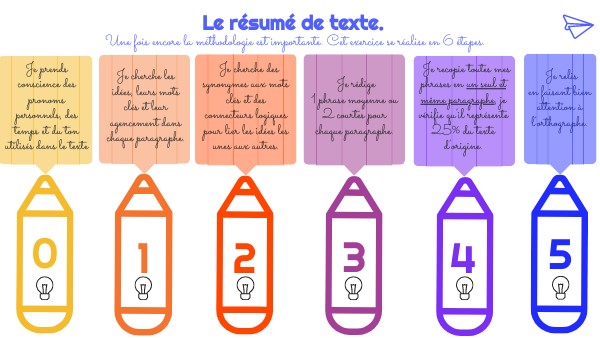
To build a solid foundation, let's dive into a comprehensive guide on the art of summarizing.
[PDF] Le résumé - Amélioration du français
The document 'Le résumé' from Amélioration du français is an excellent, detailed guide. We'll focus on the core strategies for identifying ideas and reformulating them.
Please read the following two main sections: 'DÉFIS ET STRATÉGIES - Dégager et reformuler les idées principales du texte source' (pages 5-9): Focus on the strategies for a two-step reading process and how to reformulate ideas without plagiarizing. 'DÉFIS ET STRATÉGIES - Traduire fidèlement et brièvement le propos du texte source' (pages 11-17): Pay attention to the advice on placing ideas first, using neutral vocabulary, and ensuring logical links. Don't worry about the specific examples for now; concentrate on understanding the method.
2. A Methodical Approach to Summarization
As a developer, you appreciate a clear, structured process. Let's apply that mindset here. We'll follow a systematic method to deconstruct the original text and build our summary.
Step 1: Active Reading
The first step is to fully understand the text. This requires more than one pass. The following video explains this two-part reading strategy very well.
6 Conseils pour faire un Résumé en Français 📋🙂
In '6 Conseils pour faire un Résumé en Français', Pierre from Français avec Pierre explains a methodical approach to summarizing. Let's focus on the initial reading phase.
Watch from 00:35 to 01:22. Notice the distinction between the first reading (for general understanding) and the second reading (to identify the structure and main ideas).
- First Reading (
Première lecture): Read the text from beginning to end to get a general sense of the topic and the author's main argument. What is it about? - Second Reading (
Deuxième lecture): Read it again, this time with a pencil in hand (or taking digital notes). Underline or highlight what seem to be the key ideas in each paragraph. Look for the text's structure—its introduction, main points, and conclusion.
Step 2: Distinguish the Essential from the Accessory
This is the most critical part of the process. You need to filter out everything that is not a core idea. What should you exclude?
- Examples (
les exemples) - Detailed data or statistics (
les données chiffrées) - Anecdotes or personal stories (
les anecdotes) - Repetitions and reformulations (
les répétitions et les reformulations) - Direct quotes (
les citations)
This next short video provides a clear explanation of how to identify an essential idea.
Français : Sélectionn des idées essentielles (en résumé de texte)
Let's watch 'Français : Sélectionn des idées essentielles'. The video clearly defines what constitutes an essential idea and what should be omitted from a summary.
Watch the entire video (it's short!). Pay close attention to the list of elements to avoid at the end (02:17), such as explanations, illustrations, and repetitions.
After your second reading, you should be able to formulate the main idea of each paragraph in a single sentence.
Step 3: Structure and Write with Logical Connectors
Once you have your list of essential ideas, you need to weave them together into a coherent text. Simply listing them one after another will result in a choppy, unnatural summary. This is where connecteurs logiques (logical connectors) are essential. They create smooth transitions and show the relationship between ideas (cause, consequence, opposition, addition).
Let's return to the first video for advice on this.
6 Conseils pour faire un Résumé en Français 📋🙂
The '6 Conseils' video also provides great advice on using connectors to link your summarized ideas.
Watch the section on logical connectors from 03:36 to 05:43. Notice the examples given for opposition ('cependant', 'malgré tout') and confirmation ('en effet', 'de plus').
Common Connectors:
- Addition:
De plus,En outre(Furthermore, Moreover),Également(Also) - Cause:
Car,En effet(Because, Indeed) - Consequence:
Donc,Par conséquent,Ainsi(Therefore, Consequently, Thus) - Opposition:
Cependant,Pourtant,En revanche(However, Yet, On the other hand) - To introduce/conclude:
D'abord(First),Ensuite(Next),Enfin/Pour conclure(Finally / To conclude)
Step 4: Revise and Refine
Your first draft is rarely perfect. The final step is to proofread (se relire) your summary. Check for:
- Clarity and Conciseness: Can any sentence be made shorter or clearer?
- Fidelity: Does it still accurately represent the original text?
- Grammar and Spelling: Correct any errors in verb conjugations, adjective agreements, etc.
- Length: Is it appropriately short? A common rule of thumb is to aim for about 25-30% of the original text's length.
3. Let's Practice: Summarizing a Tech Article
Now it's time to put this method into practice. Below is a short article on a topic you're familiar with: component-based architecture in front-end development.
Read the text, then follow the steps we've discussed to write a summary of approximately 60-80 words.
Titre : Pourquoi l'architecture par composants est devenue la norme en front-end
L'architecture par composants est aujourd'hui une approche fondamentale dans le développement web moderne. Popularisée par des frameworks comme React et Vue.js, elle consiste à diviser l'interface utilisateur en morceaux indépendants et autonomes appelés "composants". Cette méthode a remplacé les approches monolithiques traditionnelles en raison de ses nombreux avantages en termes d'efficacité et de qualité.
Le principal avantage est la réutilisabilité. Un composant, comme un bouton ou un formulaire de connexion, peut être développé une seule fois puis réutilisé à plusieurs endroits dans une application, ou même à travers différents projets. Cela permet non seulement de gagner un temps de développement considérable, mais aussi d'assurer une cohérence visuelle et fonctionnelle sur l'ensemble du site.
Ensuite, cette architecture améliore grandement la maintenabilité du code. Chaque composant ayant son propre état et sa propre logique, il peut être mis à jour ou débogué de manière isolée. Une modification apportée à un composant n'entraîne pas de répercussions imprévues sur d'autres parties de l'application, ce qui rend le processus de maintenance beaucoup plus simple et moins risqué.
Enfin, l'approche par composants favorise la scalabilité. Pour les applications de grande envergure, il est plus facile de gérer la complexité en assemblant des briques logicielles petites et bien définies. Les équipes peuvent travailler en parallèle sur différents composants sans se gêner, et de nouvelles fonctionnalités peuvent être ajoutées en créant de nouveaux composants, ce qui facilite l'évolution de l'application.
En conclusion, l'architecture par composants n'est pas une simple tendance, mais un paradigme solide qui répond aux exigences du développement front-end actuel. En favorisant la réutilisabilité, la maintenabilité et la scalabilité, elle permet de créer des applications plus robustes et de manière plus productive.
Your Task:
Take your time to read the text, identify the key ideas, and write your summary in the space below. Try to use at least two logical connectors.
(Take about 15 minutes for this exercise.)
...
Model Answer (Corrigé):
Here is an example of what a good summary could look like. Compare it with yours.
L'article explique que l'architecture par composants est devenue un standard du développement front-end grâce à ses nombreux avantages. D'abord, elle favorise la réutilisabilité du code, ce qui accélère le développement et garantit la cohérence. De plus, son approche modulaire simplifie la maintenabilité, car les composants sont isolés les uns des autres. Enfin, cette structure facilite la scalabilité des applications complexes. Ces atouts en font une méthode efficace pour construire des logiciels robustes. (73 mots)
Conclusion of the Course
Excellent work on this final exercise! You have now practiced the four pillars of language learning: listening, speaking, reading, and writing, all within contexts directly relevant to your professional goals.
Today's Key Takeaways:
- Summarizing is a methodical process: Read actively, Identify essential ideas, Structure with connectors, Reformulate in your own words, and Revise.
- This skill allows you to efficiently process and share technical information, making you a more effective engineer in a French-speaking environment.
This lesson marks the end of our course. You have come a long way from basic greetings to discussing complex technical topics, preparing for job interviews, and now synthesizing professional texts. The foundation you have built is strong.
The key to fluency is consistent practice. I encourage you to continue immersing yourself in French:
- Read French tech blogs like Le Journal du Net or Developpez.com.
- Follow French-speaking developers on social media.
- Contribute to French-language documentation on open-source projects.
- Most importantly, seek opportunities to speak and interact.
You have the tools and the knowledge. I am confident that you will achieve your goal of working and communicating effectively in French.
Félicitations pour tout votre travail et bonne continuation