Hello! Welcome back to our course.
In our first lesson, we created a high-level map of the key brain regions for communicators: the prefrontal cortex for persuasion, the amygdala for emotion, and the hippocampus for memory. We established that to make a message memorable, we need to engage the hippocampus.
Today, we're going to zoom in from the level of brain regions to the level of individual brain cells. We'll explore the fundamental mechanism that allows the hippocampus, and the brain as a whole, to form memories. This process is the biological basis for the old saying, "practice makes perfect."
Today's Lesson: How Repetition Builds Recall
Learning Outcome: By the end of this 60-minute lesson, you will be able to explain how synaptic strengthening through repeated neural firing relates to building brand recall with consistent messaging.
We will cover:
- The Synapse: The communication point between brain cells (neurons).
- Synaptic Strengthening: The core principle of "neurons that fire together, wire together."
- The Application: How consistent brand messaging uses this principle to build strong, lasting recall.
Let's begin with the basic building blocks of brain communication.
1. The Synapse: The Brain's Communication Junction
The brain is made up of billions of neurons that form a vast, interconnected network. For a thought to occur, a memory to be formed, or an action to be taken, these neurons must communicate with each other. They do this at specialized junctions called synapses.
Think of a neuron as a tiny electrical wire. It sends a signal (an action potential) down its length. When the signal reaches the end, it needs to be passed to the next neuron. The synapse is the gap where this handoff occurs, typically using chemical messengers called neurotransmitters.
The image below provides a great overview of this process and introduces the concept of synaptic plasticity, which is central to our lesson today.
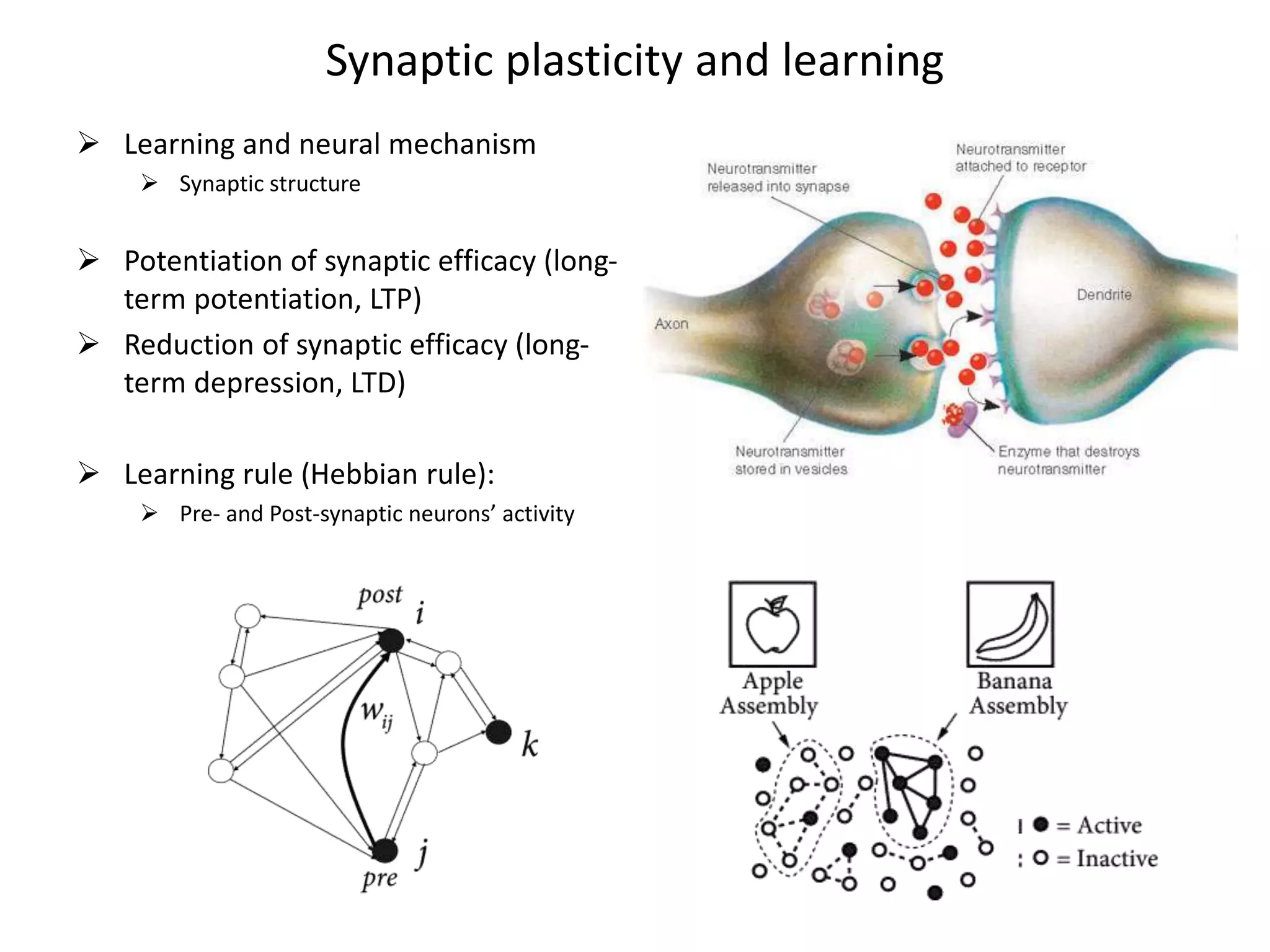
The key takeaway is that communication isn't a one-time event. The strength of the connection at the synapse can change based on how often it's used. This ability to change is called synaptic plasticity, and it's the foundation of all learning and memory.
2. Synaptic Strengthening: "Neurons That Fire Together, Wire Together"
Imagine forging a path through a dense forest. The first time you walk it, it's difficult. But if you walk the same path every day, the undergrowth gets trampled down, the ground becomes packed, and the path becomes clearer and easier to travel.
Synaptic connections in the brain work in a very similar way. When one neuron repeatedly sends a signal to another, the connection between them becomes stronger and more efficient. This phenomenon is known as Long-Term Potentiation (LTP). It is the cellular mechanism behind the famous neuroscience maxim, "neurons that fire together, wire together."
LTP was first discovered in the hippocampus—the very memory-making region we discussed in our last lesson. To get a more precise understanding of this crucial process, we'll turn to a chapter from a neuroscience textbook.
Long-Term Synaptic Potentiation
This reading from 'Neuroscience' (2nd ed.) provides a clear, scientific explanation of Long-Term Potentiation (LTP). It describes how it was discovered and its essential properties that make it a likely candidate for the basis of memory.
Please read the introductory section (starting with 'LTP has been most thoroughly studied...') and the section detailing its properties (starting with 'LTP of the Schaffer collateral synapse exhibits several properties...'). Focus on understanding the core idea of LTP and its three key properties: state-dependency, input specificity, and associativity.
This is a dense but powerful text. Let's break down the most important properties of LTP and relate them to communication:
-
Input Specificity: LTP only strengthens the active synapses. If a neuron receives signals from two different sources, but only one is firing repeatedly, only that one connection will be strengthened.
- Application: This is why consistent messaging for your brand strengthens recall for your brand, not your competitors. You are selectively strengthening a specific neural pathway.
-
Associativity: A weak connection can be strengthened if it's activated at the same time as a strong connection.
- Application: This is a cellular analog for classical conditioning and a cornerstone of storytelling. You can link your brand (initially a weak signal) to a powerful emotion, a compelling story, or a universally understood value (a strong signal). By firing these two signals together, the positive attributes of the story become associated with your brand, strengthening its neural network.
The core idea is simple: repetition strengthens connections. The more a neural pathway is used, the more efficient and easy to activate it becomes.
3. From Synapses to Brand Recall
Now, let's connect this cellular mechanism directly to your goal of building brand recall. A concept like a brand isn't stored in a single neuron. It's represented by a distributed network of neurons that encode its various attributes: its name, logo, colors, the sound of its jingle, the feelings it evokes, and the stories associated with it.
When you see a Nike ad featuring a triumphant athlete, the "Nike" network and the "triumph" network are activated simultaneously. When you hear their "Just Do It" slogan, the "Nike" network fires again.
Each time a piece of marketing communication causes this "brand network" to fire, you are triggering the process of Long-Term Potentiation. The synaptic connections among the neurons in that network get a little bit stronger.
The following resource directly links this neuroscience concept to marketing strategy.
Role of Neuroplasticity in Understanding Brain Adaptations to ...
This article, 'Role of Neuroplasticity in Understanding Brain Adaptations to Marketing Stimuli,' explicitly discusses how the brain's ability to change (neuroplasticity) is leveraged by marketing.
First, read the two paragraphs starting with 'The real power of marketing lies in its ability to create lasting changes...'. This section explains how repeated exposure builds neural circuits for brands. Then, jump to the '6. Implication' section and read the bullet point that begins 'Managers should employ repetitive and consistent messaging...'. This part provides the direct strategic advice.
As the article makes clear, consistent and repetitive messaging isn't just about being annoying or "getting your name out there." It is a deliberate strategy to physically re-wire the consumer's brain.
By repeatedly activating the same neural pathways, you are:
- Strengthening synaptic connections within the brand's neural network.
- Making the network more stable and long-lasting.
- Lowering the activation threshold, so it takes less of a cue to bring the entire brand concept to mind.
The end result is effortless brand recall. When a customer has a need your product fulfills, their well-worn "brand path" is the easiest one for their brain to take. This is the neurobiological foundation of a strong brand.
This principle extends to your work in product design. When you create a consistent design system with predictable patterns for buttons, menus, and workflows, you are helping users form strong neural pathways for how to use the product. This reduces their cognitive load and makes the product feel intuitive and easy to use—because you've literally made it easier for their brain to process.
Lesson Summary & Key Takeaways
Today we drilled down into the cellular basis of memory to understand why repetition is such a powerful tool for communicators.
- Neurons communicate across synapses, and the strength of these connections can change over time (synaptic plasticity).
- When a neuron repeatedly stimulates another, their connection strengthens. This is called Long-Term Potentiation (LTP), the mechanism behind the principle "neurons that fire together, wire together."
- A brand or message is represented by a network of neurons. Consistent messaging activates this network repeatedly.
- This repeated activation uses LTP to strengthen the network, making the brand concept more stable and easier to recall. This is the neural basis of brand recall.
Next time...
We've established that repetition works by physically strengthening neural connections. In our next lesson, we will move from theory to practice. We'll explore how to apply this knowledge to design a message repetition strategy—like using spaced repetition—to enhance audience memory effectively over time without causing burnout or fatigue.