Welcome back. In our previous lesson, we explored the devastating impact of Russell's paradox on Frege's logicist project. We saw that the paradox wasn't just a minor puzzle but a fatal flaw that invalidated Frege's Basic Law V, the very axiom he needed to generate numbers as logical objects. The ground, as Frege put it, had collapsed beneath him.
Having discovered the problem, Bertrand Russell felt a profound intellectual responsibility to solve it. His response was not a simple patch, but a deep and complex philosophical diagnosis that would reshape the foundations of logic.
Today's lesson fulfills the learning outcome: Evaluate Russell's theory of types as a philosophical response to the paradoxes. We will unpack this theory, not just as a technical formalism, but as the embodiment of a philosophical principle designed to prevent the kind of inconsistency that doomed Frege's work. We will examine its structure, its motivations, and the serious philosophical and practical problems it faced.
1. The Diagnosis: The Vicious-Circle Principle
Russell believed that his paradox was not an isolated error in set theory, but a symptom of a much deeper mistake in reasoning: a certain kind of circularity. Along with the French mathematician Henri Poincaré, Russell diagnosed the root cause of the paradoxes as residing in what they called impredicative definitions.
An impredicative definition is one that defines an object by referring to a collection that contains the very object being defined.
Consider some examples:
- "The least integer not nameable in fewer than nineteen syllables." The definition of this integer refers to the collection of all integers nameable in a certain way. But if this phrase itself names an integer, it seems to be part of the very collection it is being distinguished from.
- "Napoleon had all the qualities of a great general." This defines a property of Napoleon ("having all the qualities...") by quantifying over a totality of properties, of which this very property is one.
Russell and Poincaré argued that such definitions are illegitimate. They proposed a rule to prohibit them, known as the Vicious-Circle Principle (VCP). One of its classic formulations states:
"Whatever involves all of a collection must not be one of the collection."
This principle is the philosophical heart of Russell's solution. The paradox arose because the definition of the Russell set involved quantifying over all sets, and the resulting set was then considered part of that same totality. The VCP is designed to make such a move impossible.
To delve deeper into this crucial diagnostic step, please read the following text.
[PDF] Ins and outs of Russell's theory of types
This excerpt from an academic paper, 'Ins and outs of Russell's theory of types', provides the essential philosophical background for the theory. It explains the concept of impredicativity and the Vicious-Circle Principle, which are Russell's diagnosis of what went wrong.
Please read from the paragraph beginning 'From the standpoint of predicative foundations of mathematics...' to the end of the section (just before the heading 'The ramified theory of types...'). This corresponds to pages 10-15 of the PDF. Focus on understanding what makes a definition 'impredicative' and how the Vicious-Circle Principle is formulated to prevent this.
With this diagnosis in hand, Russell's task was to build a logical system where the Vicious-Circle Principle was not just a guideline, but an iron-clad structural rule. This system is the theory of types.
2. The Basic Prescription: The Simple Theory of Types
The most straightforward way to enforce the VCP is to legislate a strict hierarchy, ensuring that no collection can ever contain itself. This is the core idea of the Simple Theory of Types.
In this theory, the universe of discourse is not a single domain of objects. Instead, it is stratified into an infinite hierarchy of types:
- Type 0: Individuals (the basic objects of discourse, like 'Socrates' or 'the Moon').
- Type 1: Classes (or properties) of individuals.
- Type 2: Classes of classes of individuals.
- ...and so on.
The fundamental rule is that a class of type can only have members of type . This structure makes expressions like (a class being a member of itself) or (a circular membership chain) syntactically ill-formed, or "meaningless."
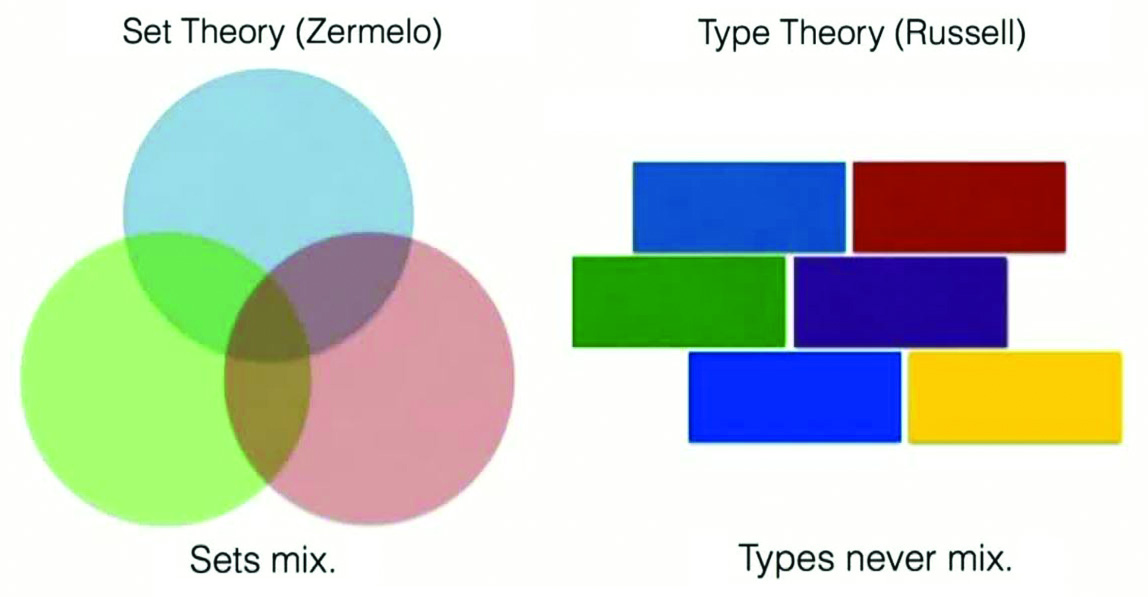
This simple hierarchy is sufficient to block Russell's paradox. The "set of all sets that are not members of themselves" cannot be formed. Any set we define must have a specific type, say type . It can only contain members of the type below it, type . Therefore, it cannot contain itself, as it is of type . The question of its self-membership cannot even be coherently asked.
3. The Full Prescription: The Ramified Theory of Types
While simple type theory solved the set-theoretic paradoxes, Russell's Vicious-Circle Principle was more demanding. He was also concerned about the semantic paradoxes (like the Liar) and the general problem of impredicative definitions, which can still occur within a single type.
For example, in simple type theory, we can still define a property of individuals (type 1) by quantifying over all properties of individuals (also type 1). This is an impredicative definition, and Russell believed it violated the VCP.
To block this as well, Russell (in Principia Mathematica) proposed a more complex system: the Ramified Theory of Types. This theory introduces a second hierarchy within each type, called orders.
- Type still refers to the level of the object (individual, class of individuals, etc.).
- Order refers to how the object is defined. A first-order property is one defined without quantifying over any properties. A second-order property can be defined by quantifying over first-order properties, and so on.
This creates a two-dimensional grid of categories. A property is now specified by both its type and its order. The rule is that a definition can only quantify over objects of a lower order. This makes it impossible to define a property by reference to a totality of properties that includes the very one being defined.
The following reading explains both the simple and ramified hierarchies and the philosophical shift they represent.
Type Theory - Stanford Encyclopedia of Philosophy
The Stanford Encyclopedia of Philosophy entry on 'Type Theory' provides a clear account of both the simple and ramified hierarchies, and crucially, the philosophical motivations and problems associated with them.
Please read Section 2, 'Simple Type Theory and the λ-Calculus,' and Section 3, 'Ramified Hierarchy and Impredicative Principles.' Focus on the distinction between the two hierarchies and why Russell felt the need to introduce the more complex 'ramified' version.
4. Evaluation: The Cure and Its Side-Effects
The ramified theory of types was a philosophically principled solution, but it came at a staggering price. In preventing all forms of impredicativity, it crippled mathematics.
Problem 1: Too Weak for Mathematics
Many fundamental concepts in mathematics rely on impredicative definitions. A classic example is the least upper bound of a set of real numbers. The definition of this bound involves quantifying over all upper bounds—a collection to which the least upper bound itself belongs. In the ramified theory, this definition is illegal. The least upper bound of a set of reals of order would have to be of order . This shatters the real number line into an infinite number of disjoint orders, making real analysis as we know it impossible.
Problem 2: The Axiom of Reducibility
To save mathematics from this paralysis, Russell and Whitehead introduced a special axiom: the Axiom of Reducibility. This axiom asserts that for any property of any order, there exists an equivalent property of the lowest possible order (a "predicative" property).
This axiom essentially acts as a bridge, allowing one to use impredicative definitions to specify a property and then assume that there is a "safe," predicative equivalent that can be used in its place. It collapses the hierarchy of orders, restoring the power needed for mathematics.
Problem 3: Undermining the Philosophy
The Axiom of Reducibility solved the mathematical problem, but it created a massive philosophical one.
- It is entirely ad hoc. Russell admitted he had no logical or philosophical justification for it, other than that it was needed to make the system work. This ran contrary to the logicist goal of grounding mathematics in self-evident logical truths.
- It defeats the purpose. Critics like F. P. Ramsey were quick to point out that if you accept the Axiom of Reducibility, you have effectively undone all the work of the ramified hierarchy. You might as well have just used the simple theory of types from the start and accepted that impredicative definitions (while distinct from the self-membership that causes paradox) are a legitimate part of logic.
This critique was powerful. The consensus that emerged was that Russell had correctly distinguished two issues:
- Set-theoretic paradoxes (like ), caused by self-membership. These are solved by the Simple Theory of Types.
- Semantic paradoxes and impredicativity, which the ramified hierarchy was meant to solve.
Ramsey argued that only the first group were genuinely logical contradictions, and that the Simple Theory of Types was the correct logical solution. The second group could be handled by other means, and the contortions of the ramified theory were unnecessary.
The following short video clip summarises Russell's response and its difficulties.
Michael Beaney: The Analytic Revolution (Royal Institute of Philosophy)
To conclude our evaluation, let's return to Professor Michael Beaney's lecture. This segment briefly describes the theory of types and Russell's view of classes as 'logical fictions', a key part of his philosophical stance.
Please watch from 33:19 to 37:01. Notice how Russell's response is not just to create a hierarchy, but to argue that abstract objects like classes are 'logical constructions' or 'fictions' that can be analyzed away. This is a core part of his broader philosophical method.
Conclusion
Today we have evaluated Bertrand Russell's ambitious attempt to save logicism from the paradox he discovered. His theory of types stands as a monumental intellectual achievement, born from a deep philosophical diagnosis.
Key Takeaways:
- Philosophical Diagnosis: Russell's response was driven by the Vicious-Circle Principle, a prohibition against the circularity of impredicative definitions.
- The Technical Solution: The theory of types enforces this principle by stratifying the universe into a hierarchy. The simple theory uses types to block set-theoretic paradoxes. The ramified theory adds orders to block impredicativity.
- The Cost of the Cure: The ramified theory, while philosophically motivated, proved too restrictive for standard mathematics.
- The Unpopular Medicine: The Axiom of Reducibility, introduced to restore mathematics, lacked philosophical justification and seemed to undermine the entire motivation for the ramified hierarchy.
- The Verdict: The theory of types successfully demonstrated a way to build a paradox-free foundation for logic. However, the complexity and ad-hoc nature of the full Principia Mathematica system led most logicians and mathematicians to prefer other solutions, such as simple type theory or, more enduringly, axiomatic set theory (ZFC).
Preview of the Next Lesson:
The theory of types was one part of Russell's grand response to the crisis. Another, equally famous, part of his program was the development of a new method of philosophical analysis. In our next lesson, we will explore this method through its most celebrated application: Russell's theory of definite descriptions. We will see how he used logic to solve longstanding philosophical puzzles about language, existence, and meaning.