Hello! Welcome back to our course on the history and philosophy of logic.
In our last lesson, we explored Immanuel Kant's influential view of logic. For Kant, Aristotelian logic was a finished science, perfect and complete. He saw it as a formal canon for evaluating the correctness of thought, not an organon for discovering new truths. He argued that the real expansion of our knowledge came from "synthetic a priori" judgments, like those in mathematics, which he believed logic itself could not provide.
Today, we examine the first major crack in this Kantian edifice. We turn to the work of a self-taught English mathematician, George Boole, who single-handedly initiated the transformation of logic from a branch of philosophy into a mathematical discipline. Our learning outcome is to: Analyse the philosophical significance of Boole's algebraization of logic. We will investigate not just the technical details of his system, but the profound conceptual shift that occurred when logical deduction began to be treated as a form of algebraic calculation.
1. The Stage for a Revolution: Logic Before Boole
To appreciate the scale of Boole's achievement, we must first recall the intellectual landscape of the early 19th century. Logic, for over two millennia, was the logic of Aristotle and his scholastic followers. It was a discipline of philosophy, studied through natural language, concerned with terms, propositions, and syllogisms. Mathematics was a separate world of number and quantity.
The idea of a formal calculus for reasoning was not entirely new. The 17th-century philosopher and mathematician Gottfried Wilhelm Leibniz had dreamt of a characteristica universalis (universal language) and a calculus ratiocinator (calculus of reason) that would allow disputes to be settled by calculation. However, this dream remained largely unrealised until the 19th century.
The following video provides a brief overview of the historical context leading up to Boole, highlighting the long separation between logic and mathematics and the first stirrings of their convergence.
A brief history of logic: from Leibniz to Boole | Math Foundations 254 | N J Wildberger
This video, from the channel Insights into Mathematics, sets the historical scene for Boole's work. It discusses Leibniz's early vision and the pivotal 19th-century moment when mathematicians began to formally analyse the structure of logic.
Please watch the following three segments: 00:24 - 01:14: Focus on the traditional separation of logic (as philosophy) and mathematics. 07:18 - 09:28: Note Leibniz's ambitious but unfulfilled project to mechanize reasoning. 10:52 - 12:52: Grasp the key 19th-century development: mathematicians applying algebraic ideas to logic, a reversal of the modern idea that logic is the foundation for mathematics.
This brings us to George Boole. Unlike the philosophers who had traditionally owned logic, Boole was a mathematician. He approached the subject with a mathematician's toolkit and a radical new perspective.
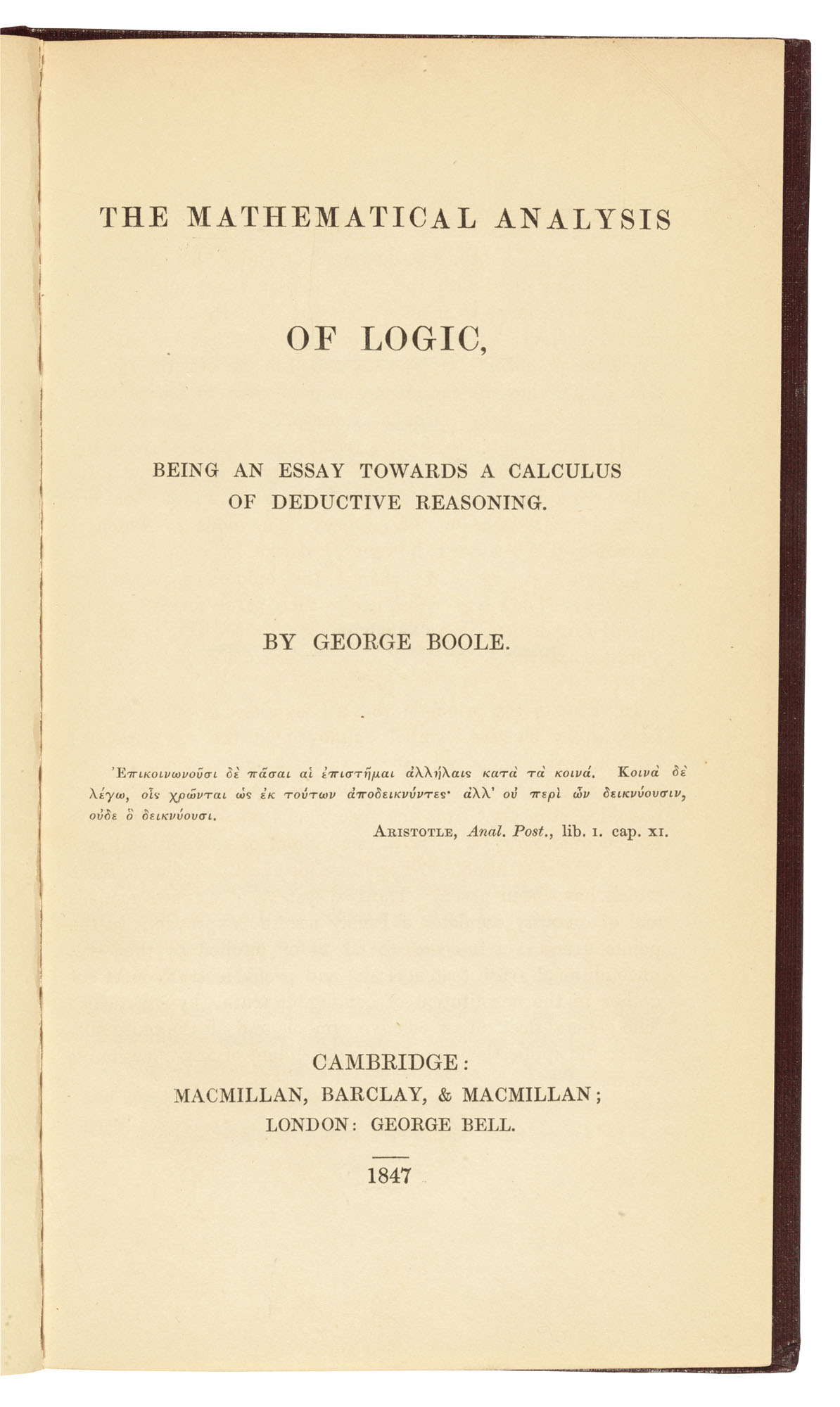
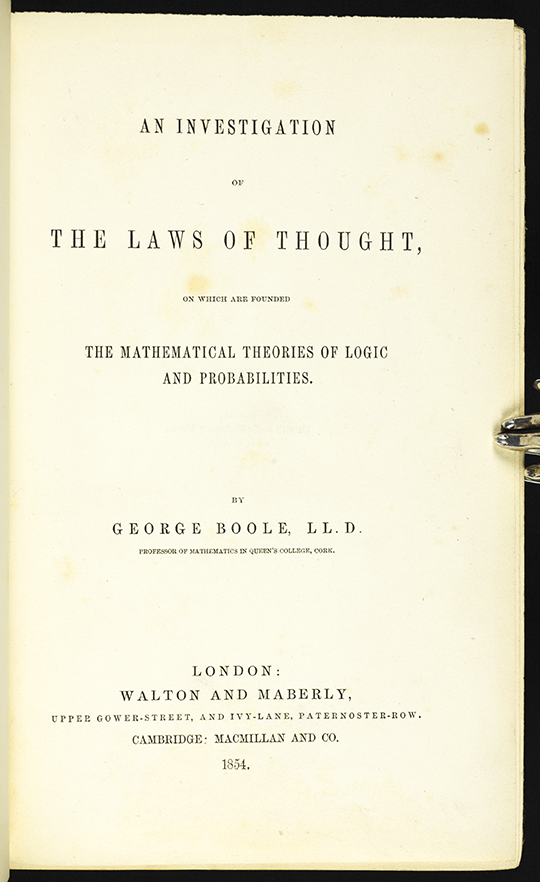
In 1854, he published his mature masterpiece, whose title reveals an even deeper philosophical ambition: not just to create a calculus, but to uncover the very laws of the mind.
Boole's central idea was to "investigate the fundamental laws of those operations of the mind by which reasoning is performed" and "to give expression to them in the symbolic language of a Calculus."
2. The Algebra of Logic: How It Works
Boole's genius was to see that the reasoning of class inclusion and exclusion could be represented using algebraic equations. His system rests on a few core components.
Hamilton, Boole and their Algebras - Professor Raymond Flood
Professor Raymond Flood of Gresham College provides an exceptionally clear explanation of the mechanics of Boole's algebra. He walks through the basic elements and demonstrates how a logical syllogism becomes an algebraic derivation.
Please watch these two key segments: 33:16 - 39:02: This explains the core of the system. Pay close attention to: How symbols like x, y represent classes of objects. How multiplication xy represents the intersection of classes (the AND operation). How addition x + y represents the union of disjoint classes (an exclusive OR). The crucial and unique 'index law': x² = x. Understand why this law holds for classes but not for numbers in general. 39:57 - 42:50: This part is the payoff. Watch how a classic syllogism ('All A's are B's, all B's are C's, therefore all A's are C's') is translated into equations and solved through pure algebraic manipulation.
Let's summarise the core algebraic ideas:
- Symbols as Classes:
x, y, z...represent classes of things (e.g.,x= the class of "sheep").1represents the "Universe of Discourse" (everything we are currently talking about), and0represents the empty class. - Operations as Logical Connections:
- Intersection (AND):
xyis the class of things that are in bothxandy. - Union (Exclusive OR):
x + yis the class of things inxory, but only whenxandyare disjoint (have no members in common). - Complement (NOT):
1 - xis the class of things in the universe that are not inx.
- Intersection (AND):
- Propositions as Equations: Categorical propositions are translated into equations.
- "All
xarey" becomesx = xy(the class of things that arexis identical to the class of things that are bothxandy). This can be rewritten asx(1-y) = 0. - "No
xarey" becomesxy = 0. - "Some
xarey" is more complex, involving a special symbolvfor an indefinite class:v = xy.
- "All
The most philosophically interesting law is the idempotent law, . For any class x, selecting the x's from the x's just gives you the x's back. This simple equation captures a fundamental property of logical concepts and distinguishes this algebra from the ordinary algebra of numbers, where is only true for and .
The crucial outcome, as you saw in the video, is that logical deduction becomes a process of algebraic manipulation. You translate premises into equations, apply algebraic rules (substitution, simplification), and translate the resulting equation back into a conclusion. Reasoning becomes calculation.
3. The Philosophical Significance
Boole's work was far more than a technical innovation; it prompted a philosophical re-evaluation of what logic is.
A. The Formalist Turn: Separating Form from Interpretation
Your background in mathematics has prepared you to appreciate one of the most significant aspects of Boole's work. Boole was deeply influenced by a movement in British mathematics known as "Symbolical Algebra." The proponents of this view argued that the validity of algebraic operations depended not on what the symbols meant (e.g., numbers), but purely on the formal laws of their combination.
This is a profound idea that you'll recognise from abstract algebra, where the same group axioms can apply to integers under addition, matrices under multiplication, or geometric symmetries. Boole took this idea and applied it directly to logic.
Boole’s Symbolized Laws of Thought Facing Empiricism
This scholarly article by Marie-José Durand-Richard, 'Boole’s Symbolized Laws of Thought Facing Empiricism', provides crucial philosophical context. It connects Boole's project directly to the Symbolical Algebra movement, clarifying the philosophical principles behind his method.
Please read the short 'Introduction' section and the section '3.1. The main features of the symbolical approach from Peacock to Boole'. \nFocus on this central claim, quoted by Boole in the introduction to his 1847 work: '...the validity of the processes of analysis does not depend upon the interpretation of the symbols which are employed, but solely upon the laws of their combination.' Think about how this principle allows him to apply algebra to a completely new domain: logic.
By abstracting the laws of combination from their traditional interpretation (numbers), Boole could re-apply them to a new interpretation (classes). The result is that logic itself becomes a formal system. The correctness of a deduction is guaranteed by the algebraic rules, independent of any intuitive understanding of the concepts involved. This is a monumental step away from logic as an informal analysis of natural language arguments and towards the modern conception of logic as a formal science.
B. The Mechanisation of Reason
A direct consequence of this formalisation is the mechanisation of reason. If deduction is just the manipulation of symbols according to rules, then it is a process that can, in principle, be carried out by a machine.
Boole’s system was the first practical realisation of Leibniz's dream of a calculus ratiocinator. The power of this idea—that circuits and switches could implement the laws of logic—was famously demonstrated almost a century later by Claude Shannon, whose work laid the foundations for all modern digital computing.
The following video clip shows Professor Flood demonstrating how Shannon applied Boolean algebra to simplify electrical circuits. You don't need to follow every detail of the circuit analysis; the key is to appreciate the direct, practical application of Boole's abstract system.
Hamilton, Boole and their Algebras - Professor Raymond Flood
This final clip from Professor Flood's lecture shows the astonishingly practical legacy of Boole's abstract algebra.
Watch from 42:50 to 45:24. The main takeaway is seeing how an electrical circuit can be represented by a Boolean equation, which can then be simplified algebraically to design a more efficient circuit with the same function. This is the birth of logic design.
This connection demonstrates that Boole's algebraization was not just a philosophical curiosity; it had the unforeseen consequence of providing the mathematical language for the digital age.
C. Psychologism: Are the Laws of Logic the Laws of Mind?
Boole did not believe he was merely inventing a useful formal game. As the title of his major work suggests, he believed he was discovering the Laws of Thought. He saw his algebraic laws, such as , as expressions of the actual psychological laws by which the human mind reasons.
This view, known as psychologism, identifies the laws of logic with the laws of psychology. It asserts that logic is normative because the laws of thought are the laws of correct thought. This was a common view in the 19th century, but it will become a major point of criticism for the next figure in our story, Gottlob Frege. Frege will argue vehemently that the laws of logic are objective and independent of the human mind, just as the laws of physics are. This debate about the relationship between logic and the mind is a central theme in the philosophy of logic, and it starts right here with Boole.
4. Limitations and Critiques
While revolutionary, Boole's system was not without its problems, which themselves spurred further philosophical and logical development.
-
The "Or" Problem: Boole's definition of addition (
+) only worked for mutually exclusive classes. This made expressing inclusive "or" (e.g., "students or staff") awkward:x + y(1-x). Later logicians, like W. S. Jevons, argued that logic would be simpler if+was defined as inclusive "or" (union). This would lead to a different algebraic law:x + x = x. Boole resisted this change, because in ordinary algebra,x + x = ximpliesx = 0. This highlights Boole's commitment to founding his logic on ordinary algebra, even when it made the logic itself more complex. -
Uninterpretable Steps: In solving his equations, Boole sometimes used steps (like division, or subtraction that results in a negative) that had no clear logical interpretation, even if the final result was interpretable. This raised philosophical questions: is a proof valid if it travels through "meaningless" intermediate stages?
-
Limited Expressive Power: Boole's algebra was an algebra of classes. It could handle reasoning involving properties of things (e.g., "All humans are mortal"). However, it could not handle reasoning involving relations between things (e.g., "Every integer has a successor"). Most of mathematics, which relies on relations like
<,>, and functions, could not be expressed in Boole's system. This was its most significant limitation, and overcoming it would be Frege's great achievement.
Conclusion
George Boole's work represents a fundamental turning point. By subjecting logic to mathematical analysis, he took it from the exclusive domain of philosophy and set it on the path to becoming a formal science.
Key Takeaways:
- Boole's primary achievement was the algebraization of logic, treating logical deduction as a form of symbolic calculation. This directly challenged Kant's view that logic was a complete, non-mathematical discipline.
- This move was philosophically significant for several reasons:
- It embodied a formalist approach, separating the validity of reasoning from the interpretation of the symbols.
- It opened the door to the mechanisation of reason, a concept that would later become the foundation of computer science.
- It grounded logic in psychologism, the view that logic's laws are the mind's laws, setting up a major philosophical debate for his successors.
- Boole's system, while revolutionary, had crucial limitations in its handling of disjunction and, most importantly, its inability to express relational reasoning. These limitations created the very problems that the next generation of logicians would seek to solve.
Preview of the Next Lesson:
Boole gave logic the form of a calculus, but it was a calculus with limited power. In our next lesson, we will meet the figure who is arguably the single most important logician since Aristotle: Gottlob Frege. We will analyse the revolutionary impact of Frege's replacement of the ancient subject-predicate analysis of propositions with a function-argument structure, a move that finally gave logic the expressive power needed to formalise mathematics and launch the era of modern logic.