Hello! Welcome to the next lesson in our exploration of the history and philosophy of logic.
In our last lesson, we saw how Gottlob Frege revolutionized logic by replacing the ancient subject-predicate analysis with a far more powerful function-argument structure. This move allowed logic to finally capture the structure of relations and statements with multiple quantifiers, giving it the expressive power needed to formalize mathematical reasoning.
However, this new, powerful logic raised a subtle but profound philosophical puzzle. If the meaning of a name is simply the object it refers to, how can an identity statement like "The Morning Star is the Evening Star" be informative? If both names refer to the same object (the planet Venus), then the statement seems to be saying no more than "Venus is Venus," which is a trivial truth. Yet, the identity of the Morning Star and the Evening Star was a significant astronomical discovery.
Today, we will examine Frege's solution to this problem, a distinction that has become one of the cornerstones of modern philosophy of language. Our learning outcome is to explain Frege's distinction between sense (Sinn) and reference (Bedeutung) using the puzzles of identity and cognitive significance.
1. Frege's Puzzle: Identity and Cognitive Value
Frege begins his seminal 1892 paper, "On Sense and Reference" ("Über Sinn und Bedeutung"), by focusing on the puzzling nature of the identity relation. He observes that identity statements seem to fall into two distinct categories.
Consider these two statements:
- a = a: The Morning Star is the Morning Star.
- a = b: The Morning Star is the Evening Star.
Statement (1) is trivial. It is knowable a priori (independently of experience) and, following Kant, Frege calls it analytic. It tells us nothing new about the world. It has low cognitive value.
Statement (2), however, is very different. It expresses a genuine discovery of astronomy. It is knowable only a posteriori (through experience and observation), and it extends our knowledge. It has high cognitive value.
The puzzle is this: If statement (2) is true, then the names "Morning Star" and "Evening Star" refer to the same object (Venus). If the meaning of a name were nothing more than the object it refers to, then both statements would seem to say the same thing: that a particular object is identical to itself. So how can we account for the profound difference in their cognitive value?
To get a firm grasp of this puzzle, please watch the following video segment. It uses several excellent examples, including Frege's classic "Morning Star/Evening Star" case, to lay out the problem clearly.
In this video from his course on Analytic Philosophy, Professor Daniel Bonevac introduces Frege's puzzle about identity, contrasting uninformative a=a statements with informative a=b statements.
Watch from 00:17:31 to 00:24:28. Focus on the distinction Frege draws between the 'cognitive value' of a=a and a=b. Note the examples used, like 'Bruce Wayne is Batman' and 'the Morning Star is the Evening Star', to illustrate how some identity statements can represent valuable extensions of our knowledge.
2. Two Unsatisfactory Solutions
Before presenting his own solution, Frege considered and rejected two alternative ways of resolving the puzzle.
1. Mill's 'Reference-Only' Theory: The philosopher John Stuart Mill had proposed a simple theory: the meaning of a proper name is just the object it refers to (its referent or denotation). As we've just seen, this theory cannot solve the puzzle. If "Morning Star" and "Evening Star" have the same meaning (the object Venus), it cannot explain why "The Morning Star is the Evening Star" is informative while "The Morning Star is the Morning Star" is not.
2. A Relation Between Signs: Frege's own earlier view, in his Begriffsschrift, was that an identity statement a = b is not about the object, but about the signs or names themselves. On this view, the statement asserts that the two names, "a" and "b", refer to the same object. This does explain the informativeness: we are learning a fact about our linguistic conventions.
However, Frege came to see this was also incorrect. The discovery that the Morning Star is the Evening Star is a discovery in astronomy, not linguistics. It's a fact about a celestial body, not a fact about our words for it. Therefore, an identity statement must be about the world, not just about language.
The following video succinctly explains the puzzle using a modern example ("Shawn Carter is Jay-Z") and walks through why these two initial attempts fail.
Gottlob Frege - On Sense and Reference
Jeffrey Kaplan provides a very clear and modern walkthrough of Frege's puzzle and the inadequacy of both Mill's theory and Frege's own earlier theory.
Please watch from the beginning to 00:07:55. The first part (to 05:13) sets up the puzzle, and the second part (from 05:13) explains why the two simple solutions are not sufficient.
3. Frege's Solution: The Sense/Reference Distinction
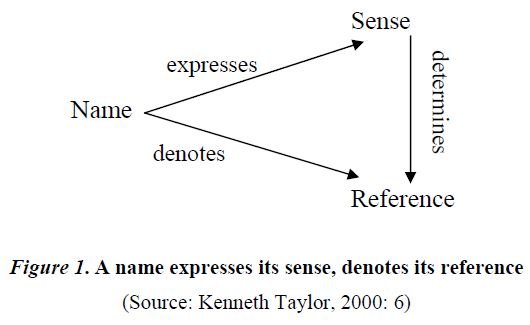
Having rejected the simpler theories, Frege introduced a new, two-level theory of meaning. He proposed that a linguistic expression (like a proper name) has two components to its meaning:
- Reference (Bedeutung): The object in the world that the expression refers to.
- Sense (Sinn): The way in which the expression presents the referent. It is the "mode of presentation" or the cognitive content associated with the expression.
Let's apply this to our main example:
- The reference of "the Morning Star" is the planet Venus.
- The reference of "the Evening Star" is also the planet Venus.
- The sense of "the Morning Star" is something like 'the heavenly body visible in the sky at a certain position in the morning'.
- The sense of "the Evening Star" is something like 'the heavenly body visible in the sky at a certain position in the evening'.
The two names have the same reference but different senses.
This distinction elegantly solves the puzzle. A statement of the form a = a is trivial because the sense is the same on both sides. A statement of the form a = b is informative because it reveals that two different senses, two different modes of presentation, lead to the very same reference. We learn that the object presented in one way is the same as the object presented in another way.
This diagram illustrates the core relationships in Frege's theory:
To see this distinction applied to several examples, including a mathematical one that may resonate with your background, continue with Jeffrey Kaplan's video.
Gottlob Frege - On Sense and Reference
This clip explains the core of Frege's solution. It introduces 'sense' as a 'mode of presentation' and uses helpful analogies, including Frege's own geometric example, to make the concept clear.
Watch from 00:07:55 to 00:16:22. Pay attention to the McMansion analogy and Frege's example of the intersecting lines of a triangle. This latter example shows how two different descriptions ('the intersection of lines a and b' and 'the intersection of lines b and c') can have different senses but the same reference (the single point of intersection).
4. What is Sense? Objectivity vs. Subjective Ideas
At this point, you might be wondering: what exactly is a sense? Is it just a mental image or a personal idea?
For Frege, the answer is a definitive no. This is one of the most important philosophical aspects of his theory. He was a staunch anti-psychologist about logic and meaning. He believed that for communication and objective knowledge to be possible, meanings must be objective, public, and shareable.
He draws a crucial three-way distinction:
- The Reference: The object itself (e.g., the planet Venus).
- The Sense: The objective mode of presentation (e.g., 'the body seen in the morning'). This is public property; we can all grasp the same sense.
- The Idea (Vorstellung): The private, subjective mental image or feeling associated with the expression in an individual's mind. This is subjective and varies from person to person. A poet, an astronomer, and a child will all have different mental 'ideas' associated with the name "Venus," but they can all grasp the same public sense and refer to the same object.
Frege uses a famous analogy of a telescope to clarify this:
- The Moon itself is the Reference.
- The image on the lens inside the telescope is the Sense. It's objective—anyone can look through the telescope and see that same image—but it is still just one perspective on the Moon.
- The retinal image in the observer's eye is the Idea. It's private and subjective; no one else can experience your retinal image.
Gottlob Frege - On Sense and Reference
This final clip from Kaplan's video explains the crucial distinction between objective, public Sense and private, subjective Idea, using Frege's telescope analogy.
Watch from 00:19:26 to 00:23:51. This section is key to understanding the philosophical underpinnings of Frege's theory of meaning and his commitment to objectivity.
5. Reading Frege
Now that we have built the necessary philosophical scaffolding, you are prepared to read Frege's own words. Reading primary philosophical texts is a central part of this course, and this excerpt from "On Sense and Reference" is where Frege lays out his argument.
Gottlob Frege ON SENSE AND REFERENCE (excerpt)
This is an excerpt from Max Kölbel's translation of Frege's 'Über Sinn und Bedeutung'. You will see Frege himself articulate the puzzle of identity, dismiss a purely sign-based account, and introduce the concepts of Sense, Reference, and Idea, culminating in his telescope analogy.
Please read the text from the beginning down to the end of the telescope analogy (from page [[25]] to the sentence ending '...would lead too far astray.' on page [[30]]). As you read, connect Frege's arguments to the concepts we've just discussed in the video lectures.
Conclusion
Frege's distinction between sense and reference was a profound contribution to philosophy. It solved the long-standing puzzle about the cognitive value of identity statements and laid the groundwork for much of 20th-century philosophy of language.
Key Takeaways:
- The Puzzle of Identity: True identity statements of the form
a = bcan be highly informative, unlike triviala = astatements. This is a puzzle if the meaning of a name is just its referent. - Frege's Solution: Names (and other expressions) have two levels of meaning: a Reference (the object they denote) and a Sense (the mode in which they present that object).
- Cognitive Significance: The statement
a = bis informative because it tells us that two different senses (modes of presentation) have the same reference. - Objectivity of Sense: A Sense is an objective, public entity, not a private, subjective mental 'idea' (Vorstellung). This objectivity is crucial for public language and knowledge.
Preview of the Next Lesson:
Why was Frege so invested in developing this sophisticated logical and philosophical apparatus? A primary motivation was his logicist project: the thesis that the truths of arithmetic are reducible to truths of pure logic. In the next lesson, we will assess Frege's logicist thesis and the philosophical motivations for reducing arithmetic to logic, seeing how he attempted to use his new logic to define the natural numbers themselves.