Introduction
Welcome to our next lesson. In the previous module, we've seen several challenges to classical logic, culminating in relevance logic's claim that the very notion of classical entailment is flawed. We framed this using the idea of logic as a revisable theory (logica docens), chosen for its ability to model the "data" of our rational intuitions.
Today, we delve into the most influential philosophical argument for this very idea: Willard Van Orman Quine's case for the revisability of logic. Quine's work represents a profound challenge to the traditional view of logic as an a priori, necessary, and unchangeable discipline. His arguments, if successful, dissolve the firm boundary between philosophy and empirical science, and between conceptual truths and factual truths.
Your learning outcome is to analyse Quine's argument for the revisability of logic and its challenge to logical apriorism. To do this, we will dissect his famous 1951 paper, "Two Dogmas of Empiricism," by:
- Understanding the philosophical positions he was arguing against, particularly the logical positivists.
- Analysing his critique of the analytic-synthetic distinction.
- Grasping his alternative model of knowledge: epistemological holism, famously known as the "web of belief."
- Connecting this holistic picture to the radical conclusion that even the laws of logic are, in principle, revisable.
1. The Target: Two Dogmas of Empiricism
Quine's primary target was a philosophical movement known as logical empiricism (or logical positivism), whose key figures included Rudolf Carnap. The empiricists sought to ground all knowledge in experience. However, this created a problem for the truths of logic and mathematics, which do not seem to be based on empirical observation. How can we know that is true without doing experiments?
Their solution was to posit a fundamental distinction between two kinds of truths:
- Analytic truths: True by virtue of meaning alone (e.g., "All bachelors are unmarried"). Logic and mathematics were placed in this category. They are known a priori and are immune to empirical refutation because they don't make claims about the world; they merely reflect the structure of our language.
- Synthetic truths: True by virtue of how the world is (e.g., "The cat is on the mat"). These are known a posteriori, through experience.
This distinction was the first dogma. It was intimately connected to the second dogma: radical reductionism, the idea that every meaningful synthetic statement could be translated into a statement about immediate experience.
Quine argued that both dogmas were unfounded. To understand the first dogma and its philosophical importance, please watch the following segment.
Quine: Two Dogmas of Empiricism
This video from Simon Cushing provides an excellent overview of the philosophical landscape Quine was addressing. This section explains the analytic-synthetic distinction and the related concepts of a priori/a posteriori and necessary/contingent knowledge.
Please watch the segment from 06:27 to 18:43. Focus on understanding what analytic and synthetic statements are, and why the logical positivists needed this distinction to separate the work of philosophy and mathematics from that of the empirical sciences.
As the video explained, the analytic-synthetic distinction provided a firewall. It allowed empiricists to hold that all substantive knowledge of the world comes from science and experience (synthetic truths), while cordoning off logic and mathematics as a system of analytic truths, true by convention and immune to revision. Quine's goal was to dismantle this firewall.
2. Quine's Attack on the First Dogma: The Circle of Unexplained Terms
Quine's core argument against the analytic-synthetic distinction is that no one has ever been able to provide a clear, non-circular account of what "analyticity" is. He systematically examines the most plausible attempts to define it and shows that they all fail.
His argument is subtle. He shows that 'analyticity' belongs to a small family of concepts—including 'synonymy' (sameness of meaning), 'necessity', and 'definition'—that can be defined in terms of each other, but for which there is no independent, external explanation.
Let's follow Quine's reasoning in the next part of the video.
Quine: Two Dogmas of Empiricism
We continue with Simon Cushing's explanation, which now turns to Quine's deconstruction of the first dogma.
Please watch from 18:43 to 29:32. Pay close attention to the way Quine dismantles the attempts to explain analyticity. For example, to explain 'All bachelors are unmarried' as analytic, you might appeal to the synonymy of 'bachelor' and 'unmarried man'. But how do you explain synonymy without implicitly relying on a notion of necessity or analyticity itself? Track this circularity.
Quine's argument can be summarised as a dilemma:
- One type of analytic statement is a logical truth (e.g., "No unmarried man is married"). These are uncontroversial but form a very narrow class.
- The more interesting type are statements like "All bachelors are unmarried." To show these are analytic, we need to show they can be turned into logical truths by substituting synonyms ("bachelor" for "unmarried man").
- But what is synonymy? An attempt to define it via interchangeability in all contexts (salva veritate) fails unless the language is rich enough to contain modal adverbs like "necessarily."
- But appealing to "necessity" to ground synonymy, which is meant to ground analyticity, is circular, because analyticity was supposed to be the very concept that explained necessity in the first place.
Having argued that the distinction is philosophically untenable, Quine proposes a radical new picture of knowledge to replace it.
3. Holism: The Web of Belief
By dismantling the first dogma, Quine simultaneously demolishes the second (reductionism). If there's no clear line between analytic and synthetic, then we can no longer maintain that individual statements can be tested against experience one by one.
Instead, Quine proposes his famous doctrine of epistemological holism. Our statements about the world face the "tribunal of sense experience" not individually, but as a corporate body. Our knowledge forms a vast, interconnected "web of belief."
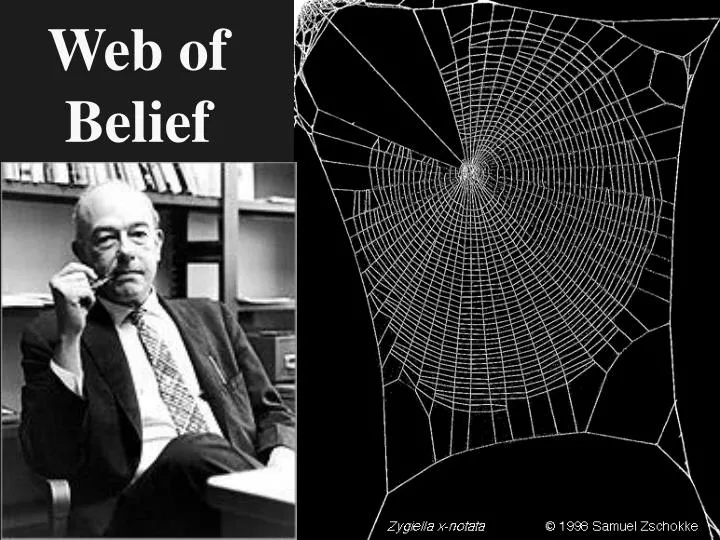
The following video segment explains this holistic picture and its profound consequences.
Quine: Two Dogmas of Empiricism
This final segment from the Cushing video explains Quine's holism and directly connects it to the idea that any statement, including those of logic, can be revised.
Please watch from 41:44 to 57:07. Focus on the 'web' or 'bowl' metaphor. How does recalcitrant experience (an observation that contradicts the theory) lead to revisions? And crucially, what determines which beliefs we revise?
This brings us to the heart of the matter. In Quine's holistic picture:
- There is no fundamental difference between analytic and synthetic truths, only a difference in degree.
- Statements at the periphery of the web are those closely tied to sensory experience (e.g., "There is a brown dog here").
- Statements at the center are the most general and abstract principles of our knowledge, including the laws of mathematics and logic.
- When experience conflicts with our theory, we must make a revision somewhere in the web. The choice of where to revise is a pragmatic one. We tend to make adjustments that cause the least overall disruption to the system.
4. The Revisability of Logic
Now we can see how Quine's argument delivers its radical conclusion. Since the laws of logic are simply statements at the center of the web—not a special class of a priori truths—they too are, in principle, up for revision.
To solidify this crucial point, let's turn to a couple of concise textual resources.
This section from the Stanford Encyclopedia of Philosophy entry on Quine explains how his holistic view provides an alternative account for the apparent necessity and a priori status of logic and mathematics.
Please read Section 3.2, 'Quine's Alternative'. Focus on how the centrality of a belief within the 'web' explains why it seems necessary and immune to revision, without appealing to analyticity.
So, why does logic feel a priori and necessary? Not because it's true by definition, but because it is so deeply embedded in our entire system of knowledge that revising it would have catastrophic consequences for the rest of the web. We are extremely reluctant to touch the statements at the center.
However, this reluctance is merely pragmatic. It is not a matter of principled impossibility. Quine famously claims that "no statement is immune to revision." He even suggests that puzzling results in quantum mechanics might one day lead us to revise the law of excluded middle (p ∨ ¬p) as the most efficient way to organize our scientific theory.
This pragmatic principle for belief revision is sometimes called the "maxim of minimum mutilation."
Quine's Philosophy of Logic and Mathematics
This excerpt from a paper by the logician and philosopher John P. Burgess discusses Quine's practical stance on revising logic.
Please read the second paragraph of the section titled '§2 A Priori Knowledge: Quine vs Carnap'. It begins 'First, though Quine denies...'. Pay attention to the 'maxim of minimum mutilation' and why, despite the possibility of revision, Quine doesn't think it's likely to be a good idea in practice.
This final point adds a crucial layer of nuance. Quine's claim is about the epistemological status of logic. He argues that logic is empirical, continuous with science, and therefore revisable in principle. However, as a matter of scientific and philosophical practice, the bar for revising logic is extraordinarily high due to the "maxim of minimum mutilation."
Conclusion
Today, we have analyzed one of the most significant arguments in 20th-century philosophy. By attacking the analytic-synthetic distinction, Quine dismantled the barrier that had protected logic from empirical science, challenging the very idea of a priori knowledge.
Key Takeaways:
- Quine rejects the analytic-synthetic distinction, arguing that attempts to define 'analytic' are circular and rely on unexplained notions like synonymy and necessity.
- He replaces this with epistemological holism, the view that our beliefs form an interconnected "web" that confronts experience as a whole.
- In this model, there is no principled difference between analytic and synthetic statements. Logical and mathematical truths are simply those beliefs at the center of the web.
- The central consequence is that no statement is immune to revision. We can, in principle, revise even logical laws if that is the most pragmatic way to accommodate recalcitrant experience.
- Our strong reluctance to revise logic stems from its centrality (the maxim of minimum mutilation), not from its being a priori or necessary in the traditional sense.
Preview of the Next Lesson:
Quine's argument is the classic foundation for a position known as anti-exceptionalism about logic—the view that logic is not a special, a priori discipline, but is continuous with the methods and goals of the empirical sciences. In our next lesson, we will evaluate this position directly, exploring contemporary arguments for and against the idea that logic is, in the end, just another part of our scientific theory of the world.