Introduction
Welcome back. In our previous lesson, we examined the ambitious philosophical project known as Hilbert's Programme. We saw that it was motivated by a foundational crisis and driven by two main goals:
- Completeness: To create a single formal axiomatic system that could decide the truth or falsity of any mathematical statement.
- Consistency: To prove, using only secure, finitary methods, that this system would never lead to a contradiction.
This programme represented the high-water mark of optimism in the power of formal methods to provide a complete and final foundation for mathematics. However, in 1931, this optimism was shattered by a single, revolutionary paper from the 29-year-old logician Kurt Gödel.
Today, we will analyse the philosophical significance of Gödel's first incompleteness theorem for Hilbert's programme. We will explore what the theorem says, how it works in principle, and why it delivered such a decisive blow to Hilbert's dream of a complete formalization of mathematics. Given your background in mathematical logic, we can focus less on the technical proof construction and more on its profound philosophical implications.
The Decisive Refutation
At its core, Gödel's first incompleteness theorem (often abbreviated as G1) is a limitative result. It places a fundamental boundary on what any formal axiomatic system can achieve.
A common statement of the theorem is as follows:
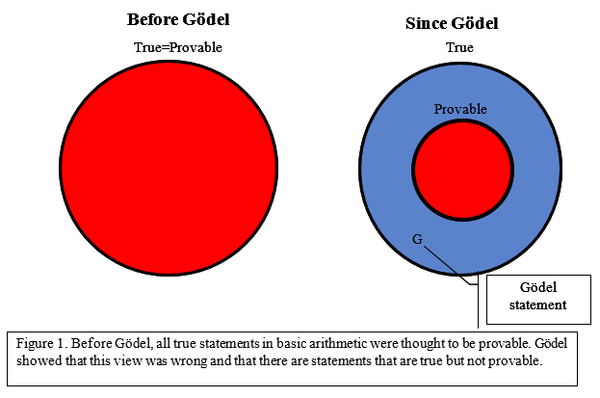
Gödel's First Incompleteness Theorem (G1): Any consistent, recursively axiomatizable formal system capable of expressing elementary arithmetic contains a true statement that is not provable within that system.
Let's break down the conditions, which are crucial for understanding its impact on Hilbert's Programme:
- Consistent: The system does not prove a contradiction (e.g., ). This was a non-negotiable starting point for Hilbert.
- Recursively axiomatizable: There is an effective procedure (an algorithm) to determine whether a given formula is an axiom. This captures the essence of a "formal system"—one whose axioms can be written down and mechanically checked. Hilbert's Programme required exactly this kind of system.
- Capable of expressing elementary arithmetic: The system must be strong enough to represent basic facts about the natural numbers, including addition and multiplication. Any system aiming to formalize "all of mathematics" would certainly need to meet this condition.
The theorem's conclusion—that there exists a true but unprovable statement—directly targets the first and most central goal of Hilbert's Programme.
The following video lecture gives a vivid account of how this result was received and why it was so devastating.
The Gödel incompleteness phenomenon
Professor Joel David Hamkins begins his lecture by setting Hilbert's Programme as the context, describing it as a natural and ambitious goal, before introducing Gödel's theorems as 'bombs exploding at the very center' of it.
Please watch from 01:30 to 09:34. The first part will be a review of the goals of Hilbert's Programme, which we covered last time. Pay special attention to the two imagined worlds he presents: 'Hilbert's world' (where a complete theory allows for a theorem-enumeration machine) and the alternative. Then, listen for how he frames the incompleteness theorems as a 'decisive refutation' of Hilbert's vision.
As Professor Hamkins explains, Hilbert's dream was of a world where mathematical truth could be systematically and mechanically generated from a finite set of axioms. Gödel's theorem shows this world to be a "mirage." The existence of true-but-unprovable statements means that the goal of completeness is not just difficult, but impossible for any single formal system.
The Engine of Incompleteness: Self-Reference
How can such a statement be constructed? The technical details are intricate, but the core philosophical idea is a masterful application of self-reference within the confines of formal arithmetic. You are likely familiar with the proof from your logic courses, but let's review the two key conceptual innovations that make it possible, as they are philosophically significant in their own right.
- Arithmetization (Gödel Numbering): Gödel's first crucial insight was that the entire syntax of a formal system—its symbols, formulas, and proofs—could be encoded using nothing but natural numbers. Every formula and every finite sequence of formulas (i.e., every proof) can be assigned a unique "Gödel number."
- Self-Reference through Diagonalization: Once syntax is encoded as numbers, the language of arithmetic, which talks about numbers, can indirectly talk about itself. Gödel used a technique related to Cantor's diagonal argument to construct a very special arithmetic sentence, often called .
The following clips explain these two key ideas.
The Gödel incompleteness phenomenon
First, Professor Hamkins explains the concept of arithmetization, using the modern analogy of how computers represent complex information—from novels to engineering schematics—as long strings of numbers. This allows mathematical statements, which talk about numbers, to also talk about mathematical statements.
Please watch from 23:58 to 30:02. Focus on the core idea: how any finite combinatorial structure, including the syntax of a formal language, can be encoded by numbers, thereby enabling self-reference.
The Gödel incompleteness phenomenon
Now, building on arithmetization, Hamkins explains how Gödel used a 'fixed-point lemma' to construct a sentence G that asserts its own unprovability.
Please watch from 36:38 to 41:29. You can skim the technical proof of the fixed-point lemma (32:06 - 36:38) if you wish, as the main point is the construction and analysis of the Gödel sentence G, which effectively says, 'I am not provable.' Follow the reasoning: If G were provable, the system would be inconsistent. Therefore, it must be unprovable. But if it's unprovable, what it says is true.
The argument is a masterpiece of logical reasoning:
- Let be our formal system (e.g., Peano Arithmetic).
- Gödel constructs a sentence in the language of which asserts: "The sentence with Gödel number is not provable in ," where happens to be the Gödel number of itself. In short, says, "I am not provable in ."
- Argument:
- Suppose is provable in . Then what asserts must be true (assuming only proves true statements, which follows from consistency). But asserts that it is not provable. This is a contradiction. Therefore, cannot be provable in , assuming is consistent.
- Since we have just demonstrated that is not provable in , what asserts is, in fact, true.
- Conclusion: is a true statement of arithmetic, but it is unprovable within the system .
This is not a paradox in the way the Liar sentence ("This sentence is false") is. The Gödel sentence is a perfectly well-formed statement about natural numbers. It is demonstrably true, yet the formal system is powerless to prove it.
The Philosophical Fallout
The refutation of the completeness goal sent shockwaves through the philosophy of mathematics. It fundamentally changed our understanding of the relationship between truth, proof, and knowledge.
Did the Incompleteness Theorems Refute Hilbert's Program?
This brief excerpt from the Stanford Encyclopedia of Philosophy article on Gödel's work summarizes his own view on the impact of his discovery, particularly after Turing's work clarified the general nature of a 'formal system.'
Please read the short introduction to this supplement. Note Gödel's own reflection that his theorems, in their full generality, refuted the Hilbert program by showing that 'mathematics cannot be formally reconstructed strictly on the basis of concrete intuition of symbols.'
Let's unpack the main philosophical consequences of G1 for Hilbert's Programme.
1. Mathematical Truth Outruns Formal Proof
Perhaps the most significant consequence is the decisive separation of the concepts of truth and provability. Hilbert's formalist-instrumentalist approach sought to effectively define mathematical truth for complex ("ideal") domains in terms of formal provability from a set of axioms. G1 shows this reduction is impossible. The collection of true statements of arithmetic is demonstrably larger than the collection of theorems provable by any single axiomatic system.
In the words of mathematician Gregory Chaitin, "truth outruns proof." There will always be mathematical truths that lie beyond the reach of our current axiomatic framework.
2. The Inevitable Incompleteness of Formal Systems
Hilbert's dream of a single, final, complete theory of mathematics is shown to be impossible. For any consistent system we propose, we can find its Gödel sentence . We can then "repair" the system by adding as a new axiom, creating a new, stronger system . However, this new system (if consistent) is also subject to Gödel's theorem and will have its own true-but-unprovable Gödel sentence, .
This process can be repeated infinitely, creating a never-ending hierarchy of formal systems, none of which can ever capture all of arithmetic truth. This reveals mathematics not as a closed, static system waiting to be fully axiomatized, but as an open-ended, dynamic, and potentially inexhaustible field of inquiry.
3. The Refutation of Mechanical Mathematics
The vision of Hilbert's world, as described by Hamkins, was one where a "theorem-enumeration machine" could, in principle, solve any mathematical problem by simply churning through all possible proofs. G1 demolishes this picture. Since the set of all true arithmetic statements is not recursively enumerable (a deeper result related to G1), no such machine can exist.
This implies that mathematical progress cannot be fully mechanized. It requires a form of insight or creativity that transcends the rules of any single formal system—for instance, the "meta-level" insight required to see that the Gödel sentence is true.
Conclusion
Today we have seen how Gödel's first incompleteness theorem directly and decisively refuted the goal of completeness, which was a cornerstone of Hilbert's Programme. By constructing a true but unprovable sentence, Gödel revealed a fundamental limitation of all formal axiomatic systems.
Key Takeaways:
- G1 states that any consistent, recursively axiomatizable system for arithmetic is necessarily incomplete.
- It refutes Hilbert's goal of completeness by showing that no single formal system can prove all mathematical truths.
- The philosophical significance is immense:
- It severs the identity between truth and formal provability, showing that truth outruns proof.
- It demonstrates that mathematics is an open-ended endeavor, as any formal system can be extended with new, independent truths.
- It undermines the idea that mathematics could ever be fully mechanized, reasserting the role of non-formal insight and creativity.
While G1 was a devastating blow to the first goal of Hilbert's Programme, one might wonder if the second goal—a finitary proof of consistency—could still be salvaged. What if we could at least prove that our incomplete systems are safe?
Preview of the Next Lesson:
As it turns out, Gödel had a second theorem. Gödel's second incompleteness theorem is an even more direct assault on Hilbert's Programme. It shows that any sufficiently strong, consistent system cannot prove its own consistency. In our next lesson, we will assess the philosophical impact of the second incompleteness theorem on foundationalist programmes in mathematics, exploring why this result shattered the very last hope of Hilbert's original vision.