Hello! Welcome to the final lesson of our first module on sleep fundamentals.
In our last session, we explored the "afternoon dip," learning that the dip in alertness we feel after lunch is a pre-programmed part of our circadian rhythm. We saw how scheduling our day around this natural trough—tackling demanding tasks during our energy peaks and easier ones during the dip—can make us more effective.
So far, we've focused on what happens while we're awake. Today, we're going to dive into the crucial work your brain does while you're asleep. Our goal is to explain the role of sleep in memory consolidation and emotional regulation. You'll discover how sleep acts as both a sophisticated filing system for memories and a vital emotional reset button, helping you learn better and wake up ready to face the day with a clearer mind.
Part 1: Sleep as Your Brain's Filing System
Have you ever noticed that you can recall things more clearly after a good night's sleep? Or that 'sleeping on it' helps you make sense of new information? This isn't just a feeling; it's a core function of sleep called memory consolidation.
During the day, your brain takes in a massive amount of information. These new experiences are initially stored as fragile, short-term memories. For them to become stable, long-term knowledge, they need to be processed and filed away. As a project manager, you can think of this like processing the day's data, tagging it, and storing it in the correct database so it can be easily retrieved later. This filing process happens primarily during sleep.
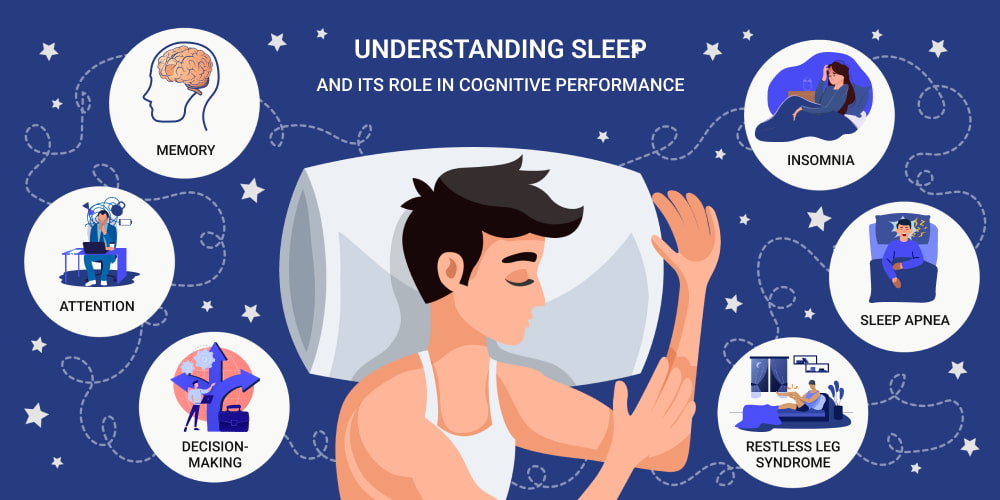
Different sleep stages specialize in handling different types of memories:
- Deep Sleep (Non-REM): This stage is crucial for locking in factual information—what you might call "textbook knowledge." It acts like a transfer service, moving information from your brain's temporary storage (the hippocampus) to its permanent hard drive (the cortex).
- REM Sleep: This stage is more about integration. It helps you connect new information with your existing knowledge, allowing you to see patterns and solve problems. It's particularly important for procedural memory (learning a new skill) and creative insights.
To see a great, simple explanation of this, let's turn to sleep scientist Matt Walker.
A walk through the stages of sleep | Sleeping with Science, a TED series
In this short clip from the TED series 'Sleeping with Science', Matt Walker explains how deep sleep acts as a memory-fixing service.
Please watch from 01:13 to 01:44. Notice how he describes deep non-REM sleep as the time when memories are consolidated and fixated.
This process is why cramming all night for an exam is often counterproductive. You might expose yourself to the information, but without sleep, your brain doesn't get the chance to properly store it.
Part 2: Sleep as Your Emotional Reset
Beyond organizing facts and skills, sleep performs another vital function: it manages our emotions. It acts as an overnight therapy session, allowing us to process the day's emotional experiences. This is directly linked to your goal of using sleep to feel more motivated for the day ahead; a well-regulated emotional state is the foundation for resilience and drive.
When we are sleep-deprived, our emotional responses can become exaggerated. Small frustrations can feel like major crises. To understand why, we need to look at two key brain regions:
- The Amygdala: You can think of this as the brain's "emotional gas pedal." It's responsible for generating strong, quick emotional reactions, especially negative ones like fear and anger.
- The Prefrontal Cortex: This is the "rational brake pedal." It's the CEO of your brain, responsible for logical thought and keeping your emotional responses in check.
A good night's sleep ensures a strong connection between the brake and the gas pedal. Without sleep, that connection weakens.
The following video explains this beautifully.
How sleep affects your emotions | Sleeping with Science, a TED series
This video, also from Matt Walker, provides one of the clearest explanations of how sleep deprivation affects our emotional control. The analogy of the accelerator and brake is particularly powerful.
Please watch the entire video (0:00 to 03:40). Pay close attention to the accelerator/brake analogy and the concept of REM sleep as 'emotional first aid.'
As you just saw, sleep—and REM sleep in particular—provides a form of "nocturnal soothing." It replays the emotional events of the day but in a safe environment, stripping away the intense emotional charge. This allows you to retain the learning from an experience without carrying the full emotional baggage. You wake up with perspective, not reactivity.
This is why getting a full night's sleep is so important. As we saw in the first video clip today, REM sleep occurs in much greater concentrations in the last few hours of an 8-hour sleep cycle. If you cut your sleep short by waking up two hours early, you might lose 50-70% of your REM sleep, severely impacting your brain's ability to perform this emotional reset.
Test your understanding!
Think about a time you had to "sleep on" a difficult decision or an upsetting event. How did you feel about the situation the next morning? Based on what you've learned, what do you think was happening in your brain overnight?
Show answer
You likely felt that the situation was more manageable or less emotionally overwhelming the next day. Based on the lesson, your brain was engaged in emotional regulation during REM sleep. It reprocessed the memory of the event but dampened the activity of the amygdala (the "emotional gas pedal"). This process acted as "emotional first aid," taking the sharp edges off the experience and strengthening the connection to your prefrontal cortex (the "rational brake"), allowing you to approach the situation with a clearer, less reactive mindset.
Sleep's Place in Your Emotional Toolkit
Managing emotions is a skill, and sleep is a foundational part of your toolkit. It's not a luxury; it's a non-negotiable part of maintaining emotional well-being.

As you can see, experts place good sleep right alongside other well-known emotional health practices. When you are well-rested, you are better equipped to handle stress and use other regulation strategies effectively. When you're sleep-deprived, even the best techniques can fail because your brain is biologically primed for hyper-reactivity.
Conclusion
Congratulations on completing the first module! You now have a solid understanding of the fundamental "why" behind sleep.
Here are the key takeaways from today's lesson:
- Sleep is an active period where the brain consolidates memories, transferring new information into long-term storage.
- Deep (NREM) sleep is vital for filing away facts, while REM sleep is crucial for integrating knowledge and skills.
- Sleep, particularly REM sleep, acts as "emotional first aid." It recalibrates our brain, reducing emotional reactivity and helping us process difficult experiences.
- A lack of sleep weakens the connection between our rational prefrontal cortex and our emotional amygdala, making us prone to exaggerated emotional responses.
We've covered the basics of sleep cycles, the two-process model, the afternoon dip, and now, the critical roles of memory and emotional processing. You have a great foundation to build upon.
In our next lesson, we will begin Module 2: Key Factors Influencing Your Sleep. We'll move from the "why" to the "how," starting with the single most powerful environmental factor you can control to improve your sleep: light exposure.