Welcome back. In our previous lesson, we explored the CAP theorem and the fundamental trade-off between consistency and availability in distributed systems. We established that for any system requiring partition tolerance, the real design choice is between being a CP (consistent) or an AP (available) system. This led us to the idea of "eventual consistency" as the model used by AP systems.
Today, we will dive much deeper into this topic. We'll move beyond the high-level CP/AP distinction to precisely compare strong and eventual consistency models. You'll see that consistency isn't a simple binary choice but a spectrum of possibilities. Understanding these models is critical for an AI infrastructure engineer, as they directly influence the design, performance, and user experience of everything from model metadata stores to the massive vector indexes that power retrieval-augmented generation (RAG) systems.
The Two Poles: Strong and Eventual Consistency
At the heart of the discussion are two opposing models: strong consistency and eventual consistency. Let's start by establishing clear definitions and a simple mental model for each.
The video below offers an excellent, straightforward explanation of the core concepts and uses relatable examples to illustrate the trade-offs.
Data Consistency | Strong Consistency vs. Eventual Consistency | System Design for Beginners
This video, "Data Consistency," provides clear definitions and practical examples to contrast strong and eventual consistency.
Please watch the following segments: First, the introduction from the beginning, which explains why data consistency is a challenge in replicated systems. Next, watch the core definitions of strong and eventual consistency. Then, see the YouTube views counter example, which is a classic illustration of where eventual consistency is acceptable. Finally, contrast this with the stock exchange example to understand when strong consistency is non-negotiable.
As the video makes clear, the choice between these models depends entirely on the use case. The negative impact of seeing a slightly stale view count on a video is negligible, while the impact of seeing a stale stock price could be catastrophic.
The fundamental difference between the two models lies in how write operations are handled and acknowledged. The diagram below visualizes the process for a simple two-node cluster.
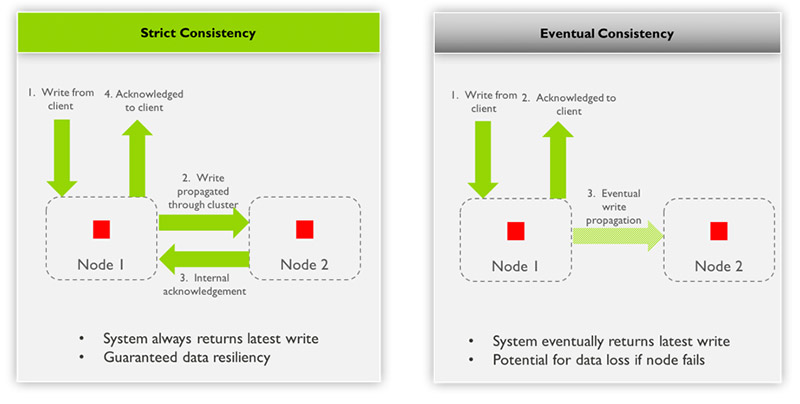
In a strongly consistent system (labeled "Strict Consistency" in the image), the process is:
- A client sends a write to Node 1.
- Node 1 propagates the write to Node 2.
- Node 2 sends an internal acknowledgment back to Node 1, confirming the write has been received and applied.
- Only after receiving this internal confirmation does Node 1 acknowledge the write to the client.
This ensures that once the client receives confirmation, the data is durable and consistent across the cluster. Any subsequent read from any node is guaranteed to see the new data. However, the client has to wait for this multi-step coordination to complete, which increases latency.
In an eventually consistent system:
- A client sends a write to Node 1.
- Node 1 immediately acknowledges the write to the client.
- In the background, Node 1 asynchronously propagates the write to Node 2.
This provides very low write latency but creates an "inconsistency window." Between steps 2 and 3, a read request to Node 2 would return stale data. The system eventually becomes consistent, but there's no guarantee on when.
A Spectrum of Consistency Models for AI Systems
While strong and eventual consistency represent the two extremes, modern distributed systems employ a variety of models that fall somewhere in between. These "weaker" consistency models offer a compromise, providing better performance and availability than strong consistency while avoiding some of the more confusing behaviors of pure eventual consistency.
This is especially relevant in complex AI systems like Retrieval-Augmented Generation (RAG), which consist of multiple distributed components. An excellent article on ApX Machine Learning explores these models specifically in the context of RAG.
Data Consistency Models in Distributed RAG - ApX Machine Learning
This article provides definitions for several key consistency models and frames them within the practical context of designing a RAG system.
Please read the introduction under the heading "Core Consistency Models and Their RAG Implications". Then, carefully read the descriptions for Strong Consistency (read section) and Eventual Consistency (read section). These will reinforce what we've just discussed, but in the specific context of AI document and vector stores.
The article you just reviewed provides a great foundation. Now, let's explore the more nuanced models that exist between these two poles. These intermediate models are often crucial for building user-friendly and predictable applications on top of eventually consistent infrastructure.
Data Consistency Models in Distributed RAG - ApX Machine Learning
This next part of the article introduces three important "weaker" consistency models that offer more guarantees than eventual consistency.
Continue reading in the same article. Please study the following three models: Causal Consistency: Read the section from this point. This model is vital for multi-step data pipelines where one operation depends on another. Read-Your-Writes Consistency: Read the section starting from this point. This is critical for interactive applications where users expect to see the results of their own actions immediately. Monotonic Reads Consistency: Read the section beginning here. This prevents the user experience from "going back in time," which can be deeply confusing.
As a senior engineer, you can see how these weaker models directly address specific user experience and application logic challenges. For example, a system without Read-Your-Writes consistency would feel broken to a user who edits a document and then immediately searches for the content they just added, only to find the old version. These models allow architects to build intuitive applications on top of scalable, highly available systems.
Choosing the Right Model for the Job
A complex AI system is not a monolith; it's a collection of interacting components, each with its own requirements. A key task in AI infrastructure design is choosing the right consistency model for each part of the system. It's almost never a one-size-fits-all decision.
Let's return to our RAG example. Consider its main components:
- Vector Database Index: Stores billions of embeddings. It's constantly being updated as new documents are added or changed. For this component, availability and read performance are paramount. A slight delay (seconds or even minutes) for new data to become searchable is usually acceptable. This makes eventual consistency a perfect fit. Enforcing strong consistency would make updates prohibitively slow and expensive.
- Document Access Control List (ACL): This data determines which users can see which documents. Here, an error is unacceptable. You cannot have a situation where a user can briefly access a document they aren't authorized to see due to replication lag. This requires strong consistency.
- Interactive Editing Interface: A user edits a document in the knowledge base and then asks the RAG chatbot a question about it. They expect the chatbot to be aware of their edit. This is a classic case for Read-Your-Writes consistency.
The final part of the article we've been using summarizes this balancing act nicely.
Data Consistency Models in Distributed RAG - ApX Machine Learning
This section connects the choice of consistency model back to the CAP theorem and other high-level system goals.
Please read the section under the heading "Balancing Consistency". Pay attention to how it ties the discussion back to availability, performance, and user experience.
The "Weirdness" of Eventual Consistency
While eventual consistency enables incredible scale and performance, it can lead to behaviors that seem counter-intuitive. The following video provides a memorable, non-technical illustration of what it feels like to interact with an eventually consistent system.
L17: Consistency Models in Distributed Systems
This segment from a "Distributed Systems Course" lecture uses a Facebook comment thread to illustrate the user experience of eventual consistency.
Please watch the segment on Eventual Consistency, from this timestamp. The key insight here is the trade-off: life gets "weirder" for developers and users, but the system gains performance. The observation that this model is often used for data consumed by humans—who can tolerate some ambiguity—is particularly insightful.
Conclusion
In this lesson, we moved from the abstract CAP theorem to the concrete realities of data consistency in distributed systems. You now have a much more nuanced understanding of the spectrum of models available.
Here are the key takeaways:
- Strong vs. Eventual: Strong consistency guarantees that every read sees the most recent write, at the cost of higher latency and lower availability. Eventual consistency prioritizes availability and low latency, accepting a temporary "inconsistency window."
- Consistency is a Spectrum: Models like Causal, Read-Your-Writes, and Monotonic Reads provide intermediate guarantees that are crucial for building predictable and user-friendly applications.
- Fit the Model to the Component: In a complex AI system, you will use different consistency models for different components. The vector index may be eventually consistent, while the metadata store for security permissions must be strongly consistent.
- Driven by Use Case: The choice of consistency model is a critical design trade-off between correctness, performance, availability, and user experience.
We've discussed what strong consistency is, but we haven't yet explored how distributed systems achieve it. In our next lesson, we will do just that. We'll dive into the world of consensus algorithms, exploring how protocols like Raft and Paxos allow a cluster of independent nodes to agree on a single source of truth, forming the foundation of modern CP systems.