Welcome back! In our last lesson, we introduced the habit loop, the simple three-part neurological pattern of cue, routine, and reward that underpins all of our habits. You took the first step in becoming a behavioral architect by deconstructing one of your own simple habits into these components.
Today, we go deeper into the "why" that you're so interested in. We'll move from the what to the how. This lesson addresses the learning outcome: Describe how repeated behaviors lead to automaticity through neural pathway changes. We will explore the fascinating process of neuroplasticity, uncovering how your brain physically rewires itself to turn conscious, effortful actions into effortless, automatic routines. This is the core mechanism that allows you to offload mental effort and build a foundation for high performance.
1. The Brain's Drive for Efficiency
At its core, habit formation is about one of your brain's primary directives: conserve energy. Conscious thought is metabolically expensive. To be more efficient, your brain is always looking for ways to turn repeated behaviors into automatic routines that require little to no conscious effort. This process of automation happens in a specific area of your brain.
To start, let's get a concise overview of this principle and the key brain region involved.
The Science of How Your Brain Forms Habits (and How to Take Control)
Psychiatrist Dr. Tracey Marks explains why the brain automates behaviors and introduces the concept of neuroplasticity in the context of habit formation.
Watch from 00:45 to 02:11. Focus on the brain's goal to 'save energy' and the role of the basal ganglia as the 'autopilot system'.
As Dr. Marks explained, this process is like carving a path in a field of tall grass. The first time is hard work, but each repetition makes the path clearer and easier to follow. This "path-carving" is a physical process of changing the connections between your brain cells—a process called neuroplasticity.
2. The Neural Machinery of Habits
So, how does the brain actually do this? A specific network of brain regions works together to form, execute, and automate habits. While the basal ganglia are the central hub for automatic behaviors, other areas play critical roles.
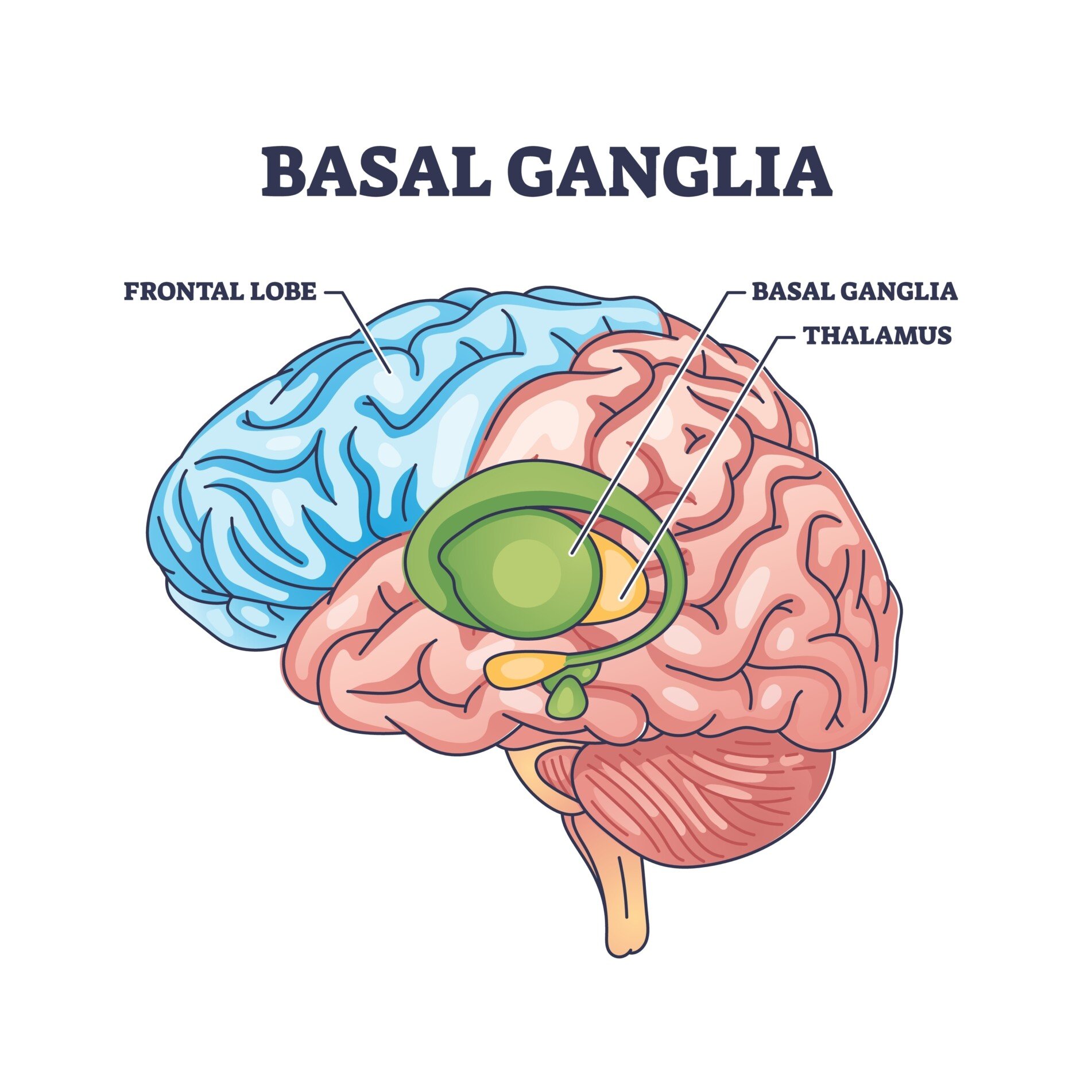
To understand the key players and their roles, the following article provides a clear and structured overview of the brain's habit-forming machinery.
This article, 'The Neuroscience of Habits' by Dr. Lynne Reid, details the specific brain regions involved in habit formation and their functions.
Please read the section 'The Brain Regions Involved in Habit Formation.' Pay attention to the distinct roles of the Basal Ganglia, Striatum, Prefrontal Cortex, Hippocampus, and Amygdala. This will give you a mental map of the hardware involved.
To summarize the key roles:
- Basal Ganglia: The "habit hub" that stores and runs automated programs.
- Prefrontal Cortex (PFC): The "CEO" of your brain. It's in charge during the initial, effortful stages of learning a new behavior. As the behavior becomes automatic, the PFC's involvement decreases significantly.
- Striatum: A part of the basal ganglia, crucial for reinforcement. The dopamine hit from the reward is processed here, telling the brain "this is worth remembering."
- Hippocampus: The "context manager," linking the habit to specific cues like location or time.
- Amygdala: The "emotions processor," linking feelings to the habit loop.
3. How Neurons "Learn": The Cellular Basis of Automaticity
We've seen the brain regions involved, but what is actually changing on a microscopic level? The answer lies in the connections between individual neurons. This is where we get to the core principle of neuroplasticity, often summarized by the phrase: "Neurons that fire together, wire together."
This concept is known as Hebbian learning. When you repeat a behavior, the same set of neurons fires in the same sequence. Each repetition strengthens the synaptic connections between them, making it easier for them to fire together in the future. This strengthening process is called Long-Term Potentiation (LTP).
Neuroscientist Andrew Huberman provides an excellent explanation of the cellular and molecular mechanisms behind this process.
The Science of Making & Breaking Habits
In this clip, Andrew Huberman breaks down how visualizing a habit can start the process of neuroplasticity, and then explains Hebbian learning and the role of NMDA receptors in strengthening neural connections.
Watch from 24:59 to 29:33. Focus on his explanation of Hebbian learning ('when they fire together, they tend to strengthen their connections') and how NMDA receptors make a neuron 'more responsive to input in the future.' This is the fundamental 'why' of automaticity.
The key takeaway here is that automaticity isn't a vague psychological concept; it's a physical reality in your brain. With each repetition of the habit loop, LTP makes the neural circuit for that habit more robust and efficient. The behavior requires less input and less conscious thought to initiate, until it becomes your default response to the cue.
4. The Brain's "Hand-Off" to Autopilot
Now we can put it all together. When you first perform a new action, your prefrontal cortex is heavily engaged. You're thinking about it, making decisions, and exerting effort.
As you repeat the action and the habit loop (cue-routine-reward) is reinforced, the neural pathway in the basal ganglia strengthens through Long-Term Potentiation. The brain detects this efficient, well-traveled path and begins to shift control. It "hands off" the execution of the behavior from the effortful prefrontal cortex to the automatic, energy-saving basal ganglia.
This shift is observable in brain imaging studies.
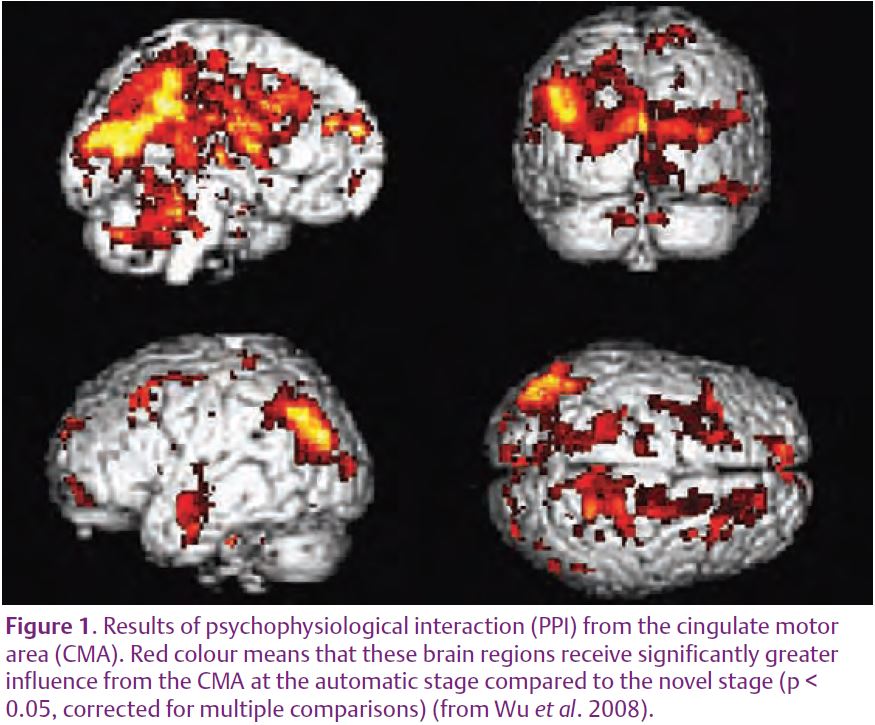
This "hand-off" is the essence of automaticity. The result is that you can perform the habit—like driving a familiar route, typing on a keyboard, or brushing your teeth—while your conscious mind is free to think about other things. This is the biological foundation for building complex skills and achieving high performance.
5. Advanced Concept: How the Brain "Brackets" a Habit
To take this a step further, the brain doesn't just automate the routine itself. It automates the entire chunk of behavior from start to finish. A specific part of the basal ganglia, the dorsolateral striatum (DLS), acts like a set of brackets, marking the beginning and the end of the habit sequence.
Understanding this "task bracketing" reveals why habits can become so powerful and independent of your immediate feelings or environment.
The Science of Making & Breaking Habits
Andrew Huberman explains the concept of 'task-bracketing' and the crucial role of the dorsolateral striatum. This explains how a habit becomes a self-contained, robust unit in your brain.
Watch from 31:10 to 35:28. Pay close attention to how the dorsolateral striatum is active at the beginning and end of a habit, effectively framing it. This is a key mechanism for making habits deeply embedded and context-independent.
This concept of task-bracketing is critical for performance. When a habit is deeply encoded with these neural brackets, it becomes a reliable routine you can execute regardless of whether you feel tired, distracted, or unmotivated. Your brain knows: "When this cue appears, run this program until the end."
Conclusion
In this lesson, we've journeyed deep into the brain to uncover the physical process behind habit formation. You now understand that when you repeat a behavior, you are literally forging and strengthening a dedicated neurological superhighway.
Key Takeaways:
- Habits are the brain's strategy for conserving mental energy, shifting control from the effortful prefrontal cortex to the efficient basal ganglia.
- This process is driven by neuroplasticity—the brain's ability to change its structure and function in response to experience.
- At the cellular level, the principle "neurons that fire together, wire together" (Hebbian learning) describes how repeated actions strengthen synaptic connections via Long-Term Potentiation (LTP).
- This strengthening makes the neural circuit for the habit more robust and efficient, leading to automaticity.
Preview of the Next Lesson:
Now that we know what a habit loop is and how the brain physically builds it, we can move on to practical analysis. In the next lesson, you will learn to analyze an existing personal habit by identifying its cue, routine, and reward. While we touched on this before, we will now go deeper, learning how to experiment and accurately diagnose the precise triggers and the underlying cravings the rewards are satisfying. This diagnostic skill is the critical precursor to effectively changing or redesigning any habit.