Hello! In our last session, we focused on preventing race conditions using mutexes to ensure that only one thread could access a critical section at a time. This enforced mutual exclusion, a cornerstone of concurrent programming.
However, many real-world problems require more than just preventing simultaneous access; they demand complex coordination between threads. Today's lesson dives into one of the most classic of these challenges: the producer-consumer problem. We'll see why a simple mutex isn't enough and how to solve it elegantly using a more versatile synchronization tool called a semaphore. This will provide you with a fundamental pattern for designing systems where different components produce and consume work asynchronously.
The Producer-Consumer Problem
At its heart, the producer-consumer problem models a common scenario in software engineering. You have one or more threads, the producers, creating data or tasks. You have another set of threads, the consumers, processing that data or executing those tasks. In between them sits a shared buffer of a fixed size, which acts as a temporary holding area.
The following video from the CodeVault channel, which you may remember from our last lesson, offers an excellent introduction to the problem and its real-world analogies.
Producer - Consumer Problem in Multi-Threading
This video introduces the abstract problem and connects it to practical examples like web server request queues and printer spools.
First, watch the overview of the problem from the beginning, where the concepts of producers, consumers, and a shared buffer are introduced here. Next, pay close attention to the breakdown of the three core challenges that any solution must address: managing shared memory (mutual exclusion), handling a full buffer, and handling an empty buffer. This is covered in the segment here.
As the video explains, any correct solution must satisfy three conditions:
- Mutual Exclusion: Producers and consumers must not access the buffer at the exact same time, as this would cause a race condition when manipulating the buffer's internal state (like its pointers or item count).
- Buffer Full: A producer must not add data to an already full buffer. It must wait until a consumer makes space.
- Buffer Empty: A consumer must not try to remove data from an empty buffer. It must wait until a producer adds something.
The first condition is about mutual exclusion, which we know how to solve with a mutex. The second and third conditions, however, are about synchronization—making one thread wait for an event to occur in another thread.
Why Mutexes Alone Are Not Enough
Let's consider what happens if we try to solve this with only the tool we have so far: the mutex. We can use a mutex to protect the buffer during read/write operations, solving the race condition. But what about the full/empty conditions?
A naive approach might be for the producer to lock the mutex, check if the buffer is full, and if it is, unlock and try again later. This is called busy-waiting or spinning. The thread wastes CPU cycles repeatedly checking a condition instead of sleeping until the condition changes. Even worse, if the producer finds the buffer is full, it might simply discard the new data, which is often unacceptable.
The next segment of the CodeVault video demonstrates exactly these flaws. It shows an initial attempt that crashes, followed by a fix using if statements that leads to both wasted CPU cycles and dropped data.
Producer - Consumer Problem in Multi-Threading
This part of the video implements a naive solution to highlight its shortcomings, motivating the need for a better synchronization primitive.
Watch the segment from this timestamp. It walks through an implementation that uses only a mutex and if checks, clearly showing why this approach is inefficient and incorrect. The key takeaway is understanding the "skipped" messages and the flood of "negative ones," which represent dropped data and wasted work, respectively.
This demonstration makes it clear that we need a mechanism that allows a thread to block efficiently (i.e., go to sleep) until a specific condition is met, without burning CPU. This is precisely what semaphores are for.
Semaphores: A More Powerful Tool
A semaphore is a synchronization primitive that maintains an internal counter and supports two primary atomic operations:
wait(S)(also calledP()ordown()): Decrements the semaphore's counter. If the counter is zero, the calling thread blocks until the counter becomes positive.signal(S)(also calledV()orup()): Increments the semaphore's counter. If any threads are blocked waiting on this semaphore, one of them is unblocked.
Unlike a mutex, which is a lock that can only be held by one thread, a counting semaphore can be thought of as managing a pool of a certain number of permits. A thread calls wait() to request a permit, and signal() to return one.
Using Semaphores for Producer-Consumer Problems
This article provides a very clear definition of semaphores and contrasts them with mutexes.
Read the section titled What is a Semaphore? to get a solid conceptual grasp of how it works with its internal counter. Then, read the short following section, What is a Mutex?, to reinforce the key difference: a mutex is for ensuring exclusive access, while a semaphore is for controlling access to a pool of resources.
The Three-Semaphore Solution
The classic and elegant solution to the producer-consumer problem uses a combination of one mutex and two counting semaphores.
mutex: A binary semaphore (value 0 or 1) or a standard mutex, initialized to1. This provides mutual exclusion for accessing the buffer, just as we did in the previous lesson.empty: A counting semaphore, initialized to the size of the buffer (N). It tracks the number of available empty slots.full: A counting semaphore, initialized to0. It tracks the number of available items (filled slots).
The logic works as follows. The following flowchart gives a high-level view of the operations.
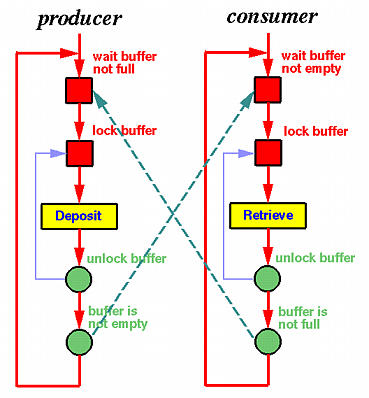
Let's break down the pseudocode for each process.
Producer Consumer Solution using Semaphores
This article from GeeksforGeeks presents the standard three-semaphore solution with clear pseudocode.
Focus on the section that begins with the Problem Statement. Read the description of the three semaphores (mutex, full, empty) and their initial values. Then, carefully study the pseudocode for both the Producer and the Consumer.
Producer's Logic:
wait(empty): "Is there an empty slot for me?" The producer first checks theemptysemaphore. If its count is greater than zero, it decrements the count and proceeds. If the count is zero (buffer is full), the producer blocks here, waiting for a signal from a consumer.wait(mutex): Once it knows a slot is available, it acquires themutexto get exclusive access to the buffer.- (Add item to buffer)
signal(mutex): It releases themutex.signal(full): It signals thefullsemaphore, incrementing its count to indicate that a new item is available. This will wake up a consumer if one is blocked waiting for an item.
Consumer's Logic:
wait(full): "Is there an item for me to consume?" The consumer first checks thefullsemaphore. If its count is greater than zero, it decrements the count and proceeds. If the count is zero (buffer is empty), the consumer blocks here, waiting for a signal from a producer.wait(mutex): Once it knows an item is available, it acquires themutexto get exclusive access to the buffer.- (Remove item from buffer)
signal(mutex): It releases themutex.signal(empty): It signals theemptysemaphore, incrementing its count to indicate that a new empty slot is available. This will wake up a producer if one is blocked waiting for a slot.
This combination of semaphores elegantly solves all three conditions without busy-waiting. The CodeVault video implements this very solution.
Producer - Consumer Problem in Multi-Threading
This final segment of the video implements the correct semaphore-based solution in C and demonstrates its robustness.
Watch from this timestamp to see the semaphore solution in action. Notice how the sem_wait and sem_post calls replace the flawed if checks, and how this immediately solves the problems of dropped data and wasted work.
Why This is Robust
The true power of this solution is revealed when you consider pre-emption, where the OS can switch between threads at any time. What if a producer executes wait(empty) and is then pre-empted before it can acquire the mutex? What happens if a consumer then runs? The Gate Smashers video provides an excellent walkthrough of exactly such a scenario, proving the solution's correctness.
L-3.11: Solution of Producer Consumer Problem using Semaphore | Operating System
This video walks through a concurrent execution trace, showing how the semaphores correctly prevent inconsistency even with context switching. Note that Down() is another name for wait(), and Up() is another name for signal().
Watch the detailed explanation from this timestamp. The key is to see how the Down(S) call (the mutex lock) blocks a thread from entering the critical section if another thread already holds the lock, even if the semaphores for full/empty would have allowed it to proceed. This demonstrates how mutual exclusion and synchronization work together.
This careful orchestration ensures that no matter how the threads are interleaved, the buffer's integrity is maintained, and the system progresses correctly.
Conclusion
In this lesson, we've moved beyond simple mutual exclusion to tackle a more complex coordination problem. You've seen how to use semaphores to build a robust and efficient solution.
Key Takeaways:
- The Producer-Consumer Problem requires both mutual exclusion (to protect the buffer) and synchronization (to handle full/empty states).
- Using only a mutex leads to inefficient busy-waiting or incorrect behavior like dropping data.
- A semaphore is a synchronization primitive that uses a counter to manage access to resources, allowing threads to block efficiently until a condition is met.
- The classic solution uses three semaphores:
- A mutex (or binary semaphore) for exclusive access to the critical section (the buffer manipulation code).
- A counting semaphore
emptyto track empty slots, on which producers wait. - A counting semaphore
fullto track filled slots, on which consumers wait.
This pattern is a fundamental building block in concurrent systems, appearing in everything from OS task schedulers to web server thread pools and data processing pipelines.
In our next lesson, we will delve deeper into the two types of semaphores we used today—binary and counting—to formalize their differences and explore other resource allocation problems they can solve.