In our previous lesson, we examined the intricate mechanics of TCP's connection lifecycle, including the three-way handshake that establishes a reliable channel. This process, as you saw, is foundational to TCP's promise of guaranteed, in-order data delivery.
This lesson pivots to a broader perspective on the Transport Layer. We will directly compare TCP with its primary alternative: the User Datagram Protocol (UDP). Your goal is to understand their fundamental differences, enabling you to make informed decisions about which protocol is best suited for various application scenarios—a critical skill in system design. We'll explore the core trade-off between TCP's reliability and UDP's speed, moving from protocol characteristics to practical application.
The Core Distinction: A Phone Call vs. a Postcard
At the heart of the TCP vs. UDP debate is a simple difference in philosophy. TCP is connection-oriented, while UDP is connectionless.
Think of TCP as making a phone call. You dial, the other person picks up, you both say "hello" to confirm you're connected, you have your conversation, and then you both say "goodbye" to hang up. This setup (the handshake) ensures both parties are ready and provides a framework for a reliable exchange.
UDP, on the other hand, is like sending a postcard. You write a message, put an address on it, and drop it in the mail. You don't establish a connection beforehand, and you don't get a confirmation of receipt. It's a "fire and forget" mechanism—fast, simple, but with no guarantees.
The following resource frames this distinction in the context of a system design interview, which should resonate with your role as an engineering manager.
System Design Mock Interview: Understanding TCP vs UDP
This article from Medium provides a clear, practical breakdown of the core differences.
First, read the section on the core distinction, which formally defines "connection-oriented" versus "connectionless." Then, jump to the end and read the excellent analogy in the section titled How I’d Explain This to a Junior Dev. It uses the metaphor of "Registered Mail" for TCP and a "Postcard" for UDP to solidify the concept.
Comparing Key Characteristics
This fundamental difference—connection-oriented vs. connectionless—gives rise to several other major distinctions in how the protocols behave. Let's break them down.
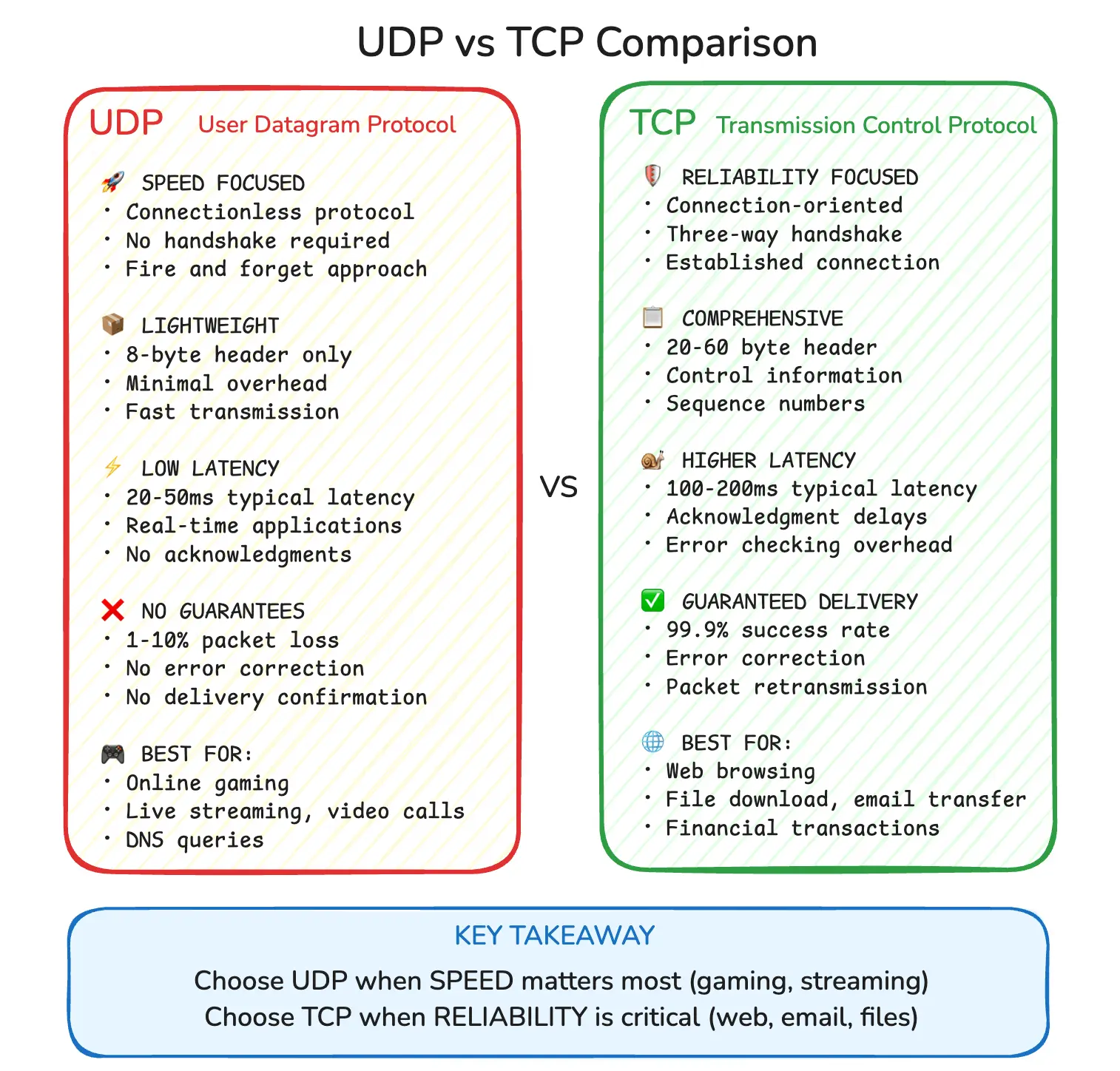
1. Reliability, Ordering, and Error Checking
As we've established, TCP's primary goal is reliability. UDP's is speed. This manifests in three key ways:
- Confirmation of Delivery: TCP uses acknowledgments (ACKs) to confirm that data was received. If an ACK isn't received within a certain time, the sender retransmits the lost packet. UDP provides no such confirmation.
- In-Order Delivery: TCP uses sequence numbers to ensure that data packets are reassembled at the destination in the same order they were sent. Packets that arrive out of order are held and re-arranged. UDP makes no such guarantee; datagrams are delivered to the application as they arrive.
- Error Awareness: Because TCP expects ACKs, it is aware when a packet fails to reach its destination and can take corrective action. UDP is unaware of packet loss at the transport layer.
The following video from Practical Networking offers an excellent breakdown of these three facets of reliability.
TCP vs UDP - Explaining Facts and Debunking Myths - TCP Masterclass
This segment of the "TCP vs UDP" video clearly unpacks the term "reliable" into its constituent parts.
Please watch the section that explains the three sub-components of TCP's reliability: confirmation, error awareness, and in-order delivery. Note how each of these is handled by TCP but not by UDP.
2. Flow and Congestion Control
Imagine you're sending data to a server whose input buffer is nearly full, or the network path between you is congested. How the protocol reacts is a key differentiator.
-
TCP has built-in flow control and congestion control.
- Flow Control: The receiver advertises its available buffer space (the "receive window"), so the sender knows not to send data faster than the receiver can process it. This prevents the receiver from being overwhelmed.
- Congestion Control: TCP monitors the network for signs of congestion (like packet loss) and slows down its sending rate to avoid making the congestion worse. It acts as a "good citizen" on the network. An algorithm often used here is AIMD (Additive Increase, Multiplicative Decrease), where the sending rate is increased slowly but cut dramatically when congestion is detected.
-
UDP has neither flow control nor congestion control. It will send datagrams at whatever rate the application dictates, regardless of the receiver's state or the network's health. This can be desirable for real-time applications that can't afford to slow down, but it also risks causing packet loss and network saturation.
This video provides a great visual explanation of these concepts.
TCP vs. UDP in 12 minutes | Systems Design Interview 0 to 1 With Ex-Google SWE
This video from "Jordan has no life" clearly illustrates flow and congestion control.
First, watch the explanation of flow control, which focuses on not overwhelming the receiver's buffer. Then, watch the segment on congestion control, which introduces the AIMD algorithm for managing the load on the network itself.
3. Overhead
All these reliability features in TCP come at a cost: overhead.
- TCP Header: A minimum of 20 bytes. It must include fields for sequence numbers, acknowledgment numbers, the receive window size, and control flags (SYN, ACK, FIN, etc.).
- UDP Header: A mere 8 bytes. It only needs to specify the source and destination ports, the packet length, and an optional checksum.
This difference in header size means that for every packet sent, TCP uses more bandwidth just for protocol management. Furthermore, the handshakes for connection setup and teardown add latency before any data can even be sent.
Making the Choice: Application Scenarios
The decision to use TCP or UDP boils down to a simple trade-off: Is it more acceptable to have a delay, or is it more acceptable to lose some data?

Use TCP When Reliability is Non-Negotiable
If every single bit of data must arrive, and in the correct order, TCP is the only choice.
- Web Browsing (HTTP/HTTPS): A single missing packet could corrupt an image or break a web page's layout.
- File Transfer (FTP, SFTP): A corrupted file is useless.
- Email (SMTP, IMAP): You need the entire email to be readable.
- Database Connections & Secure Shell (SSH): Data integrity and order are paramount.
Use UDP When Speed is Paramount
If your application is real-time and can tolerate some data loss, UDP's low overhead and lack of delay from retransmissions make it ideal.
- Live Video/Audio Streaming (VoIP, Video Conferencing): A lost packet might cause a momentary glitch or pixelation, which is far more acceptable than the entire stream pausing to wait for a retransmission. An old audio or video frame is useless anyway.
- Online Gaming: Player position updates must be delivered with the lowest possible latency. A stutter from a lost packet is better than lag caused by TCP's retransmission delays.
- DNS (Domain Name System): DNS requests are small and transactional. The overhead of a TCP handshake is inefficient. If a UDP request is lost, the client simply sends another one.
The following reading provides a concise list of these use cases.
This guide from PubNub clearly outlines the decision criteria and provides real-world examples.
Read the two sections Use TCP When and Use UDP When. Then, review the lists under Real-World Applications to see these principles in action.
Dispelling Common Myths
As an experienced engineer, it's important to have a nuanced understanding and avoid common oversimplifications. Let's address a few myths.
TCP vs UDP - Explaining Facts and Debunking Myths - TCP Masterclass
The Practical Networking video concludes by debunking four common myths about TCP and UDP. This is crucial for precise communication in technical discussions.
Please watch this entire segment on dispelling myths. Pay close attention to the explanations for why the following statements are misleading: "UDP is faster." (It has lower overhead, not lower latency.) "TCP is more secure." (Neither is inherently secure.) "UDP is unreliable." (It's more accurate to say it doesn't provide reliability at Layer 4.) "TCP provides guaranteed delivery." (It provides informed delivery; it can't magically fix a broken network path.)
A particularly important pitfall for engineering teams is the temptation to "reinvent TCP on top of UDP." An engineer might choose UDP for perceived speed, only to then spend significant effort implementing their own system of acknowledgments and retransmissions—often resulting in a solution that is less efficient and more bug-prone than just using TCP in the first place. Modern protocols like QUIC (which underlies HTTP/3) do exactly this, but they are the result of massive, expert-level engineering efforts.
A Look at Implementation
From a practical coding standpoint, the choice between TCP and UDP is reflected in the type of socket you create. Using Python's socket library as an example, you can see the distinction clearly.
This section of the PubNub article shows simple client-side code for both protocols.
Review the two code snippets under the heading Implementing TCP and UDP. Notice the key difference: TCP uses socket.SOCK_STREAM. UDP uses socket.SOCK_DGRAM (for Datagram). This small change in your code completely alters the underlying transport mechanism, reflecting all the trade-offs we've just discussed.
Conclusion
You have now compared the fundamental characteristics of TCP and UDP. The choice between them is one of the most classic trade-offs in network-centric software engineering, balancing the need for reliability against the need for speed and low latency.
Key Takeaways:
- TCP is a connection-oriented protocol that provides reliability through acknowledgments, sequencing, flow control, and congestion control. This comes at the cost of higher overhead and latency. It's the choice for applications like web browsing and file transfers where data integrity is paramount.
- UDP is a connectionless protocol that offers a fast, low-overhead "fire and forget" service. It provides no guarantees of delivery, order, or error correction. It's the choice for real-time applications like streaming and gaming where speed trumps perfect reliability.
- The decision between TCP and UDP is a direct trade-off between the cost of delay (due to retransmissions) and the cost of data loss.
- Be wary of common myths; for example, UDP isn't inherently "faster" in terms of latency, and neither protocol is inherently "more secure."
In this lesson, we identified DNS as a canonical use case for UDP. In our next session, we will delve into the mechanics of the Domain Name System, tracing the entire resolution process from a browser's request for a domain name to receiving the final IP address.