Introduction
In our previous lesson, we established the crucial role of the reverse proxy as a gateway to your backend services, managing traffic, enhancing security, and improving performance. We primarily discussed its function within the context of the standard HTTP request-response model. However, many modern applications require a level of interactivity that this model struggles to support efficiently.
This lesson addresses the learning outcome: Describe the WebSocket protocol and identify scenarios where it is preferable to HTTP. We will explore the limitations of HTTP for real-time applications and introduce WebSockets as a powerful alternative. You'll learn how the WebSocket protocol establishes a persistent, bidirectional communication channel and understand the specific use cases, such as chat systems and live dashboards, where it provides a distinct advantage.
The Limits of HTTP for Real-Time Communication
The web was built on HTTP, a protocol that operates on a strict request-response cycle. The client sends a request, and the server sends a response. This is a robust and scalable model for retrieving documents and making API calls, but it has a fundamental limitation: the server cannot initiate communication. It can only respond to a client's request.
To create the illusion of real-time updates using HTTP, developers have historically relied on workarounds like polling:
- Short Polling: The client repeatedly sends requests to the server at a fixed interval (e.g., every second) to ask, "Is there any new data?" This is inefficient, as most requests return no new information, creating unnecessary network traffic and server load.
- Long Polling: The client sends a request, but the server holds the connection open until it has new data to send. Once it sends the response, the client immediately initiates a new request. This is more efficient than short polling but is still complex to manage and can be resource-intensive.
The following video provides an excellent summary of the HTTP model and its inherent overhead, which sets the stage for why a different approach is needed.
WebSockets vs REST API (HTTP): Which One Should You Use?
This video from The Coding Gopher explains the traditional HTTP request-response model and its shortcomings for real-time scenarios.
Watch the first segment from the beginning until the end. Pay close attention to the discussion of statelessness, connection overhead, and why the request-response framework adds latency.
As you can see, for applications requiring low-latency, high-frequency updates, the request-response paradigm becomes a bottleneck.
The WebSocket Protocol: A Persistent Connection
WebSockets were designed to solve this problem by providing a persistent, full-duplex communication channel over a single TCP connection. This means that after an initial setup, both the client and the server can send data to each other at any time, without the overhead of new HTTP requests.

The process begins with a special HTTP request known as the WebSocket handshake.
- The client sends a standard HTTP
GETrequest to the server, but includes specific headers:Upgrade: websocketandConnection: Upgrade. This signals its intent to switch protocols. - If the server supports WebSockets, it responds with an HTTP status code
101 Switching Protocols. - At this point, the underlying TCP connection is no longer used for HTTP. It is "upgraded" to a WebSocket connection, and both parties can start sending data back and forth freely.
This initial "upgrade dance" is a clever way to establish a WebSocket connection using the existing HTTP infrastructure, including ports 80 and 443, which helps with traversing firewalls and proxies.
WebSocket vs HTTP: When to Use Each Protocol
This article from websocket.org provides a clear breakdown of how the WebSocket protocol works, starting with the handshake.
Read the section How WebSockets Work. Focus on understanding the "Upgrade Dance" and the specific headers involved in the initial handshake.
Once established, communication occurs through WebSocket frames, which have minimal overhead (typically 2-14 bytes) compared to the hundreds of bytes of headers in a typical HTTP request. This dramatic reduction in overhead is a key factor in the protocol's efficiency.
HTTP vs. WebSockets: A Head-to-Head Comparison
The differences between HTTP and WebSockets go beyond just the connection model. They have fundamental implications for performance, state management, and architectural complexity.
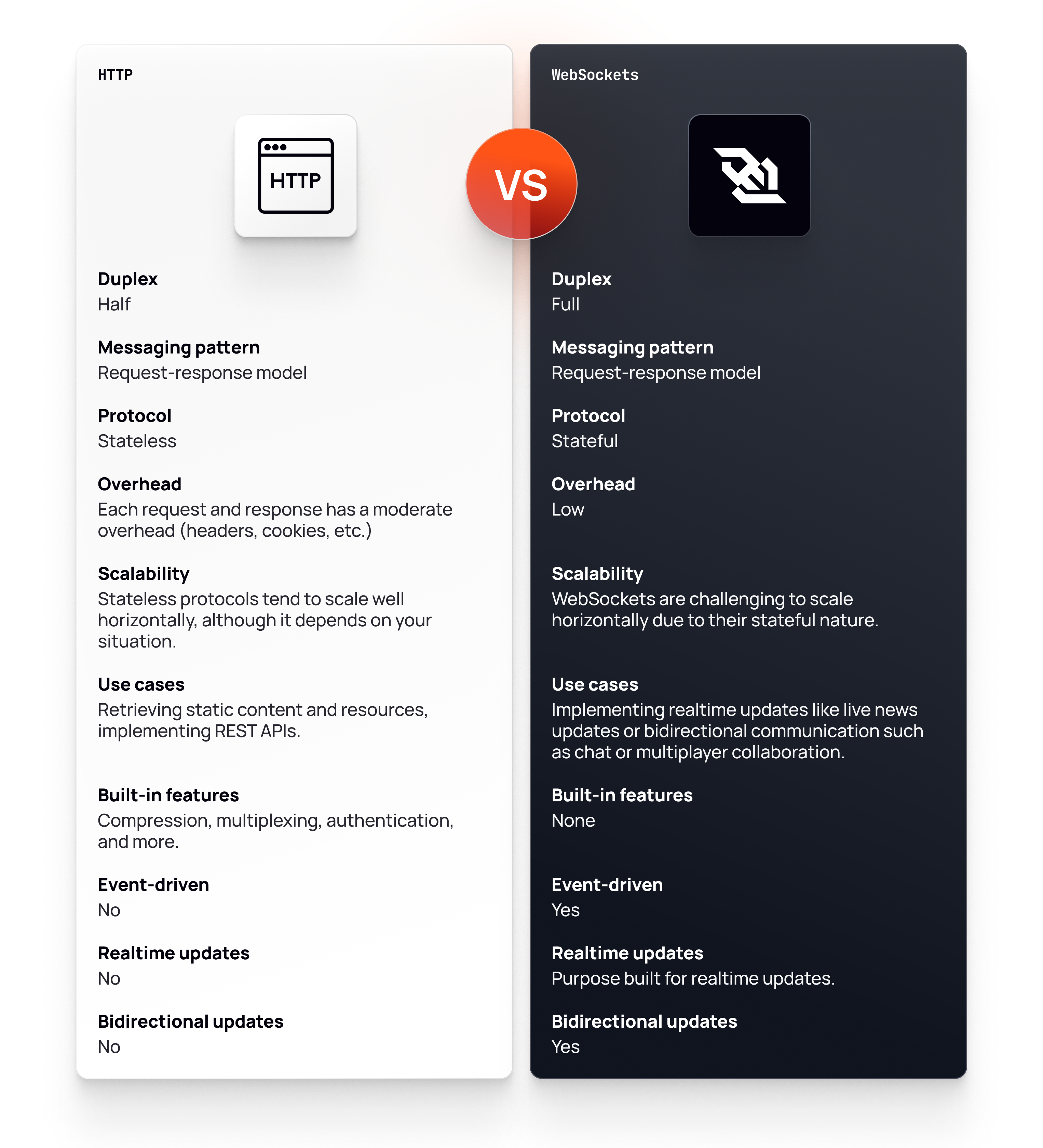
Let's delve into the most critical distinctions:
- Communication Model: HTTP is half-duplex (client requests, server responds). WebSockets are full-duplex (both client and server can send data independently and simultaneously).
- Statefulness: HTTP is stateless. Each request is independent, and state is managed externally (e.g., with cookies or tokens). This makes horizontal scaling simple. WebSockets are stateful. The server maintains an open connection for each client, which has implications for scaling. A server must be able to track thousands of open connections, and load balancing requires "sticky sessions" to ensure a client's messages are always routed to the same server that holds its connection state.
- Overhead: HTTP has high per-request overhead due to headers. WebSockets have very low per-message overhead after the initial handshake.
The following video provides a practical benchmark comparing the performance of HTTP and WebSockets, focusing on latency and network usage. For an engineering manager, seeing this data-driven comparison can be particularly insightful for capacity planning and cost estimation.
HTTP vs WebSockets Performance & Comparison (2026)
This video from Anton Putra offers a hands-on performance comparison, which is highly relevant to your background.
First, watch the section that explains the connection and overhead differences in a practical context. Then, observe the benchmark results, paying special attention to the graphs for latency and, most importantly, network usage. The difference in bandwidth consumption is often the most significant factor in production.
As the benchmark shows, while latency improves, the most dramatic benefit is the reduction in network traffic, which can translate directly to lower infrastructure costs.
When to Use WebSockets (and When to Use HTTP)
Choosing the right protocol is critical. Using WebSockets where HTTP would suffice adds unnecessary complexity, while forcing HTTP into a real-time scenario leads to inefficiency.
Use WebSockets for:
WebSockets are the superior choice when you need the server to push data to the client with low latency.
- Real-Time Chat Applications: When a user sends a message, the server can immediately push it to all other participants in the conversation (e.g., Slack, WhatsApp Web).
- Live Data Feeds & Dashboards: Financial trading platforms pushing stock prices, monitoring systems displaying live metrics, or sports apps showing real-time score updates.
- Multiplayer Online Gaming: Synchronizing player positions, actions, and game state between multiple clients and the server in real-time.
- Collaborative Editing Tools: Applications like Google Docs or Figma use persistent connections to broadcast cursor positions and edits from one user to all others in the session instantly.
WebSockets for Real-Time Distributed Systems - GeeksforGeeks
This GeeksforGeeks article provides excellent real-world examples of where WebSockets are indispensable.
First, review the list under the heading Common Use Cases. Then, look at the concrete examples under Real-World Examples (Slack, Twitch, Uber, Google Docs) to solidify your understanding of these scenarios.
Use HTTP for:
HTTP remains the workhorse of the web and is the best choice for traditional request-response interactions.
- RESTful APIs: Performing standard CRUD (Create, Read, Update, Delete) operations.
- Serving Static Content: Delivering HTML pages, CSS files, images, and other assets. HTTP's compatibility with caching mechanisms and CDNs is a major advantage here.
- Form Submissions: When a user submits data that requires a single, one-off action.
In many complex applications, a hybrid approach is the most effective strategy. A user might load a web page via HTTP, authenticate via a REST API, and then establish a WebSocket connection to receive live updates.
Conclusion
In this lesson, we moved beyond the traditional request-response world of HTTP to explore the WebSocket protocol. You've learned how it establishes a persistent, full-duplex connection that enables efficient, low-latency, server-initiated communication.
Key Takeaways:
- HTTP's request-response model is inefficient for real-time applications, leading to workarounds like polling.
- The WebSocket protocol begins with an HTTP "upgrade" handshake to establish a single, long-lived, bidirectional communication channel.
- WebSockets offer significantly lower overhead and latency for frequent data exchange compared to HTTP because they eliminate repeated headers and connection setups.
- WebSockets are stateful, which makes scaling them more complex than stateless HTTP services and requires considerations like sticky sessions on load balancers.
- The ideal use cases for WebSockets are applications requiring real-time, server-pushed data, such as chat systems, live dashboards, and multiplayer games. HTTP remains the best choice for traditional web requests and APIs.
In our next lesson, we will discuss Content Delivery Networks (CDNs). While WebSockets are a solution for highly dynamic, real-time data, CDNs are the architectural answer to scaling the delivery of static, cacheable content globally—a classic HTTP use case. This will complete our look at modern networking patterns for both dynamic and static data.