Hello. Last lesson, you saw why a neuron’s lipid membrane can separate its internal fluid from the fluid outside: charged ions cannot readily pass through the membrane’s hydrophobic core. You also met a channel protein as one possible route across that barrier.
This lesson gives four kinds of protein distinct jobs: receptors detect signals, ion channels provide passages, transporters move substances across membranes, and enzymes catalyse chemical changes. These distinctions will let you read a synapse diagram without mistaking a chemical message for the machinery that handles it. Allow about 35–40 minutes, including the short reading, videos, and time with the diagram.
Four jobs, all performed by proteins
A protein is a chain of amino acids folded into a particular shape. That shape helps determine what the protein can bind and what it can do. Some proteins are embedded in a cell membrane; others work inside a cell or in the fluid around it. Protein names the kind of molecule. Receptor, channel, transporter, and enzyme describe jobs that proteins perform.
| Protein’s job | What to look for |
|---|---|
| Receptor | Binds a signalling molecule and initiates a cellular response |
| Ion channel | Provides a selective passage through a membrane for ions |
| Transporter | Moves a substance across a membrane by binding and transferring it |
| Enzyme | Speeds a chemical reaction that builds, breaks down, or modifies a substance |
The key is what happens after binding. A receptor binds a messenger to detect it. A transporter binds its cargo to move it. An enzyme binds material on which it acts—its substrate—to change it chemically. Binding alone does not tell you which job a protein has.
Neurons need enzymes because a neurotransmitter must be made before it can be used as a message. Read the brief selection below for the relationship between starting materials and the proteins that modify them. You do not need to learn the dietary details or metal cofactors yet.
3.1 General Neurochemistry Principles - Introduction to Behavioral Neuroscience | OpenStax
Read OpenStax’s explanation to see why producing a neurotransmitter requires both starting materials and enzymes.
In “How do neurons produce neurotransmitters?”, begin with “Neurotransmitters are produced inside neurons.” Continue past Figure 3.3 to the paragraph beginning “After an amino acid, fatty acid or sugar molecule is inside a neuron”; stop after its sentence about cofactors assisting conversion. Read this passage, focusing on the difference between a precursor that is changed and an enzyme that helps change it.
A useful distinction follows: moving a molecule is not the same as changing the molecule. A transporter can move an intact neurotransmitter across a membrane. An enzyme can convert a precursor into a neurotransmitter or help break a transmitter down. We will examine dopamine’s specific synthesis and breakdown enzymes later; for now, the difference in jobs matters more than their names.
A passage is not a carrier
The membrane barrier from last lesson makes ion channels and transporters necessary. Both can help substances cross a membrane, but they do it differently.
An ion channel forms a selective passage. When it is open, suitable ions can move through it if the conditions on the two sides favour movement. Opening a channel provides an opportunity for movement; it does not act like a motor pushing each ion through. Some channels are gated—they open or close in response to a change, such as a change in membrane voltage or the binding of a particular molecule.
A transporter, in the narrower sense used when comparing it with a channel, binds its cargo and changes shape to transfer that cargo from one side of the membrane to the other. It does not leave an open passage through which many ions can stream at once. Transporters vary in how they obtain the energy needed for their work: some facilitate movement in a favourable direction, some couple one substance’s movement to another’s, and pumps such as the sodium–potassium pump use ATP directly. Do not assume every transporter consumes ATP for each transfer.
Watch the following video for the visual difference between an open channel and a carrier that changes shape. Its broader term transport proteins includes channels as well as carriers and pumps; here, we are separating their mechanisms.
Transport Proteins: Pumps, Channels, Carriers
Watch “Transport Proteins: Pumps, Channels, Carriers” from Nonstop Neuron to compare three ways membrane proteins assist movement.
Watch the membrane problem for why these proteins are needed, then ATP-powered pumps. In ion channels, notice the selective passage and its possible gate. Finish with carrier movement, stopping after the explanation of how a carrier binds and transfers its cargo; the subsequent carrier subclasses are not needed yet.
There is a naming wrinkle worth keeping: a channel is a transport protein in the broad sense, because substances cross a membrane through it. But when a synapse diagram labels a neurotransmitter transporter, it generally means a protein that binds and transfers neurotransmitter—not an open ion channel. Think in terms of the depicted mechanism, not just the word transport.
Receiving a message is different from moving it
A receptor detects a signal. A molecule that binds a receptor is called a ligand; a neurotransmitter can be a ligand. Binding changes the receptor’s activity and can alter what happens inside the receiving cell. It does not, by itself, mean that the neurotransmitter has entered the cell.
This raises an important exception to any overly tidy four-column classification. Some neurotransmitter receptors are themselves ligand-gated ion channels. When the ligand binds, the receptor’s channel changes its state, potentially allowing ions through. These are called ionotropic receptors: one protein assembly has both a receptor job and a channel job.
Other receptors, called metabotropic receptors, do not contain an ion passage. Binding initiates signalling inside the cell, which can in turn affect other proteins, including separate ion channels and enzymes. Dopamine receptors belong to this latter group. Thus, “dopamine binds a receptor” should not be translated into “dopamine directly opens a pore in that receptor.”
Watch the short selections below. The final segment connects these general categories to dopamine without requiring you to learn its pathways or receptor subtypes yet.
Watch “Neurotransmitters” from Neuroscientifically Challenged to distinguish receptor activation from transmitter clearance, then identify dopamine’s receptor and transporter categories.
In receptor types, compare a receptor that includes an ion channel with one that signals through a G protein. In clearing messengers, distinguish enzymatic breakdown from transporter-mediated reuptake. Finally, watch dopamine examples; focus on the statements about dopamine receptors and the dopamine transporter, rather than the brief pathway reference at the start.
Reuptake means that a transporter takes released neurotransmitter back across a cell membrane, commonly into the releasing neuron. The dopamine transporter is a specific example: at many dopamine-releasing terminals, it helps remove dopamine from the extracellular space. Reuptake relocates dopamine; it does not itself chemically break dopamine apart. Likewise, a dopamine receptor responds to dopamine but is not the protein that retrieves it.
Reading the protein jobs in a synapse
The diagram below shows two neuronal parts separated by a narrow synaptic cleft. At the top is an axon terminal; below is part of a receiving neuron. The small dots represent neurotransmitter molecules. The membrane structures labelled as channels, receptors, and a transporter represent proteins. It is a general chemical synapse, not a diagram of a dopamine synapse in particular.
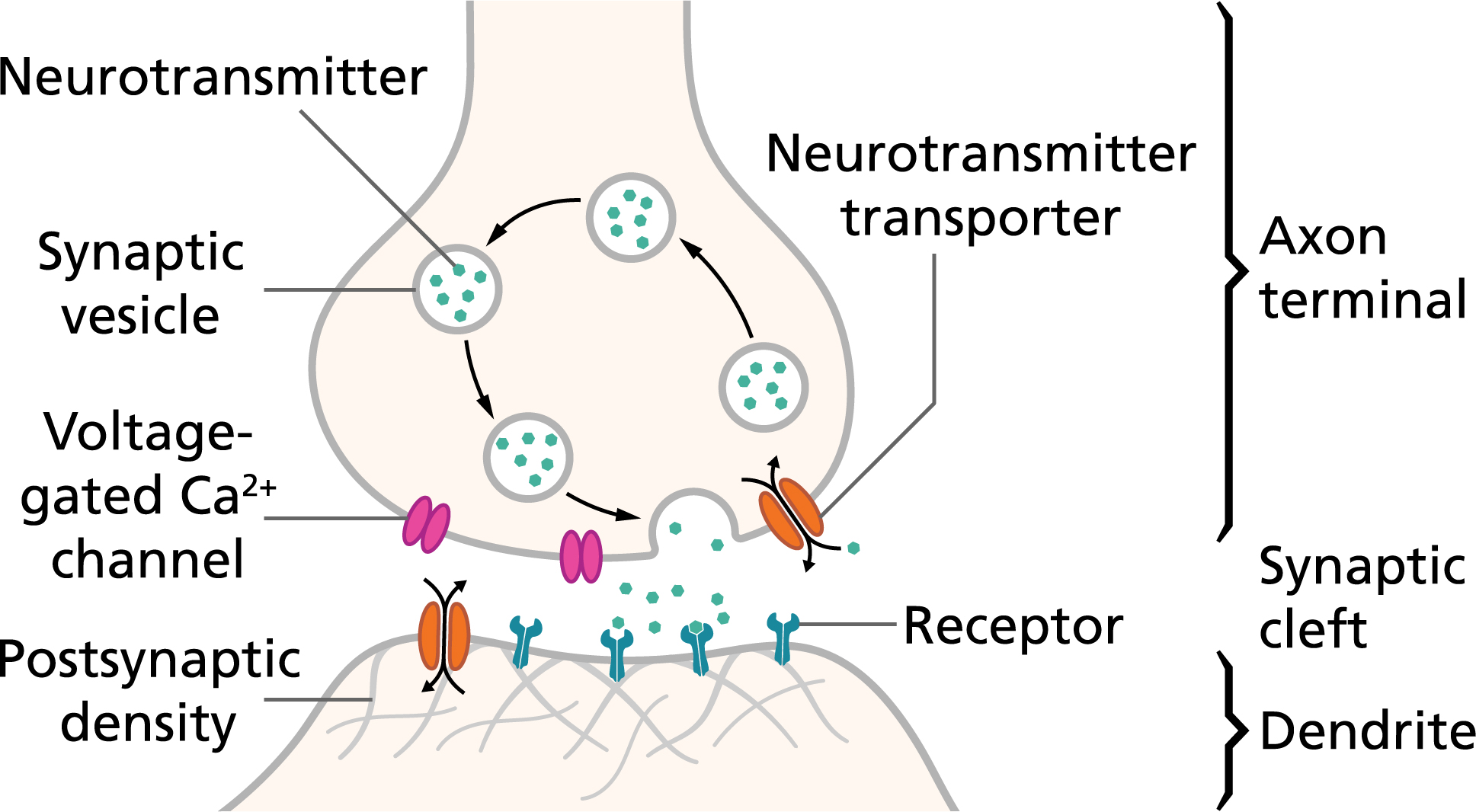
Notice how location and action help identify each job. The voltage-gated calcium channels in the upper membrane provide a route for calcium ions when open; they do not manufacture neurotransmitter. The labelled receptors on the lower membrane detect transmitter that reaches them across the cleft. The neurotransmitter transporter in the upper membrane provides a route for transmitter to be taken back into the terminal. The membrane-bound vesicles are storage compartments, not a fifth kind of protein.
Where is the enzyme? No enzyme is explicitly labelled in this simplified drawing. Enzymes involved in making or breaking down a neurotransmitter can act within cells or, depending on the transmitter and enzyme, in other locations. You should not relabel the depicted transporter as an enzyme merely because both can help end a signal: one transfers molecules; the other catalyses a chemical change.
The diagram also illustrates why a protein’s position alone is not enough to classify it. A receptor is often shown on the receiving side, but receptors can also occur on the releasing side. A channel may be present in either membrane. To identify a protein reliably, look for what binds to it, whether anything passes through or is carried across the membrane, and whether a substance is chemically changed.
Takeaways
The four labels identify functions, not four mutually exclusive kinds of molecule. Receptors detect signals; channels offer selective ion passages; transporters transfer cargo across membranes; enzymes catalyse chemical changes. A ligand-gated receptor can also be a channel, while dopamine receptors signal without forming their own ion pore. In a synapse, receptor binding, transmitter reuptake, and enzymatic breakdown are different events even though all can affect signalling.
Next, you’ll examine the conditions that determine which direction an ion tends to move when a channel opens. That will connect these protein jobs to the electrical behaviour of a neuron.