Hello! Welcome to your next lesson in the Market Structure Fundamentals module.
In our last session, we established the rules for defining market trends. You learned that a bullish market creates a sequence of higher highs (HH) and higher lows (HL), while a bearish market forms lower lows (LL) and lower highs (LH). We also stressed the importance of using candle body closes to confirm these structural points.
Today, we build directly on that foundation. If the last lesson was about identifying a stable trend, this lesson is about confirming when that trend has the strength to continue. We will be learning how to identify a Break of Structure (BOS), which is the specific event that signals the continuation of institutional order flow in a trending market.
Mastering this concept is crucial. A BOS provides objective confirmation that your read on the market direction is correct and that the trend is likely to keep moving.
1. What is a Break of Structure (BOS)?
A Break of Structure, or BOS, is the event that confirms the continuation of the current trend. It happens when price moves with energy beyond a previously established swing point in the direction of the trend.
- In a bullish trend (an uptrend), a BOS occurs when price breaks and closes above the most recent higher high (HH).
- In a bearish trend (a downtrend), a BOS occurs when price breaks and closes below the most recent lower low (LL).
Think of it as the market "endorsing" the current trend by pushing past its previous boundary.
Let's look at a diagram and a real chart example.

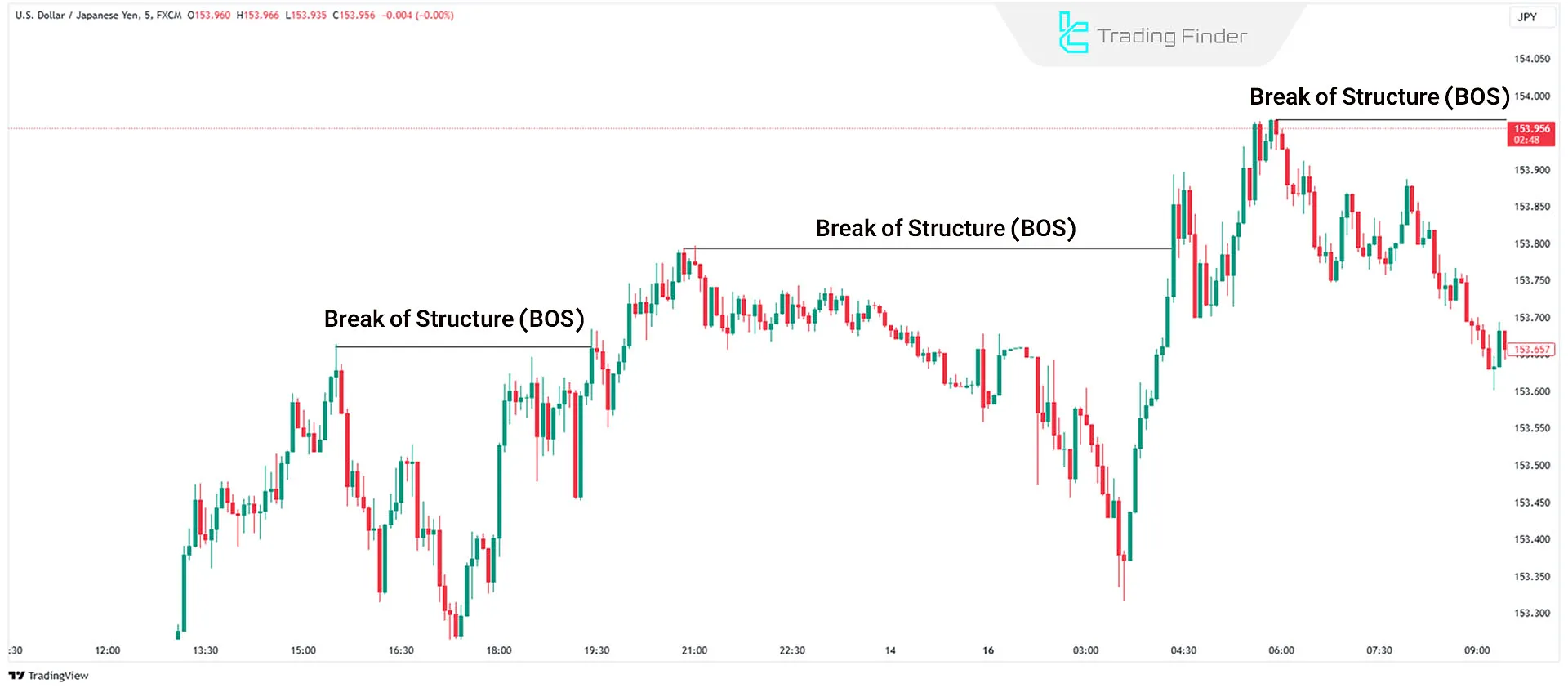
2. The Two Golden Rules of a Valid BOS
Not every poke above a high or below a low is a valid BOS. In ICT, a true BOS must satisfy two critical conditions. Mistaking a false break for a real one is a common pitfall, so these rules are essential.
Rule #1: Confirmation by Candle Body Close
As we established in the last lesson, wicks represent probes into a price level, but bodies represent acceptance. A true Break of Structure requires a candle to close with its body beyond the prior swing point.
- A wick piercing a high or low and then retreating is often a liquidity sweep (or stop hunt). This is a trap, designed to fool traders into thinking the trend is continuing, right before it reverses. It is a sign of weakness, not strength.
- A candle body closing beyond the level shows genuine commitment and tells you that the market was willing to accept prices beyond the old structure.
Rule #2: The Break Must Have Displacement
The character of the break matters just as much as the break itself. A valid BOS should be an energetic, powerful move. ICT refers to this as displacement.
Displacement is characterized by large, decisive candles that move quickly through the price level. It indicates that institutional capital is forcefully driving the market in the direction of the trend. A break that slowly grinds through a level with small, overlapping candles is weak and untrustworthy.
To understand this crucial difference, let's watch the introduction to a video that explains it perfectly.
Stop Losing Trades from False Break of Structures! (BOS) | ICT Concepts
The video 'Stop Losing Trades from False Break of Structures!' by Justin Werlein provides an excellent explanation of displacement. We'll focus on the first part where he contrasts a weak break (a sweep) with a strong, displaced break (a true BOS).
Watch from the beginning to 02:20. Pay close attention to the visual distinction he draws between a liquidity sweep and a valid break of structure with displacement.
3. A Systematic Approach to Identifying BOS
Now that you know the rules, let's consolidate this into a systematic process. The following reading provides a clear, step-by-step guide to identifying BOS, reinforcing the concepts we've just discussed.
Break of Structure (BOS) Trading Guide - Alchemy Markets
The 'Break of Structure (BOS) Trading Guide' from Alchemy Markets is a very well-structured article that aligns perfectly with our learning goals today. It will serve as our core reference text.
Please read the following sections from the article: Start with 'How to Identify the Break of Structure'. Continue through 'Identifying Bullish BOS' and 'Identifying Bearish BOS'. Finish with 'The Three Stages in BOS'. This section provides an excellent summary of the process: Structure Formation, The Break, and Confirmation. Focus on how the article reinforces the importance of a candle close and a decisive, impulsive move.
4. Practice: Spotting BOS on the Charts
Theory is one thing, but identifying these patterns in real-time is the skill you need to develop. Let's return to the video from Justin Werlein and watch how he applies these rules to find valid trading opportunities based on a BOS.
Stop Losing Trades from False Break of Structures! (BOS) | ICT Concepts
Now we'll watch some of the practical examples from the same video. Observe how the trader waits patiently for a clear break with displacement before considering a trade.
Watch the two examples from 02:20 to 06:25. In the first example (starting at 02:20), notice how he identifies a liquidity sweep first, then waits for a clear BOS to the downside with displacement before looking for a short entry. In the second example (starting at 04:41), he shows a bullish setup. Notice again how the initial move above the high is a weak sweep, and he waits for the strong, displaced move before confirming the BOS to the upside.
This practice of distinguishing between a weak sweep and a strong break is a fundamental skill in ICT. Always prioritize the quality and character of the move.
Conclusion
Great work today. You have now learned to identify one of the most important events in price action analysis: the Break of Structure. This moves you from simply identifying a trend to confirming its health and continuation.
Key Takeaways:
- A Break of Structure (BOS) confirms the continuation of the current market trend.
- A Bullish BOS is a candle body close above a previous higher high.
- A Bearish BOS is a candle body close below a previous lower low.
- A valid BOS must have two key ingredients: a candle body close and displacement (a strong, energetic move).
- A wick that breaks a level without a body close is often a liquidity sweep, a potential sign of reversal, not continuation.
Preview of the Next Lesson:
We've now defined a trend and identified how it continues (BOS). The logical next question is, "How do we spot the first sign that a trend might be ending or reversing?" In our next lesson, we will cover the Change of Character (CHoCH). This is the structural break that works in opposition to the trend and gives you the earliest objective clue that the market's direction may be about to change.