Welcome back. The previous lesson explained why some Catholics hoped James I would ease religious restrictions, and why a small militant group came to reject that prospect. This lesson moves from the pressures behind the Gunpowder Plot to the people who organised it. Guy Fawkes was indispensable to the attempt, but Robert Catesby led it. The distinction becomes clearer when you see what the other conspirators supplied: trusted contacts, access to Westminster, money, horses, weapons, and help guarding the gunpowder.
Catesby built the conspiracy
Robert Catesby was not simply another man standing beside Fawkes. He conceived the attack on Parliament and brought others into it. His earlier involvement in rebellion had already drawn official attention, but he also had something the plot required: close relationships among Catholic gentry who might trust him with a dangerous secret.
Read the short account below for the difference between originating a plan and recruiting people capable of carrying it out.
Robert Catesby - UK Parliament
Read UK Parliament’s account of Catesby’s background and the beginnings of his recruitment. It provides a useful factual foundation before the documentary’s more dramatic presentation.
Read the opening biographical paragraphs and the “Dangerous” subsection. Begin with Catesby’s recruitment, and stop before “Discovery.” Notice the distinction between the people he first approached and those brought in as the undertaking grew.
The account identifies Christopher and John Wright and Thomas Winter among Catesby’s early confidants. In May 1604 he disclosed the plan to Guy Fawkes and Thomas Percy; other men joined later. That pattern matters. Catesby did not assemble a ready-made organisation and hand it a task. He expanded a circle of trusted people as the plan’s practical needs grew—and each addition also meant another person knew the secret.
The documentary below conveys why Catesby, rather than Fawkes, is described as the leader. Its reconstructions are useful for visualising roles, but treat spoken dialogue and confident judgments about personalities as dramatisation, not as a transcript of private meetings.
The Gunpowder Plot: How Close Did Guy Fawkes Actually Get To Blowing Up Parliament? | Chronicle
Watch “The Gunpowder Plot: How Close Did Guy Fawkes Actually Get To Blowing Up Parliament?” from Chronicle – Medieval History Documentaries to contrast Catesby’s leadership with Fawkes’s practical experience.
Watch Catesby’s leadership, focusing on who proposed the attack and gathered supporters. Then watch Fawkes’s role, focusing on why his military experience made him valuable. Set aside the documentary’s character judgments and concentrate on the different work each man was expected to do.
Catesby supplied direction: he persuaded recruits, sustained the undertaking, and sought people and resources for its later stages. Leadership did not mean he could accomplish the attack alone. To place gunpowder near Parliament and prepare a wider revolt, he depended on others’ skills, property, and connections.
Fawkes made the attack practicable
Fawkes had served as a soldier with Catholic forces in the Spanish Netherlands. His experience with gunpowder and military operations made him a strong choice to manage the explosive part of the plan. He helped oversee the powder, guarded it near the intended target, and was to ignite it. He was a committed conspirator exercising judgment, not merely a hired technician. But technical responsibility is different from conceiving and leading the conspiracy.
Thomas Percy supplied a different kind of access. His position and connections helped him obtain lodgings at Westminster, giving the plotters a base close to Parliament. Powder could be acquired, but without a way to bring it near the intended site and keep it concealed, Fawkes’s expertise would have served little purpose. In turn, Percy’s access would have achieved nothing without someone to manage the powder.
This is why the best-known name can obscure the structure of the plot. Fawkes became its most visible figure because he was found with the gunpowder. That explains his prominence in the later story; it does not make him its originator.
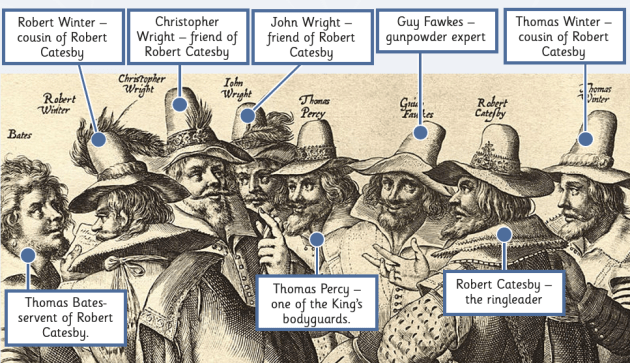
The labelled figures show how heavily Catesby drew on personal ties. They also show the limits of a picture centred on famous faces. Several people essential to the plot’s supplies and intended continuation appear only when we look beyond it.
A network of recruits, supplies, and access
UK Parliament’s overview gives a compact account of the wider group. Read the named entries as descriptions of different contributions, rather than as a list of interchangeable plotters.
People behind the Gunpowder plot - UK Parliament
Read UK Parliament’s overview to place Fawkes and Catesby within the wider conspiracy. Its brief entries are especially helpful for separating early recruitment, care of the powder, weapons, and financial support.
In the main article, read the introductory paragraph and every named entry, from “Thomas and Robert Winter” through “Guy Fawkes”; stop before the “In this section” navigation. Begin with the introduction. The Winter entry distinguishes early and later recruitment. Pay particular attention to powder and weapons and service and funds.
Thomas Winter belonged to Catesby’s early circle and helped bring Fawkes into it. John Wright was another early associate; his brother Christopher was also involved. These relationships were valuable because secrecy made trust crucial. They did not, however, provide everything the undertaking needed. As preparations expanded, Catesby recruited people for more specific purposes.
Robert Keyes helped look after the gunpowder. Thomas Bates, Catesby’s servant, became involved in supporting the preparations. John Grant obtained weapons. These may sound like supporting tasks beside Fawkes’s intended act, but an attack requiring stored powder and a subsequent armed effort could fail if those tasks were neglected. The conspirators depended on people who could guard materials, make arrangements, and prepare for what they hoped would follow the explosion.
The documentary offers a glimpse of the work surrounding the powder:
The Gunpowder Plot: How Close Did Guy Fawkes Actually Get To Blowing Up Parliament? | Chronicle
Return briefly to the Chronicle documentary for its account of the helpers and the accumulation of gunpowder.
Watch the helpers for Bates and Keyes. Then watch the powder for the problem of moving and storing it. The point is the coordination required, rather than the documentary’s comparisons of explosive force.
Money and transport created another set of needs. Ambrose Rookwood and Sir Everard Digby were brought in partly because their wealth could support the conspiracy; horses were also important to the movement of men after the proposed attack. Francis Tresham, a late and reluctant recruit, was sought for his resources and connections. It is more accurate to say that Catesby wanted such resources than to assume every wealthy recruit provided equal sums or embraced the plan equally. Thomas Winter’s brother Robert joined later too, extending the circle of people on whom Catesby hoped to rely.
A useful way to keep the roles distinct is to group them by the problem they addressed:
| Need | Principal people and contributions |
|---|---|
| Direction and recruitment | Catesby conceived and led the undertaking; early associates such as Thomas Winter and the Wright brothers helped form its trusted circle. |
| Westminster access and the proposed explosion | Percy secured nearby lodgings; Fawkes supplied military experience and took charge of the gunpowder operation, with help including Keyes and Bates. |
| Resources for continued action | Grant obtained weapons; Rookwood and Digby were recruited for wealth and horses; Catesby sought Tresham’s resources and connections. |
These are not exclusive job titles. A conspirator might be trusted as a friend, provide money, and take part in later plans. The groupings show why expanding the conspiracy seemed useful to Catesby, while also showing why it became harder to keep secret.
Why the circle kept growing
Catesby intended more than one violent moment at Westminster. He hoped that after the attack, supporters could mount an armed rising in the Midlands. That prospect helps explain the recruitment of people with horses, weapons, wealth, and regional connections. A stockpile of powder addressed the attack itself; it could not by itself secure political power afterward.
Watch the final short passage with that distinction in mind. The documentary describes Catesby’s hopes for a mounted rising, but its assessments of how likely that rising was to succeed are interpretations, not measurements.
The Gunpowder Plot: How Close Did Guy Fawkes Actually Get To Blowing Up Parliament? | Chronicle
Watch the Chronicle documentary’s discussion of later recruitment to see why the plot required resources beyond those needed at Westminster.
Watch later recruits for Grant, Christopher Wright, and Robert Winter. Then watch horses and rising, focusing on why Catesby approached Rookwood and Digby and why he expected help from other Catholics. Treat that expected support as the plotters’ hope, not as evidence that English Catholics generally backed them.
The widening circle exposes a tension in Catesby’s leadership. Every additional recruit might solve a problem: gaining access, safeguarding powder, obtaining weapons, raising money, or securing horses. Every recruit also increased the danger of disagreement or disclosure. And the plotters’ hope of broader Catholic support should not be mistaken for a commitment by Catholics as a whole. As the previous lesson established, sharing a faith or suffering restrictions did not mean supporting mass violence.
Conclusion
The Gunpowder Plot was Catesby’s conspiracy, not Fawkes’s independent scheme. Catesby originated and directed it; Fawkes brought the experience and took the operational role needed for the proposed explosion. Percy’s access, the help of Keyes and Bates, Grant’s weapons, early associates’ trust, and later recruits’ wealth and horses made the undertaking a network rather than a two-person story. Those contributions also reveal its vulnerability: a plan demanding many people and resources was difficult to conceal.
The next lesson follows the political purpose behind that network. It examines how the plotters imagined turning the destruction at Parliament into a Midlands rising and a new monarchy—and the gap between what they intended and what they could plausibly achieve.