Hello! Welcome back to our module on "Storytelling for Impact."
In our last lesson, we broke down the architecture of compelling stories, identifying the core elements of Setup, Conflict, and Resolution within the three-act structure. We also touched upon the "But and Therefore" rule as a way to create narrative momentum.
Today, we move from analysis to creation. Your goal is to construct a simple narrative arc within a short anecdote. An anecdote is a powerful tool for a writer like you. It allows you to take a grand philosophical idea—something abstract and cosmic—and ground it in a small, relatable, human story. This is a key technique for making complex thoughts clear and engaging, which is central to your goal of using writing as a medium for thought.
1. The Anecdote: A Story in Miniature
So, what exactly is an anecdote? It's simply a short, interesting story about a real incident or person. Think of it as a narrative snapshot. While a full story might be a feature film, an anecdote is a single, well-composed scene that makes a point.
Anecdote: Definition, Examples, and Usage
To get a formal definition and see the different hats an anecdote can wear, let's look at this article from Grammarly. It neatly defines the concept and gives examples of different types.
Read the introductory section ('Key takeaways') and then the 'Types of anecdotes' section. As you read, notice how anecdotes can be personal, humorous, or even cautionary. Think about how you might use these different types in your own writing.
As you can see, anecdotes are versatile. A humorous anecdote can disarm the reader before you introduce a serious point, while an inspirational one can give emotional weight to a philosophical argument.
2. The Blueprint of an Anecdote
Like the larger stories we studied, anecdotes have a structure. They are not just random recollections; they are carefully shaped to have an impact. The three-act structure of Setup, Conflict, and Resolution applies here too, just in a more compressed form.
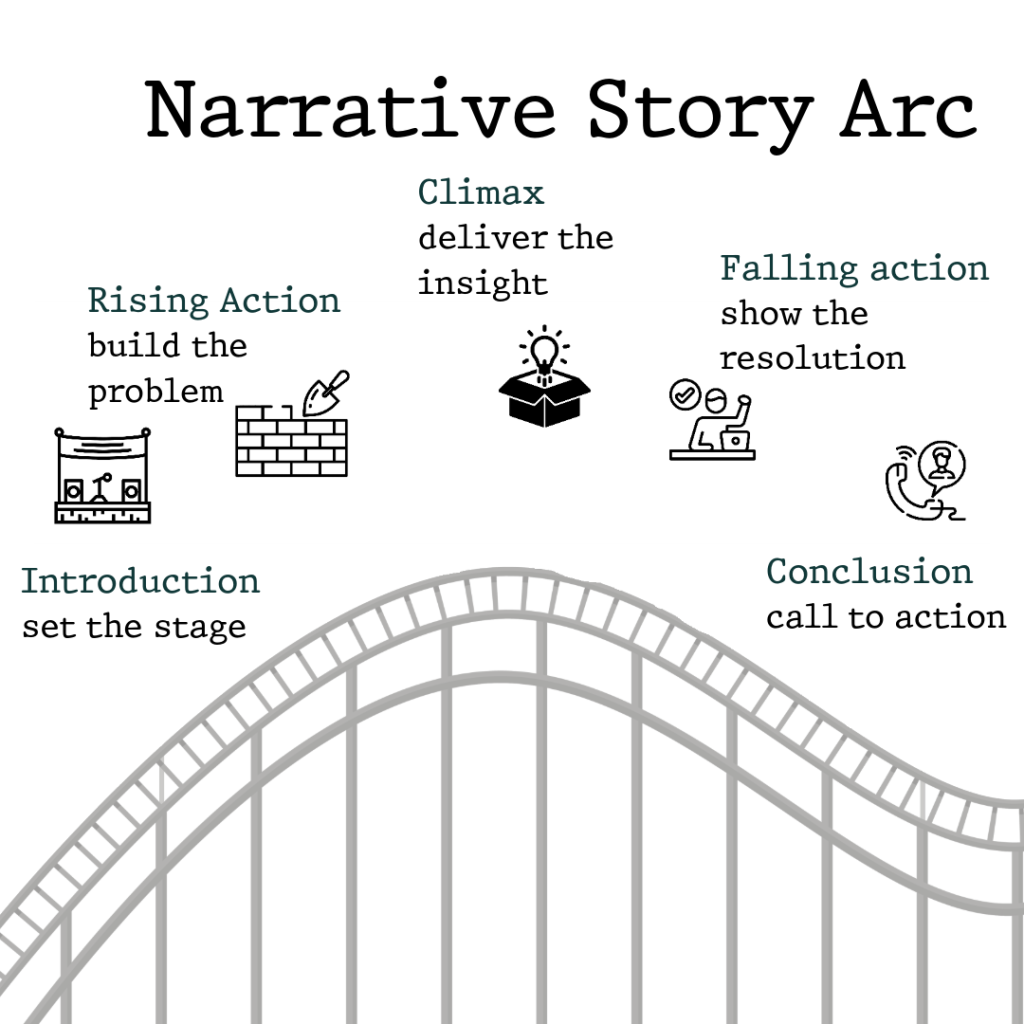
Let's look at a few practical frameworks for building this arc.
Framework 1: The Basic Arc (Setup, Event, Takeaway)
The simplest way to think about an anecdote's structure is a three-step process.
Anecdote: Definition, Examples, and Usage
The Grammarly article we just looked at also provides a very clear, simple structure for an anecdote. This is a great starting point.
Read the section titled 'Structure of an anecdote.' Notice how it maps directly to Setup ('Setting the scene'), Conflict ('The key event'), and Resolution ('The takeaway').
This structure ensures your story has a beginning, a middle, and an end, and crucially, a point.
Framework 2: The ABCDE Model
For a slightly more detailed and actionable blueprint, we can use the "ABCDE" framework. This model breaks the arc down into five clear steps, making it very easy to follow when you're writing.
How To Write A Punchy Personal Story
This article, 'How To Write A Punchy Personal Story,' offers a fantastic step-by-step guide. We'll focus on its ABCDE framework for constructing a narrative arc.
Read 'Step 4: Build the narrative arc.' Pay close attention to the definition of each letter (Action, Background, Development, Climax, Ending) and the simple hiking story example. This is the framework we'll use for our exercise.
The ABCDE model is like an algorithm for storytelling:
- A (Action): Start in media res (in the middle of the action).
- B (Background): Give just enough context for the action to make sense.
- D (Development): Build the tension. This is where you use "but" to introduce a problem.
- C (Climax): The peak moment of conflict or realization.
- E (Ending): The resolution and the takeaway. This is where "therefore" explains the consequence or lesson.
3. A Model for the Screen: The 60-Second Story
Since you're interested in writing for YouTube, it's worth seeing how this structure adapts to a fast-paced, visual medium. Great video essays often use quick, punchy anecdotes to keep the audience hooked.
The Secret to Telling a Great Story — in Less Than 60 Seconds | Jenny Hoyos | TED
In this TED talk, 'The Secret to Telling a Great Story — in Less Than 60 Seconds,' Jenny Hoyos breaks down her framework for viral stories. Notice how her model—Question, Journey, Conflict, Answer—is another variation of the same fundamental narrative arc.
Watch from 00:35 to 03:32. Focus on how she uses a hook (a shocking question), shows progression (the journey), introduces a problem (the conflict), and provides a satisfying conclusion (the answer). This is a masterclass in narrative efficiency.
4. Your Turn: Constructing an Anecdote
Now it's time to put this into practice. A common hurdle for writers is believing their own life isn't interesting enough for stories. That's a myth. Stories are everywhere, hidden in plain sight. The trick is learning to spot them.
Part 1: Find a Story (5 minutes)
Let's use a technique from the "Punchy Personal Story" article called "Homework for Life."
- Reflect: Take a moment to think about your day yesterday or this morning.
- Identify an event: What was a small moment that stood out? It doesn't need to be dramatic. It could be a moment of frustration (a math problem you couldn't solve), a moment of surprise (an unexpected conversation), or a moment of quiet observation (seeing something interesting on your way to school).
- Write one sentence: In your notes, write a single sentence describing that moment.
Example: "I spent twenty minutes trying to prove a geometric identity, getting more and more frustrated with each failed attempt."
Part 2: Build the Arc (15 minutes)
Now, take that one-sentence idea and build it into a short anecdote of about 100-150 words using the ABCDE framework.
- A (Action): Start with the action. e.g., "The pencil snapped in my hand."
- B (Background): Why were you doing this? e.g., "For twenty minutes, I’d been wrestling with a single line in my geometry homework."
- D (Development): What was the struggle? e.g., "I'd tried substitution, then drawing auxiliary lines, but every path led to a tangle of variables that told me nothing."
- C (Climax): What was the turning point? The "aha!" or "oh no!" moment. e.g., "Frustrated, I leaned back and just stared at the diagram. And then I saw it—not as a collection of lines, but as two overlapping, similar triangles I had completely missed."
- E (Ending): What was the result and the lesson? e.g., "Suddenly, the proof was a trivial three steps. I realized I hadn't been stuck on the math; I'd been stuck on my own narrow perspective."
Go ahead and write your own anecdote based on the moment you identified. Don't worry about making it perfect; focus on clearly hitting each of the five ABCDE beats.
Test your understanding!
Once you've written your anecdote, review it. Can you clearly label which sentence(s) correspond to Action, Background, Development, Climax, and Ending? Does the story flow logically from one beat to the next, perhaps using an invisible "but" and "therefore" to connect the parts?
Show an example breakdown
Let's break down the sample anecdote about the geometry problem:
- Action: "The pencil snapped in my hand." (Drops us right into a moment of frustration).
- Background: "For twenty minutes, I’d been wrestling with a single line in my geometry homework." (Tells us why the pencil snapped).
- Development: "I'd tried substitution, then drawing auxiliary lines, but every path led to a tangle of variables that told me nothing." (Shows the escalating struggle).
- Climax: "Frustrated, I leaned back and just stared at the diagram. And then I saw it—not as a collection of lines, but as two overlapping, similar triangles I had completely missed." (The key "aha!" moment of insight).
- Ending: "Therefore, the proof was a trivial three steps. I realized I hadn't been stuck on the math; I'd been stuck on my own narrow perspective." (The resolution of the problem and the broader lesson learned).
Conclusion
Excellent work today. You've successfully moved from being a spectator of story structure to being an architect. You've learned how to find small, meaningful moments in your own life and shape them into anecdotes with a clear and satisfying narrative arc.
Key Takeaways:
- An anecdote is a short story used to illustrate a point in a relatable way.
- Anecdotes follow the same narrative arc as longer stories: setup, conflict, and resolution.
- The ABCDE framework (Action, Background, Development, Climax, Ending) is a practical tool for constructing an anecdote's arc step-by-step.
- Story-worthy moments are everywhere; the practice of "Homework for Life" helps you notice and capture them.
A Look Ahead:
You now have the skeleton of a story. In our next lesson, we will start adding flesh to those bones. We will focus on how to use specific sensory details and scenes rather than abstract summary, transforming a simple sequence of events into a vivid and immersive experience for your reader.