Hello! In our last lesson, we explored how to break the fourth wall to create a direct, personal connection with your audience. We saw how writers and video essayists use this technique to build rapport, inject humor, and make their work more engaging.
Today, we'll delve into a specific, powerful reason to use that author-reader connection: to acknowledge limitations or uncertainties within your own argument. This might seem counterintuitive. Won't admitting uncertainty make your argument weaker? On the contrary. When done skillfully, it demonstrates intellectual honesty, builds immense trust, and ultimately makes your writing more credible. This is a hallmark of the thoughtful, self-aware style you admire, showing you're a curious guide, not a dogmatic lecturer.
1. The Surprising Strength of "I Might Be Wrong"
In fields you're familiar with, like physics and philosophy, progress is built on questioning assumptions and acknowledging the boundaries of current knowledge. A good scientist or philosopher doesn't claim to have all the answers; they are clear about their premises, methods, and the potential for being wrong. This very process is what makes their conclusions trustworthy.
The same principle applies to writing. When you openly acknowledge that your perspective is incomplete, or that a topic is more complex than your argument can fully capture, you're not showing weakness. You're showing respect for the topic and for your reader's intelligence. This practice is often called Intellectual Humility.
To understand this concept better, let's turn to some research on the topic.
What is Intellectual Humility? How It Works And How To Develop It
The article 'What is Intellectual Humility?' by Shane Snow offers a comprehensive overview of this virtue. It explains why being aware of our own fallibility is so powerful.
Please read the first three main sections of this article. Start from the beginning ('The Power of Intellectual Humility'), continue through the section defining it ('Intellectual Humility: A Better Way...'), and stop after reading the section 'Lack of Intellectual Overconfidence'. Focus on: The definition of intellectual humility as a 'nonthreatening awareness of one’s intellectual fallibility'. The four components that result from this awareness. Ben Franklin's 'I could be wrong, but...' technique as a practical example.
The article lays out four key pillars of intellectual humility, which are worth remembering:
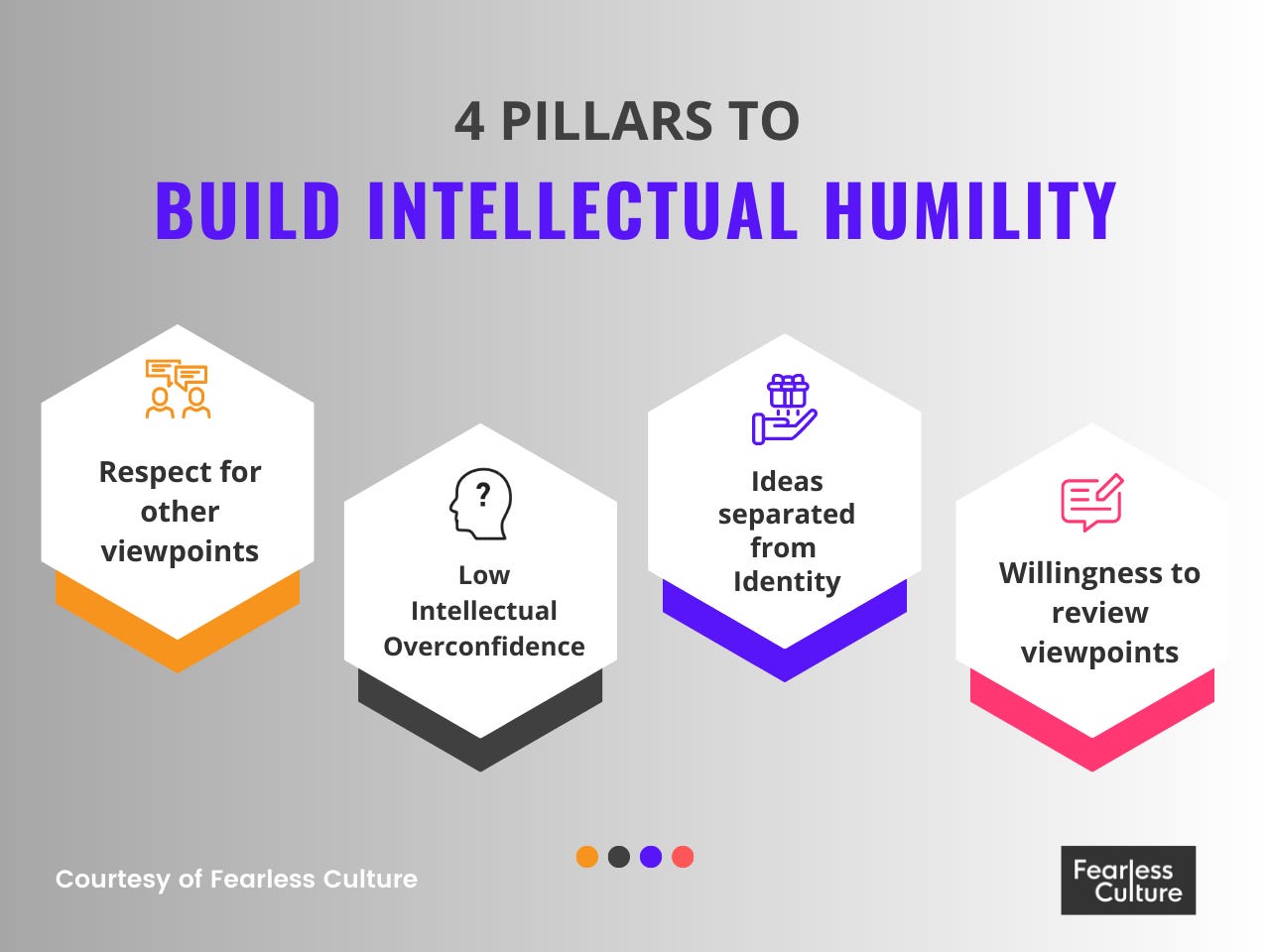
By practicing these, you shift the goal from "winning" an argument to "exploring" an idea. This invites the reader to think alongside you, making them a partner in discovery rather than a passive recipient of your unshakeable conclusions.
2. The Writer's Toolkit for Showing Humility
So, how do you translate this philosophical concept into actual sentences? There are several techniques, ranging from subtle linguistic choices to overt, conversational asides.
Technique 1: Cautious Language (Hedging)
One of the most common methods, especially in formal or academic writing, is "hedging." This involves using words and phrases that qualify your statements, making them less absolute.
Instead of saying: "This proves that..."
You might say: "This suggests that..."
Instead of: "People always do this."
You might say: "People tend to do this."
This isn't about being evasive; it's about being precise. You are calibrating the strength of your claim to the strength of your evidence.
Hedging (cautious language) in Academic Writing
The video 'Hedging (cautious language) in Academic Writing' from EAPFoundation.com provides a very clear, structured breakdown of the specific words you can use.
Watch the sections that cover three key types of hedging, from 2:20 to 4:45. Pay close attention to the examples for: Introductory verbs (e.g., tend to, seem to, suggest) Modal verbs (e.g., may, might, could) Adverbs (e.g., possibly, arguably, perhaps)
This toolkit of "cautious words" gives you the precision to state what you think without overstating your case.
Technique 2: Direct Concessions and Disclaimers
In the more conversational and humorous style of video essays, writers often acknowledge their limitations much more directly. This connects perfectly with what we learned about breaking the fourth wall. You can simply turn to the audience and tell them where your argument might be thin or oversimplified.
Let's look at how video essayist David Achu does this. His work is a great example of meta-commentary where he reflects on his own creative process.
This is a video essay about video essays
In 'This is a video essay about video essays', David Achu masterfully demonstrates intellectual humility by openly discussing the limitations of his own work.
Watch these three short clips: Disclaimer (0:22 - 0:46): Notice how he explicitly tells the audience he's going to simplify his terms. Self-Correction (3:03 - 3:17): See how he admits mid-sentence that a creative analogy he planned isn't working as well as he'd hoped. The Researcher's Struggle (12:10 - 14:43): This is a brilliant, extended metaphor about the difficulty of presenting information accurately without losing all nuance. It's a deep acknowledgment of the inherent limitations of summarizing complex topics.
Achu’s style shows that acknowledging limitations can be a source of humor and relatability. When he admits his analogy is failing or that he spent hours over-researching a simple point, he’s not losing credibility; he’s gaining it by being honest and funny about the messy reality of thinking and writing.
Test your understanding!
In the David Achu clip about researching the blue sky (the alien example), what is the core limitation he is acknowledging about his own writing process?
Show answer
The core limitation is the tension between accuracy and clarity. He shows that trying to be perfectly, comprehensively accurate can lead to a confusing spiral of exceptions and qualifications ("...but the sky can be orange... but it's a spectrum..."). The limitation is that to make a clear point (The sky is blue), a writer often has to make a simplification that isn't, technically, the whole truth. He is acknowledging the inherent difficulty of representing complex reality in simple language.
3. Practice: Infusing an Argument with Humility
Now it's your turn to apply these techniques. Below is a paragraph that makes a very strong, absolute claim about a philosophical topic. Your task is to rewrite it to be more credible by acknowledging its limitations.
Original Paragraph:
Free will is an illusion. Every choice we make is predetermined by a chain of cause and effect stretching back to the beginning of time. Our brain is just a complex biological computer running a program it didn't write. Therefore, personal responsibility is a meaningless concept created by society to control people.
Your Task:
Rewrite this paragraph (it can be longer than the original). Your goal is to keep the core argument but make it more nuanced and credible. Incorporate at least two of the following techniques:
- Hedging: Use cautious words (seems, suggests, might, arguably).
- Direct Concession: Add a sentence that explicitly admits a simplification or a part of the problem you aren't addressing (e.g., "Of course, this viewpoint struggles to account for...").
- Acknowledging a Counterargument: Briefly mention an opposing idea (e.g., "While some might point to [X] as evidence of free will...").
Take about 15 minutes to craft your new paragraph. Try to make it sound like a thoughtful exploration rather than a rigid declaration.
Conclusion
Today, we've explored the counterintuitive idea that admitting uncertainty can strengthen your writing. By embracing intellectual humility, you build a relationship of trust with your reader and present yourself as a more thoughtful, credible guide.
Key Takeaways:
- Acknowledging limitations is a strength, not a weakness. It shows intellectual honesty and respect for complexity.
- This practice builds credibility and trust with your audience, inviting them to participate in your thought process.
- You can do this through subtle hedging (using words like may, suggests, arguably) or through direct, conversational concessions, which are common in the video essay style.
A Look Ahead:
This lesson is the perfect foundation for our next topic, where we will take this self-awareness one step further. We will learn how to examine one of your own biases or assumptions explicitly in a reflective piece. This moves from acknowledging general uncertainty to introspectively questioning the very lens through which you see the world.