Hello! Welcome back to our final module, "The Writer's Craft: Revision and Feedback."
In our last lesson, we established a crucial mental framework: the separation of the creative "drafter" from the analytical "editor." You embraced the idea of a "shitty first draft" to get your ideas onto the page without judgment. Now that you have that complete draft—the raw clay—it's time to put on your editor's hat and begin the work of sculpting.
Today, we will focus on the first and most important phase of editing. Our learning outcome is to perform a 'macro' revision of a complete piece, focusing on structure, argument, and clarity.
Think of this as the architectural phase of building. Before you worry about the color of the paint or the style of the furniture (word choice, sentence rhythm), you must ensure the foundation is solid, the walls are in the right place, and the overall structure is sound. For your philosophical essays and video scripts, a strong macro-structure is what makes an argument persuasive and a complex idea easy to follow.
1. From Writer-Centric to Reader-Centric: The Goal of Macro Revision
A first draft is often, by necessity, a "writer-centric" document. It's the record of you figuring out your own thoughts. Macro revision is the process of transforming that internal monologue into a "reader-centric" dialogue. You are recasting your ideas to be as clear, logical, and impactful as possible for your audience.
Ignoring this stage is a common mistake. You can have brilliant ideas and witty sentences, but if the underlying structure is confusing, your reader will get lost and your argument will fail.
The following resource explains why this "architectural overhaul" is so vital.
Master the 5 step writing process for faster content
The article 'Master the 5 step writing process for faster content' by Unkoa makes a sharp distinction between revision and editing. We'll focus on its description of 'The Architect's Revision' to understand why this macro-level work is the most critical part of turning a draft into a powerful piece.
Please read the section titled 'Step 3: The Architect's Revision (Content & Organization),' up to but not including the sub-heading 'A Practical Playbook.' Focus on the distinction between revision and editing, and the reasons why this 'reader-centric' transformation is so important.
As the article argues, revision is about perfecting your argument, not your prose. It's where you ensure your ideas are not just present, but are presented in the most logical and persuasive order.
2. The Architect's Toolkit: Two Powerful Techniques
To perform a macro revision, you need a way to step back and see your work from a high level. We'll cover two complementary techniques to help you do this.
Technique 1: The Self-Interview (Clarifying Your Intent)
Before you can fix the structure of your argument, you must be absolutely clear about what you're trying to achieve. This first technique involves taking a moment to "interview yourself" to rediscover the core purpose of your piece.
A brief period of distance from your draft helps immensely. You don't need to wait three months, as some novelists do, but stepping away for a day or even a few hours allows you to return with fresh eyes.
The following video, though aimed at novelists, provides an excellent set of questions for this self-interview process.
How to REVISE a Novel (My Step-By-Step Revision Guide) ✏️
In this clip from 'How to REVISE a Novel,' Abbie Emmons outlines how she creates a 'revision guide' by asking herself a series of high-level questions about her story. We can adapt these questions to be about our argument and reader.
Please watch the segment from 03:42 to 08:17. Pay close attention to the questions she asks herself, such as the core message, the intended reader feeling, and the overall transformation.
Here are those questions, adapted for a philosophical essay or video script:
- The Core Idea: What is the most exciting or compelling idea in this draft? What part made you most passionate while writing?
- The Thesis: What is the single, clear message or argument you want your audience to understand? Try to state it in one sentence.
- The Reader's Journey: How do you want your reader's perspective to change from the beginning to the end of the piece? What do you want them to feel or think differently about?
- Anticipated Problems: What were you worried about while drafting? (e.g., "I'm afraid the connection between my examples is weak," or "I fear the ending is rushed.")
Answering these questions before you start marking up your draft gives you a compass. It defines "north" for your revision, so you can see where your current draft has strayed from the path.
Technique 2: Reverse Outlining (Analyzing Your Structure)
While the self-interview clarifies your intended argument, a reverse outline reveals the argument you actually wrote. This is a powerful, logical tool that is perfectly suited to an analytical mind. Instead of creating an outline to guide your writing, you create an outline from your finished draft to diagnose its structure.
This short video provides a quick overview of the concept.
This video from the Texas A&M University Writing Center clearly explains the 'what' and 'why' of reverse outlining.
Watch the full video (it's short!). Focus on how it helps you see disconnects, gaps, or overlaps in your writing.
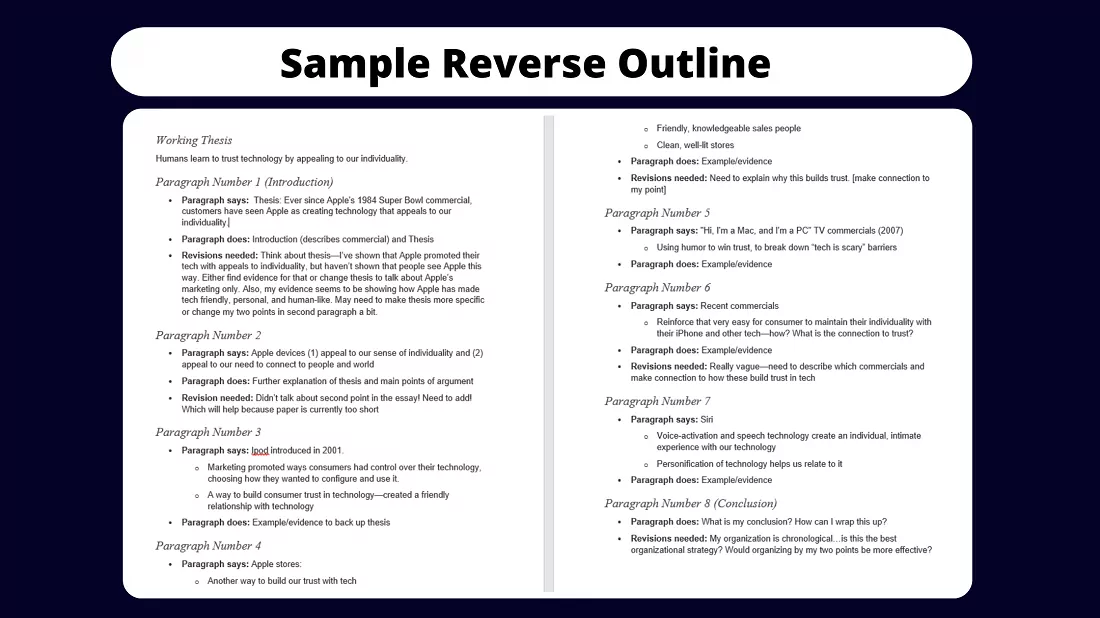
To make this more concrete, a great method is the "Saying/Doing" framework. For each paragraph, you identify what it's saying (its content) and what it's doing (its function).
This resource from the Rhode Island School of Design, 'Reverse Outlining,' gives a practical guide on how to perform a reverse outline using the 'saying' vs. 'doing' method.
Read the first two sections, up to 'Chart Format.' Pay attention to the definitions of 'saying' and 'doing' and look at the example provided in the 'Outline Format' section.
- Saying: A summary of the paragraph's main point. (e.g., "Explains the concept of Kant's categorical imperative.")
- Doing: The paragraph's role in your argument. (e.g., "Providing key definition," "Introducing the main counter-argument," "Connecting an abstract idea to a concrete example.")
By listing these "saying" and "doing" statements, your entire essay's structure is laid bare. You can easily spot where the logic jumps, where you repeat yourself, or where a paragraph isn't "doing" anything useful to advance your thesis.
Test your understanding!
You've created a reverse outline for your essay on free will. You notice the "Saying" statements for Paragraph 2 and Paragraph 6 are very similar: both summarize the philosophical position of determinism.
What structural problem has the reverse outline helped you identify?
Show answer
The reverse outline has likely identified redundancy. Having two paragraphs that do the same thing in different parts of the essay can confuse the reader and weaken the argument's flow. The macro revision would involve deciding whether to merge these paragraphs, delete one, or rewrite one to serve a different function (e.g., maybe the second one should be reframed to discuss a critique of determinism rather than just re-explaining it).
Your Task: Perform a Macro Revision on Your Draft
Now it's time to apply these techniques to the video essay script you completed. Your goal is not to rewrite it, but to create a revision plan.
Estimated Time: 20-25 minutes
Instructions:
-
The Self-Interview (5-10 minutes):
- Open a new document or grab a piece of paper.
- Answer the four "self-interview" questions we adapted earlier, based on your video essay script:
- What is the core, exciting idea?
- What is the one-sentence thesis?
- What is the intended reader's journey?
- What problems did you anticipate?
-
The Reverse Outline (10-15 minutes):
- Read through your script, paragraph by paragraph (or section by section, for a script).
- In your new document, create a reverse outline. For each paragraph, write:
- Saying: A one-sentence summary of its content.
- Doing: Its function in the script (e.g., "Hooking the viewer," "Defining a key term," "Presenting the central conflict," "Illustrating with an anecdote," "Concluding the argument").
-
Analyze Your Findings (5 minutes):
- Look at your self-interview answers and your reverse outline.
- Write a few bullet points answering these questions:
- Clarity & Argument: Does the structure revealed by your reverse outline logically support the thesis you defined in your self-interview?
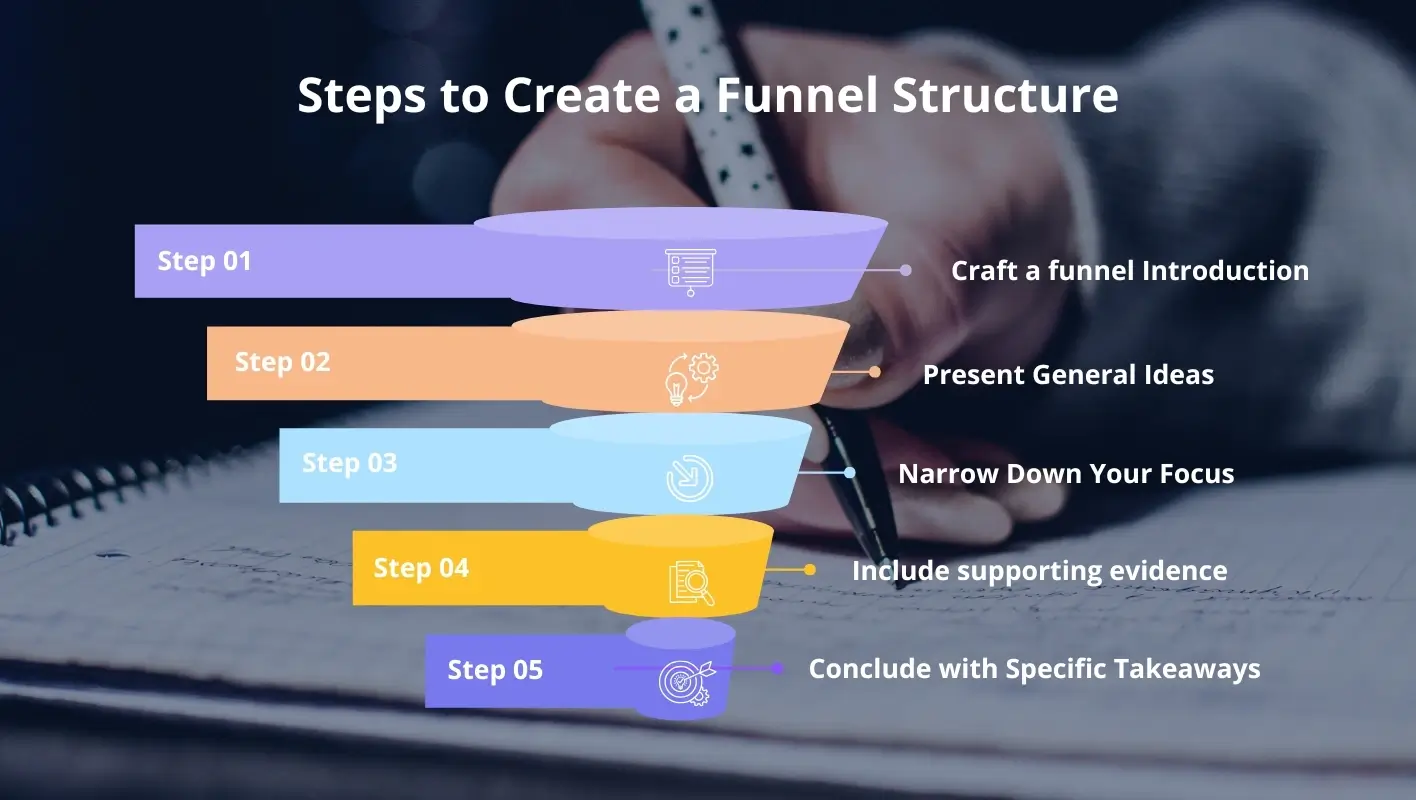
- Structure & Flow: Are there any paragraphs that seem out of place? Are there any logical gaps? Do you see a clear progression, perhaps like the "funnel structure" below, moving from broad ideas to a specific conclusion?
- Redundancy: Are there any paragraphs that are "doing" the same job?
The end result of this task should be a diagnostic report on your draft's architecture, with a clear list of what's working and what large-scale changes are needed.
Conclusion
Today we've moved from the theory of editing to the practical, high-level work of macro revision. You've learned how to diagnose the structural health of a draft by focusing on the big picture of argument, clarity, and logical flow.
Key Takeaways:
- Macro revision transforms a "writer-centric" draft into a "reader-centric" final piece.
- The goal is to perfect the argument and structure, not the sentences.
- The Self-Interview helps you clarify your intention and gives you a "compass" for revision.
- Reverse Outlining is a powerful diagnostic tool to reveal the actual structure of your draft and identify gaps, redundancies, and logical flaws.
A Look Ahead:
In our next lesson, you will put your macro-revision plan into action. After that, we'll zoom in. Armed with a solid structure, we'll perform a 'micro' revision, shifting our focus from the architectural blueprint to the fine details of voice, word choice, and the rhythm of your sentences.