Hello! Welcome back to our course on writing.
In our last lesson, we deconstructed the architecture of a great video essay, focusing on the work of exurb1a. We learned about the importance of a strong hook, the propulsive logic of "Therefore and But," and exurb1a's own powerful framework of balancing Feelings, Pictures, and Ideas.
Today, we shift from analysis to creation. You'll take those foundational principles and use them to build the blueprint for your own video essay. Our goal is to select a philosophical concept and outline a 5-7 minute video essay script to explore it. This is where your journey to becoming a writer-creator truly begins.
1. From Broad Philosophy to a Sharp Question
A video essay isn't a textbook chapter; it's a focused argument or exploration. The first step is to take a vast philosophical field and find a single, sharp question to build your video around. A broad topic like "Free Will" is too large for a 7-minute video, but a question like "Could a machine ever truly have free will?" is specific and intriguing.
This process of narrowing your focus to a "central question" is a crucial step for any video essayist.
How To Make Video Essays That People Watch (Start to Finish)
Let's watch a section of the video 'How To Make Video Essays That People Watch' by creator Prince Shakur. He explains why establishing a central question is the most important part of the planning phase.
Watch from 00:37 to 03:31. Pay close attention to how he distinguishes between a vague, general topic (e.g., 'movies and politics') and a sharp, focused question. Notice how a good question provides direction for the entire video.
As Prince Shakur explains, a central question gives your video clarity, direction, and a "pitch" you can explain to yourself and others. It's the guiding star for your entire script.
So, where do you find your question?
Your interests in philosophy, physics, and computer science are excellent starting points. Think about concepts that sit at the intersection of these fields. To get your mind working, it's helpful to browse a wide range of ideas.
200+ Philosophy Research Paper Topics to Impress
The article '200+ Philosophy Research Paper Topics to Impress' is a great source of inspiration. We'll use it not for a research paper, but as a launchpad for video essay ideas.
Don't read the whole article. Instead, skim these three lists for ideas that genuinely spark your curiosity: 'Interesting Philosophy Research Topics', 'Fun Philosophy Paper Topics', and 'Philosophy Research Topics for High School'. Look for ideas that you could rephrase as a compelling central question.
Test your understanding!
From the lists you just browsed, pick three topics that you find interesting. For each one, rephrase it as a "central question" for a potential video essay.
Example:
- Topic from list: "Possible rights of sentient robotics in the future."
- Central Question: "If we create a truly conscious AI, what's the one right we would absolutely have to give it?"
Now, you try.
Show answer
There are no wrong answers here, but here's how some other topics could be transformed:
-
Topic from list: "Is joy the same as happiness?"
-
Central Question: "We all chase happiness, but are we chasing the wrong thing? What if joy is the real prize?"
-
Topic from list: "Supernatural claims: real or myth?"
-
Central Question: "Why do our brains seem hardwired to believe in things we can't see, even in a scientific age?"
-
Topic from list: "Egg versus hen: Which came first?"
-
Central Question: "The 'Chicken or the Egg' problem seems like a silly paradox, but what does it reveal about how we misunderstand cause and effect?"
2. The Two-Column Blueprint
Once you have your central question, you need a structure to explore it. As we learned last time, a video essay needs more than just a logical argument; it needs to integrate visuals. The professional standard for this is the two-column script.
This format is simple: one column for AUDIO (your narration, music cues, sound effects) and one for VIDEO (the corresponding visuals, text on screen, animations).
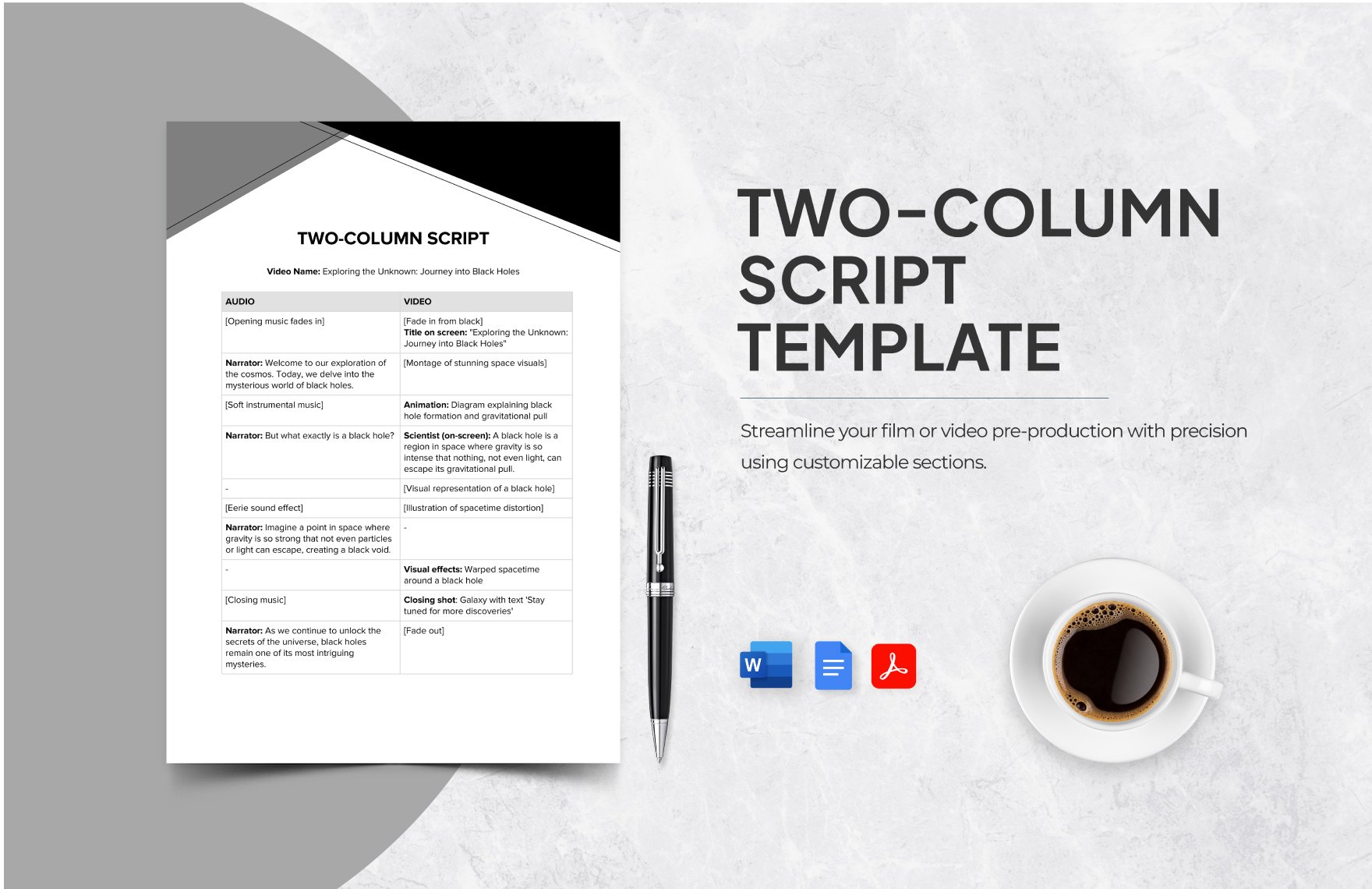
Using this format from the outlining stage forces you to think like a video creator, not just a writer. It helps you answer the question: "How can I show this idea, not just tell it?"
This approach is crucial for building an engaging script.
The article 'Developing a video essay' provides excellent advice on scriptwriting for this medium. Let's focus on its guidance about structure and integrating visuals.
Please read the sections titled 'Writing a script' and 'Sample scripts'. In the 'Writing a script' section, focus on the points about Organisation, Clarity, and especially Words and visuals. Then, look at the 'Sample scripts' section to see how the two-column format is put into practice.
Now, let's tie this back to our frameworks from the last lesson:
- The "Idea" is the argument flowing through your AUDIO column.
- The "Pictures" are the specific notes you make in the VIDEO column.
- The "Feelings" are conveyed by the tone in your narration and supported by your choice of music and visuals.
- The "Therefore and But" logic dictates how you move from one row of your script to the next, ensuring every point connects.
Your Task: Create a Video Essay Outline
It's time to build your own outline. Your goal is to create a two-column outline for a 5-7 minute video. This isn't a full script with every word written out. It's a blueprint made of bullet points that maps out the journey of your video. A typical 5-7 minute video will have an intro, 2-3 main points, and a conclusion.
Step 1: Choose Your Question
Select one of the central questions you brainstormed earlier (or a new one you feel more passionate about).
Step 2: Define Your Structure
Break your video down into key segments. For example:
- Introduction: How will you hook the viewer and introduce your central question?
- Point 1: What is the first part of your argument or exploration?
- Point 2: Where do you take the idea next? (Remember "Therefore" or "But").
- Point 3 (Optional): A final turn in the argument or a concrete example.
- Conclusion: How will you summarize your exploration and leave the viewer with a final, thought-provoking idea?
Step 3: Build the Two-Column Outline
Create a table or just draw a line down a page. On the left, write AUDIO notes. On the right, VIDEO notes. Use bullet points.
Here is a brief example using the question, "Is it better to be a dissatisfied human or a satisfied pig?"
| AUDIO | VIDEO |
|---|---|
| INTRO | |
| - (Upbeat, curious music) | - Fast cuts of people looking bored at fancy parties, then a pig rolling happily in mud. |
| - Narration: Hook with a relatable feeling. "Ever feel like you think too much? Like life would be simpler if you were... dumber?" | - Text on screen: "Ignorance is Bliss?" |
| - Introduce the quote from John Stuart Mill and the central question. | - Portrait of J.S. Mill. |
| POINT 1 | |
| - Explain the "satisfied pig" side. The value of simple pleasures, no existential dread. Pure sensation. | - Calming footage of nature, delicious food being eaten, simple video game graphics (e.g., Pac-Man). |
| - Tone: Sympathetic but slightly humorous. | - Simple animated pig with a thought bubble showing only an apple. |
| POINT 2 | |
| - BUT... introduce the "dissatisfied human" side. The value of higher consciousness, art, knowledge, love. | - Quick cuts: A rocket launch, a beautiful painting (The Starry Night), someone solving a complex math equation on a blackboard. |
| - These pleasures are more complex and lasting, even if they come with pain. | - Simple animated human with a thought bubble showing E=mc², a heart, and a question mark. |
| CONCLUSION | |
| - Conclude it's not about being a pig or human, but about the choice. Mill's point: only the human can understand both sides. The power is in knowing what you're giving up. | - Split screen: Pig on one side, human on the other. The human looks over at the pig, then turns back to a book and smiles faintly. |
| - Final thought: Maybe the goal isn't satisfaction, but meaning. (Music swells) | - Fade to black. |
Now, spend the rest of our time today creating your own outline. Focus on getting the structure and the key ideas down.
Conclusion
You've just taken the most significant step in the creative process: moving from a passive consumer of ideas to an active architect of them. You've transformed a vague interest into a concrete plan.
Key Takeaways:
- Start with a Question: A strong video essay is built around a sharp, central question, not a vague topic.
- Think in Two Columns: Outlining with both AUDIO and VIDEO in mind from the start is essential for creating a true video essay.
- Structure is Your Friend: A clear structure (Intro, Points, Conclusion) provides the skeleton for your creativity.
A Look Ahead:
In our next lesson, you'll take the first section of your outline—the Introduction—and flesh it out. We will focus on how to write a compelling hook and opening that captures attention in the first 30 seconds. This is where you'll begin translating your blueprint into a living, breathing script.