Hello! Welcome back to our module on "Finding Your Voice."
In our last lesson, we focused on the mechanics of rhythm, learning how to vary sentence length and structure to create music in your prose. You learned to be the composer of your sentences. Today, you'll learn to play different songs with that instrument.
Our learning outcome is to write the same 200-word idea in three different voices (e.g., academic, cynical, enthusiastic). This is a crucial step toward your goal of developing a creative, witty, and articulate style. The ability to deliberately shift your voice is a hallmark of a versatile writer, allowing you to adapt your writing for different effects—a skill you see frequently in the philosophical and humorous video essays you admire. The sentence structures you practiced last time will be your primary tools for this.
1. What Are Voice and Tone?
First, let's clarify some terms. You'll often hear writers talk about "voice," "tone," and "mood." While they are related, they have distinct meanings.
- Voice: This is the writer's unique personality on the page. It's the consistent style—built from word choice, sentence rhythm, and perspective—that makes your writing sound like you.
- Tone: This is the attitude the writer takes toward a specific subject in a specific piece of writing. Your voice can be consistent, but your tone can change from formal to humorous to critical, depending on your purpose.
- Mood: This is the emotional atmosphere that the writing creates for the reader. The writer's tone directly influences the reader's mood.
For today's lesson, we'll focus on consciously manipulating tone to create different authorial personas or "voices" for a specific topic.
To get a clearer sense of this, let's start with a short reading.
The Best 50 Types of Tone in Writing
The article 'The Best 50 Types of Tone in Writing' from PapersOwl gives a fantastic, straightforward explanation of these concepts.
Please read the first three subsections: 'A Simple Definition of Tone in Writing,' 'Tone vs. Mood vs. Voice,' and 'Example of Various Tones.' Notice how the simple message of a canceled meeting feels completely different in each example.
As you saw, the same core information can be delivered with entirely different effects. The formal tone establishes authority, the informal tone builds connection, and the sarcastic one signals frustration.
2. A Spectrum of Voices
Your goal is to write with wit and humor, but it's helpful to understand that "humorous" isn't a single voice. It exists on a spectrum. The same is true for "serious" or any other category.
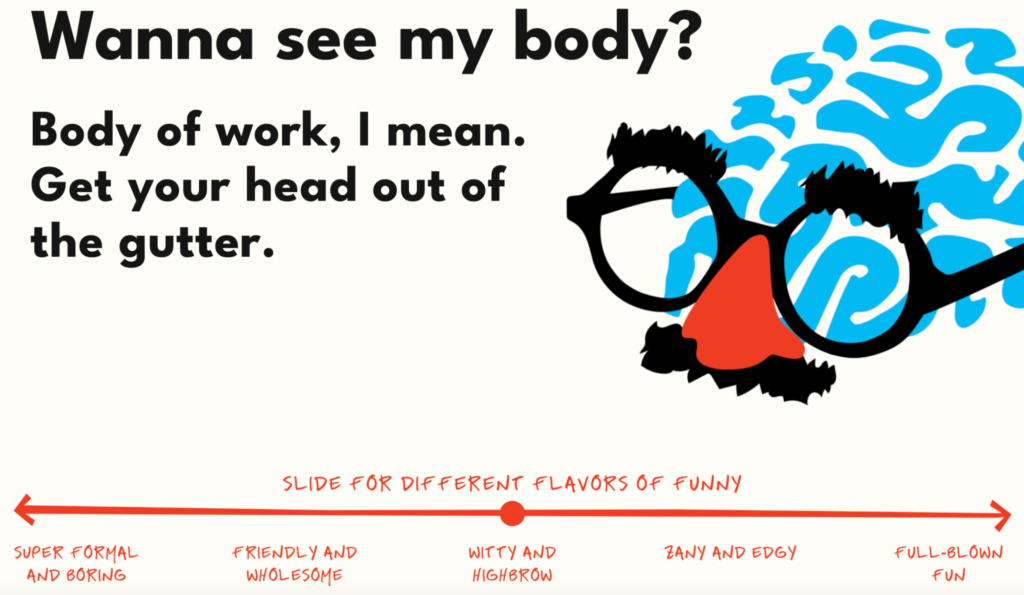
To broaden your understanding of the available options, let's explore a wider palette of tones.
The Best 50 Types of Tone in Writing
Let's return to the PapersOwl article. It provides a great catalogue of common tones.
Skim the section titled 'What Are Different Types of Tones?'. You don't need to memorize all 12, but pay attention to the descriptions for 'Formal,' 'Pessimistic,' 'Humorous,' 'Sarcastic,' and 'Encouraging.' These will be useful for today's exercise.
3. The Mechanics of Shifting Voice
So, how do you actually create these different tones? It isn't magic; it's a series of deliberate choices. The main levers you can pull are:
- Word Choice (Diction): Using "regret to inform" vs. "hey, meeting's off."
- Sentence Structure & Rhythm: The skills from our last lesson. Long, complex sentences often signal a formal or academic tone. Short, sharp sentences can feel cynical or forceful.
- Punctuation: An exclamation point adds excitement; a period offers finality.
- Figurative Language: Sarcasm often relies on irony, while an inspirational tone might use an uplifting metaphor.
The following resource provides an excellent, practical guide to making these shifts.
Types of Tones & Examples: Improve Your Writing Style
The article 'Types of Tones & Examples' from Edubirdie has a wonderful section that demonstrates how to revise a sentence to change its tone.
Please read the section titled 'The Tone Ladder: How to Shift Tone in Revision.' Pay close attention to the table ('How to Shift Tone') and the 'One Sentence, Many Tones' example. This shows exactly how word choice and structure work together.
Think of today's exercise like the "hard mode" challenge proposed by author George R.R. Martin for writing dialogue. He suggests writing the same essential message from the perspective of several different characters. The goal is to make each version so distinct in its phrasing and attitude that you can tell who is "speaking" without being told. We're doing the same thing, but with authorial voice.
4. Your Turn: Writing in Three Voices
Now it's time to put this all together. Your task is to take a single idea and express it in three completely different tones.
The Core Idea: Making mistakes is a valuable part of learning.
The Task: Write three short paragraphs (about 70 words each) on this core idea. Each paragraph should adopt one of the following voices:
-
An Academic Voice:
- Goal: Sound objective, authoritative, and analytical.
- Tools: Use a formal tone. Employ precise vocabulary (e.g., "paradigm," "iterative process," "cognitive dissonance"). Use complex sentences and a third-person perspective. Avoid emotional language.
- (Hint: Review the 'Formal Tone' examples in the resources.)
-
A Cynical Voice:
- Goal: Sound pessimistic, world-weary, and perhaps a bit sarcastic.
- Tools: Use a sarcastic or pessimistic tone. Employ short, punchy sentences for a biting effect. You might use rhetorical questions ("And what do we learn? To not try again?"). Use first-person ("If you ask me...") or a dismissive third-person.
- (Hint: Review the 'Pessimistic' and 'Sarcastic' examples.)
-
An Enthusiastic Voice:
- Goal: Sound encouraging, optimistic, and motivational.
- Tools: Use an optimistic or encouraging tone. Employ positive and uplifting words ("opportunity," "growth," "unleash"). Use direct address ("Your mistakes don't define you!"). Sentence structure can be more varied, perhaps with an exclamation for emphasis.
- (Hint: Review the 'Optimistic' and 'Encouraging' examples.)
Take about 20-25 minutes for this exercise. Focus on making the voices distinct. Read them aloud to hear the difference in their rhythms.
Test your understanding!
Here are some sample sentences to show how the voices might differ. Try not to use these directly, but let them guide your thinking.
- Academic: The analysis of error is fundamental to skill acquisition, as it provides critical data that allows for the refinement of heuristic models and the correction of flawed methodologies.
- Cynical: They say you learn from your mistakes. Mostly, you just learn how many ways there are to fail. It's a very expensive education in disappointment.
- Enthusiastic: Every mistake isn't a failure—it's a stepping stone! See it as a sign that you're pushing your limits and getting one step closer to a breakthrough. You've got this!
Now, write your own three paragraphs.
Conclusion
Excellent work today. You've moved beyond just constructing correct sentences and have started to imbue them with personality and attitude.
Key Takeaways:
- Voice is a choice: The tone of your writing is not accidental; it's the result of deliberate decisions about word choice, sentence structure, and perspective.
- A spectrum of possibilities: There isn't just one way to be "humorous" or "serious." Tones exist on a spectrum, and a skilled writer can move along it.
- Practice builds versatility: The exercise of writing the same idea in different voices is a powerful way to build flexibility and control.
In our next lesson, we will build directly on this foundation. Having practiced switching between voices, you will now work on sustaining one. Your next task will be to draft a short, first-person piece that establishes a consistent and recognizable voice. You've explored the palette; now you'll paint a small, complete picture.