Hello! Welcome to the first lesson of our new module, "Finding Your Voice."
In the last module, we focused on the fundamental logic of writing—how to generate ideas, structure them, and build a coherent argument. You successfully created a blueprint and then wrote a complete philosophical piece. That was about the what of your writing. Now, we shift our focus to the how. This module is all about style, personality, and that creative spark you're aiming for.
Today's learning outcome is to analyze how word choice and sentence structure create a distinct authorial voice in example texts. We'll move from being a consumer of writing to a critic, breaking down the mechanics of what makes a piece of writing sound unique, witty, or profound. This analytical skill is the first step toward consciously crafting your own voice.
1. What is "Voice"? Diction, Tone, and Style
Before we can analyze voice, we need a clear definition. What exactly is it? We also need to distinguish it from a related concept: tone. An author's voice is their unique personality on the page—it's consistent across different works. Tone, on the other hand, is the author's attitude toward a specific subject within a piece of writing.
An author might have a consistently witty and philosophical voice, but use a skeptical tone when discussing one topic and an enthusiastic tone for another.
Analyzing tone through word choice | Reading | Khan Academy
To start, let's watch this short video from Khan Academy. It does an excellent job explaining how to analyze an author's attitude by looking closely at their word choice, and it clearly distinguishes between tone and the broader concept of authorial voice.
Please watch from the beginning (00:26) to 04:44. Pay close attention to: The definition of tone and 'register' (formality). How the hot dog example demonstrates analysis of specific word choices (e.g., 'oceans of ink,' 'holier-than-thou,' 'dubious'). The crucial distinction made between tone (topic-specific) and authorial voice (consistent style).
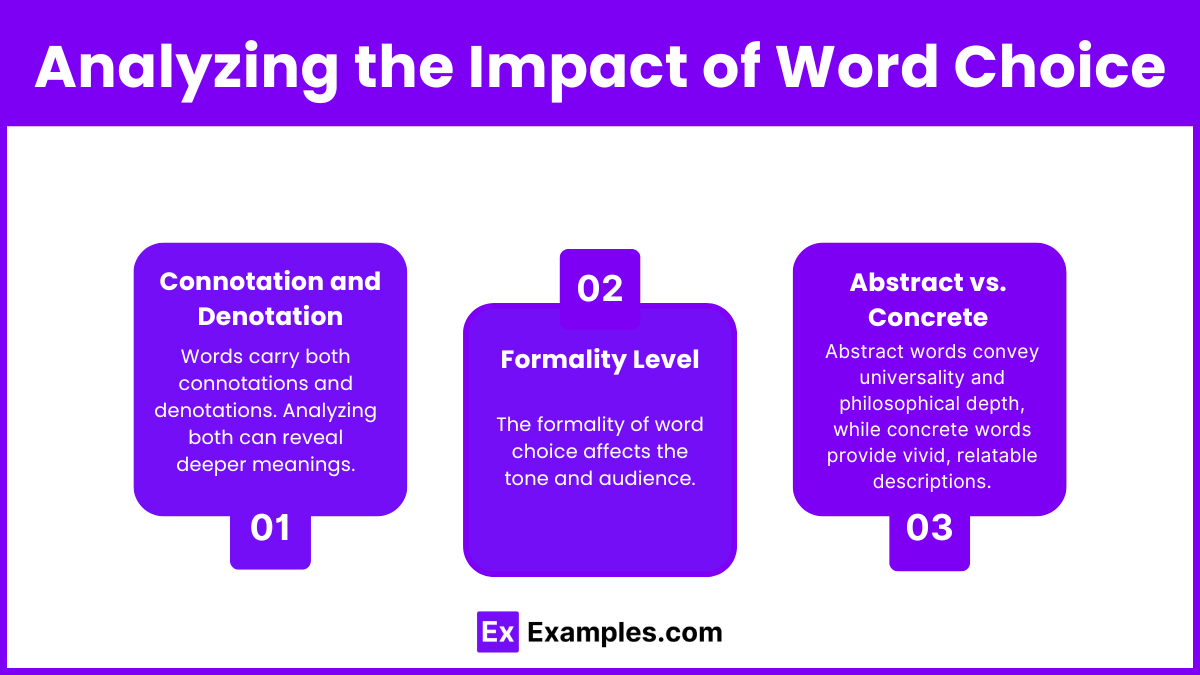
The video highlights that the key to understanding tone—and by extension, voice—is analyzing word choice, or diction. The specific words an author uses carry connotations (emotional associations) that go far beyond their literal meanings (denotations).
2. A Framework for Analyzing Voice
Saying a writer has a "witty voice" is easy. Explaining how they create that voice is the real skill. To do this, we need a more structured framework. Authorial voice isn't a single magical quality; it's the combined effect of several deliberate authorial choices.
7 Ways to Amp up Your Writer's Voice
The article '7 Ways to Amp up Your Writer's Voice' from College Essay Guy provides an excellent, practical framework. It breaks down the abstract concept of 'voice' into seven concrete, analyzable elements.
Please read the section titled 'But What is Voice, Really? What are techniques for creating voice? List, Please'. Focus on understanding the seven elements it identifies: Lens: The author's perspective or angle. Specifics: The details and imagery chosen. Vulnerability: The emotional openness. Humor: The use of wit, irony, or jokes. Rhythm: The flow and pacing of sentences. Diction: The choice of words. Syntax: The arrangement of words in sentences.
This 7-part framework is your analytical toolkit. When you read a text, instead of just thinking "I like this writer's voice," you can now ask:
- What is their lens on this topic?
- What kind of specifics do they use?
- How do they vary sentence rhythm?
- What is unique about their diction and syntax?
3. Voice in Action: Deconstructing a Classic
Let's apply this framework to a literary example. The opening lines of a great book are often a masterclass in establishing voice.
How to Do Literary Analysis (It’s Easy!)
This video from the English Nerd channel analyzes the famous opening of George Orwell's 1984. It's a perfect demonstration of how to pick apart individual word and sentence choices to understand the world and voice the author is creating.
Please watch from the beginning (00:03) to 05:39. As you watch the analysis of the first two sentences, try to map the observations back to our 7-part framework.
Let's connect the video's analysis to our framework:
-
"It was a bright cold day in April, and the clocks were striking thirteen."
- Diction/Specifics: The choice of "thirteen" is jarring. It's an unexpected detail that immediately signals something is wrong. As the video notes, it implies military time and bad luck.
- Syntax: The sentence starts simply ("bright cold day") and ends with a twist ("striking thirteen"). This structure creates a small jolt for the reader.
- Lens: This single sentence establishes a questioning, unsettling lens. The world looks normal on the surface, but it's fundamentally "off."
-
"...slipped quickly through the glass doors of Victory Mansions, though not quickly enough to prevent a swirl of gritty dust from entering along with him."
- Diction: The contrast between the grand name "Victory Mansions" and the reality of "vile wind" and "gritty dust" is powerful. This is a technique called juxtaposition, and it's a hallmark of an ironic voice.
By analyzing just two sentences, we can identify the author's specific choices in diction, syntax, and specifics, all of which combine to create Orwell's distinct, unsettling, and critical voice.
4. Anatomy of a Witty Voice
Your goal includes developing a creative and humorous voice, much like exurb1a. This style often relies on a specific set of techniques related to word and sentence structure. Humor in writing isn't random; it's engineered.
The core principle behind much of humor is incongruity: placing two or more things together in a way that violates our expectations.
This chapter on Humor Writing provides a deep dive into the mechanics of wit. We'll focus on how humor is built from the ground up, starting with word and sentence choices.
This is a dense resource, so we'll be selective. Please read the following three parts: 'Humor Defined' (the first section): Focus on the core idea that humor comes from disrupting patterns through incongruity and surprise. 'Language Humor' (the first part of this section, up to 'Puns'): Read about how slang, jargon, and portmanteaus (blended words like 'brunch') create humor through sound and unexpected combinations. 'Jokes' (the first part of this section, up to 'Non Sequitur'): Read about the 'Rule of Three,' 'Reversals,' and 'Misdirection.' These are structural patterns at the sentence level that create surprise.
Think of exurb1a's style. He constantly uses these techniques:
- Incongruity: He juxtaposes cosmic, philosophical ideas with mundane, everyday details (e.g., discussing the heat death of the universe while worrying about a parking ticket). This mixes a "high" and "low" register.
- Language Humor: He invents words (portmanteaus) and uses unexpected, informal language (slang) to describe complex concepts, making them feel fresh and funny.
- The Rule of Three: He will often list two serious, expected items and make the third one absurd and surprising. For example: "Humanity has faced many threats: plague, famine, and the existential dread of seeing a 'read' receipt with no reply."
Test your understanding!
Which of the following sentences best demonstrates the "Rule of Three" for comedic effect?
- To succeed in life, you need dedication, hard work, and perseverance.
- My weekend plans involve finishing my physics homework, reading a book on epistemology, and figuring out if a hotdog is a sandwich.
- The philosopher was brilliant, but also quite strange and very eccentric.
- She walked into the room, she looked around, and she left.
Show answer
The correct answer is 2. It sets up a pattern of serious, academic activities ("physics homework," "epistemology") and then disrupts that pattern with a humorous, trivial philosophical debate ("if a hotdog is a sandwich"). This is a classic use of the rule of three to create a witty voice.Conclusion
In this lesson, we've established a foundation for understanding and crafting an authorial voice. You've learned to look beyond the surface of a text and analyze the specific mechanics an author uses to express their personality.
Key Takeaways:
- Authorial Voice is the consistent personality of a writer, while Tone is their attitude toward a specific topic.
- Voice can be broken down into analyzable components: Lens, Specifics, Vulnerability, Humor, Rhythm, Diction, and Syntax.
- Specific choices in word choice (diction) and sentence structure (syntax) are the building blocks of voice.
- Humor is often engineered through incongruity, disrupting expectations using techniques like juxtaposition, the rule of three, and reversals.
You've now learned how to analyze voice. The next logical step is to start creating it. In our next lesson, you will get hands-on experience manipulating voice by taking a formal piece of writing and transforming it. The learning outcome will be to rewrite a formal paragraph to sound natural and conversational when read aloud. This will be your first practical exercise in finding your own voice on the page.