Hello! Welcome back to our module on "Creative Language: Metaphor and Wit."
In our last lesson, we built a systematic way to generate and evaluate metaphors. We ended by touching on one of the most exciting criteria for an effective metaphor: novelty. We saw that a surprising connection can make an idea stick in the reader's mind.
Today, we're going to expand on that single idea. Our goal is to use unexpected comparisons to make a familiar idea feel fresh. This is a cornerstone of the witty, philosophical, and creative style you admire. It’s the technique that allows a writer to take a common object or a well-worn concept and show it to the audience as if for the first time, sparking curiosity and often, humor.
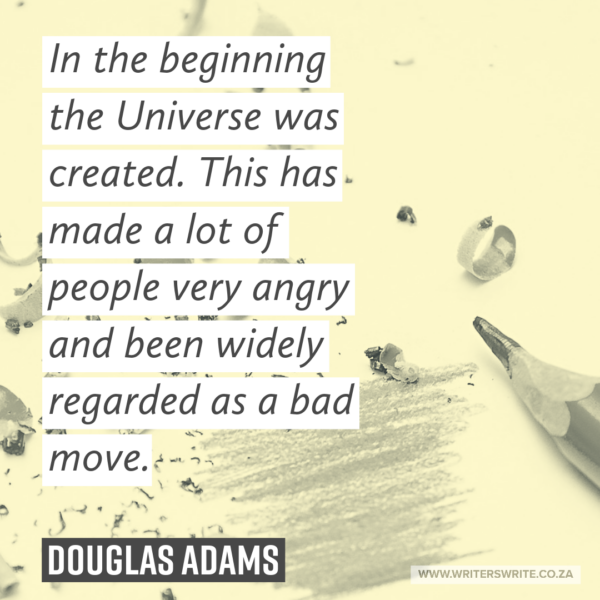
To set the stage, consider this classic quote from Douglas Adams, whose style has heavily influenced writers like exurb1a:
Today, we'll break down the mechanics of how this kind of writing works, moving from the psychological principle of surprise to practical techniques you can use in your own work.
1. The Power of Incongruity
Why do we find the Douglas Adams quote above so amusing? It works because it violates our expectations. We expect a discussion of the Universe's creation to be serious, epic, and profound. Instead, we get words like "angry" and "bad move"—language you'd associate with a cancelled meeting, not the Big Bang.
This clash between what we expect and what we get is called incongruity. The ancient Greek philosopher Aristotle believed that this surprise is the secret to all humor.
To explore this idea, let's watch a short video that introduces the "incongruity theory of humor."
How to make your writing funnier - Cheri Steinkellner
This clip from the TED-Ed video 'How to make your writing funnier' explains the core concept of incongruity—the idea that we laugh at things that feel out of place or defy our expectations.
Please watch from 01:35 to 02:22. As you watch, think about how the examples given (a lizard selling insurance, a nun disco dancing) create a mental 'jolt' by combining two completely unrelated concepts.
This principle doesn't just apply to wacky scenarios; it's a fundamental tool for observation. Comedian Jerry Seinfeld is a master at this. He takes everyday, familiar objects and describes them with such bizarre and unexpected comparisons that they become hilarious and strange.
Jerry Seinfeld Interview: How to Write a Joke | The New York Times
In this interview with The New York Times, Jerry Seinfeld breaks down how he wrote some of his classic jokes. He provides a masterclass in making the familiar feel fresh.
First, watch from 01:16 to 01:36, where Seinfeld describes Shredded Wheat and Pop-Tarts. Notice his word choices: Shredded Wheat isn't 'crunchy'; it's like 'wrapping your lips around a wood chipper.' Then, watch from 02:08 to 03:17, where he expands on the Pop-Tart joke. The Pop-Tart isn't just a new snack; it's an 'alien spacecraft,' and the kids observing it are like 'chimps in the dirt playing with sticks.'
Seinfeld's technique is to find the most extreme, yet strangely fitting, comparison possible. He's not just making a metaphor; he's performing a kind of creative shock therapy on a familiar idea.
Test your understanding!
Think of a common object in the room around you right now (e.g., a chair, a light bulb, a book). Using the Seinfeld method, try to come up with one wildly unexpected comparison for it. Don't worry about it being perfect; the goal is to practice making a big creative leap.
For example: "A ceiling fan isn't just for moving air; it's a bored helicopter dreaming of escape."
Show a possible answer
Here are a few more examples:
- A power outlet: "The shy face of a robot hiding in the wall, waiting for you to feed it electricity."
- A stapler: "A tiny, metal dragon that bites papers together."
- A crumpled piece of paper: "The ghost of a bad idea."
The key is the unexpected leap from the mundane to the fantastical or absurd.
2. A Core Technique: Juxtaposing High and Low
One of the most effective ways to create surprising comparisons is through juxtaposition, specifically by placing the "high" and the "low" side-by-side. This technique has a formal name: burlesque.
- High Concept: An idea that is grand, abstract, formal, or profound (e.g., the meaning of life, cosmic destiny, classical art, philosophy).
- Low Concept: An idea that is mundane, concrete, informal, or silly (e.g., doing laundry, complaining about traffic, pop-culture slang).
Burlesque creates humor and freshness in two main ways:
- It treats a high concept with low, ordinary language (like the Douglas Adams quote).
- It treats a low concept with high, mock-dignified language (e.g., writing a grand ode to a piece of toast).
This technique is everywhere in modern humor, especially online.
The Art of the Burlesque, 21st-Century Style
The article 'The Art of the Burlesque, 21st-Century Style' by Orin Hargraves provides a great explanation of this concept using a very modern example: internet memes.
Please read the first three paragraphs (starting 'For some readers, burlesque...' and ending '...crashing down to earth through some comic misinterpretation.'). This will give you a clear definition of burlesque and show how it works in 'Classical Art Memes,' which juxtapose revered paintings (high) with funny, informal captions (low).
This "high-low" juxtaposition is the engine behind much of the philosophical humor you're drawn to. It allows a writer to talk about profound ideas without sounding pretentious, grounding cosmic thoughts in relatable, everyday frustrations.
3. Case Study: The Douglas Adams Method in Prose
Now let's see how these ideas come together in a piece of writing. Your interest in exurb1a makes Douglas Adams an essential writer to study. He masterfully blended science fiction, philosophy, and comedy, largely by making the extraordinary seem mundane and the mundane seem extraordinary.
The following resource is a pastiche—an imitation of a writer's style—that rewrites the fairy tale of "Little Red Riding Hood" as if Douglas Adams had written it. It's a brilliant way to see his techniques in action.
How to write like . . . Douglas Adams - Going Down Writing
This blog post from 'Going Down Writing' is titled 'How to write like . . . Douglas Adams'. It contains both a creative piece and an analysis of how the style was achieved.
First, read the story itself, titled 'Zen and the Art of Whup-ass'. As you read, notice how the familiar fairy tale elements are twisted. How does the author make the story of Red Riding Hood feel new and unexpected? After reading the story, read the analysis that follows it (starting from the line 'The keynotes of his style are a razor wit, word play...'). This will break down the techniques used, connecting directly to our discussion of juxtaposition and character.
The pastiche demonstrates several ways to make a familiar idea (a fairy tale) fresh:
- Setting Juxtaposition: Placing the story not in a simple forest, but on a planet in the "Nut Tree Nebula."
- Character Juxtaposition: Dropping in an ordinary, grumbling character (Arthur Dont) who is more concerned with getting a cup of tea than with the cosmic wonders around him.
- Tonal Juxtaposition: The narrator's voice, which sounds like an omniscient, formal encyclopedia (The Guide), describes absurd events with perfect seriousness.
4. Practice Exercise: Refreshing the Familiar
Now it's your turn to practice this skill. We'll break it down into two exercises, mirroring the techniques we've discussed.
Part 1: The "Seinfeld" Method - Unexpected Analogy (5 minutes)
Choose one of the following familiar concepts. Your task is to describe it using a wildly unexpected comparison that makes it feel new. Write 1-2 sentences.
- The feeling of boredom
- A game of chess
- Solving a difficult math problem
Part 2: The "Adams" Method - High/Low Juxtaposition (5 minutes)
Choose one of the following "high" concepts. Your task is to describe it using mundane, everyday language and concerns. Write 1-2 sentences.
- The search for extraterrestrial life
- The concept of infinity
- A major historical event (e.g., the fall of Rome, the first moon landing)
Example for Part 2: "Humanity's search for extraterrestrial life is mostly just leaving the galactic equivalent of a voicemail and hoping someone, someday, decides to call back."
Take about 10 minutes to work on both parts. Focus on generating a surprising connection, not on writing a perfect paragraph.
Conclusion
Excellent work today. We've moved from the general idea of metaphor to the specific, powerful technique of using unexpected comparisons to make your writing more engaging and witty. You learned that the element of surprise, or incongruity, is a key driver of humor and insight.
Key Takeaways:
- Making the familiar feel fresh is about creating incongruity—a surprising gap between expectation and reality.
- One method is to use wildly unexpected analogies, like comparing a Pop-Tart to an alien spacecraft.
- A more structured technique is juxtaposing "high" and "low" concepts, either by treating a profound idea with mundane language or vice versa. This is a core part of the "philosophical humorist" style.
In our next lesson, we'll continue to build your toolkit for wit. Today we focused on juxtaposition. Next, we will identify the mechanics of wit (e.g., irony, juxtaposition) in humorous philosophical writing, seeing how different tools can be combined to create a sophisticated and funny authorial voice.