Hallo! In our last lesson, we mastered essential courtesy phrases like bitte, danke, and Entschuldigung. You might recall we briefly touched on the difference between Entschuldigung and the more formal Entschuldigen Sie. This distinction is a doorway to one of the most important concepts in German social etiquette.
Today, we will dive deep into that concept. This lesson is dedicated to helping you distinguish between the formal (Sie) and informal (du) forms of address and use them appropriately. Understanding this isn't just about grammar; it's about showing respect and navigating German social contexts with confidence. Mastering du and Sie is a fundamental step toward sounding like a natural speaker.
1. The Core Concept: What are du and Sie?
In English, we use "you" for everyone. German, however, makes a distinction based on the relationship between the speakers. This creates two main ways to say "you":
- du: The informal "you," used for one person.
- Sie: The formal "you," used for one or more people. It is always capitalized.
Think of it as a social protocol where you select the right mode of address based on variables like age, relationship, and setting. The choice signals either closeness and familiarity (du) or respect and distance (Sie).
To get a first overview, let's watch a video that introduces the concept.
Formal vs Informal in German | When to use what and how you use it
This video from the 'YourGermanTeacher' channel clearly introduces the 'du' versus 'Sie' distinction and explains the cultural reasons behind it.
Please watch from 01:09 to 02:26. The speaker will introduce the terms 'duzen' (to use 'du') and 'siezen' (to use 'Sie') and explain why this distinction is important for showing respect.
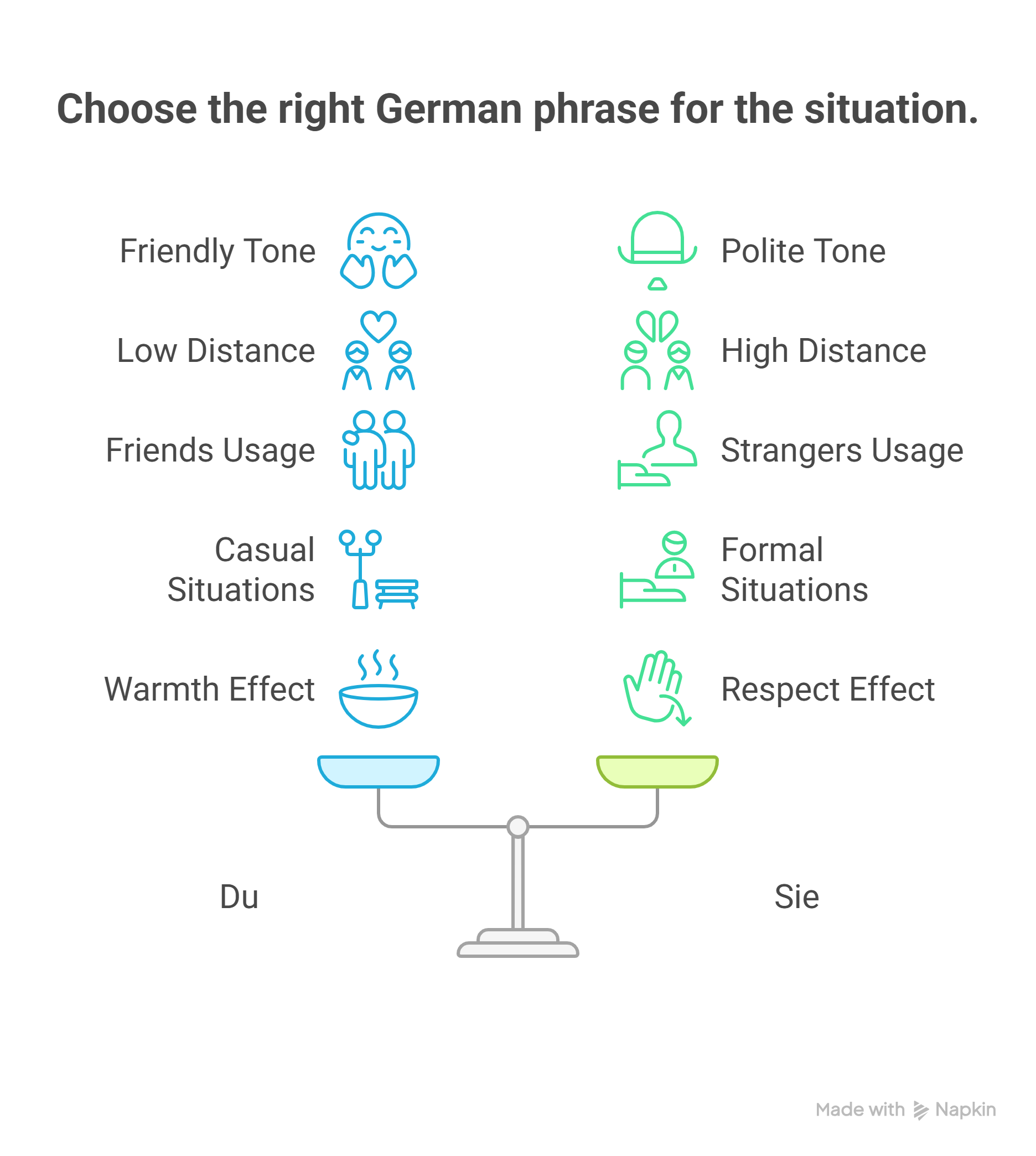
The key reasons for this system, as the video explains, are to show politeness and respect, especially towards older people, strangers, or those in positions of authority. While du fosters a sense of closeness, Sie maintains a respectful distance.
This visual summary neatly breaks down the core differences:
2. Grammatical Differences
The choice between du and Sie affects your sentence structure, specifically the verb conjugation. You've already seen this in previous lessons without focusing on it. Let's make it explicit.
| Verb | Informal (du) |
Formal (Sie) |
|---|---|---|
| sein (to be) | du bist (you are) | Sie sind (you are) |
| haben (to have) | du hast (you have) | Sie haben (you have) |
| heißen (to be called) | du heißt (you are called) | Sie heißen (you are called) |
| kommen (to come) | du kommst (you come) | Sie kommen (you come) |
Notice that the verb form for Sie is the same as the infinitive (e.g., kommen, heißen). The verb form for du typically ends in -st.
Let's see this in action with the same video.
Formal vs Informal in German | When to use what and how you use it
Now, let's look at how to conjugate verbs for 'du' and 'Sie'.
Watch from 03:28 to 05:18. Pay close attention to how the capitalized 'Sie' is a key indicator, and how the verb endings change between the formal and informal questions using the verb 'wohnen' (to live).
As a rule, if you see Sie capitalized in the middle of a sentence, it is the formal "you".
3. The Social Rules: When to Use du vs. Sie
Now for the most important part: when to use each form. The rules are a mix of grammar and social etiquette.
Formal vs. Informal German Phrases: How to Speak Appropriately
The article 'Formal vs. Informal German Phrases' provides an excellent, detailed breakdown of the situations for using 'du' and 'Sie'. It will help solidify your understanding of the social rules.
Please read the sections titled 'When to Use Formal German' and 'When to Use Informal German'. Focus on the lists of situations and the example sentences provided for each. This will give you a clear framework.
To summarize the key points from the reading:
Use du (Informal) with:
- Family and close friends.
- Children and people younger than you (roughly under 18).
- Peers in casual environments, like fellow university students.
- Online in forums and social media.
- Colleagues you have a close relationship with (but be careful here!).
Use Sie (Formal) with:
- Strangers.
- People older than you.
- People in positions of authority (e.g., police officers, public officials).
- Professional contexts: your boss, clients, customers.
- Service staff: in shops, restaurants, hotels, banks.
The Golden Rule: If you are ever unsure, always use Sie. It is better to be too polite than too familiar. An inappropriate du can be seen as disrespectful, whereas using Sie is always safe.
4. Real-World Nuances
While the rules are a great guide, real life can be more nuanced. To give you a feel for this, let's watch a short clip where native speakers discuss how they make the choice.
Du vs. Sie - How to address someone in German | Easy German 382
This video from the 'Easy German' channel shows people on the street in Berlin discussing when they use 'du' or 'Sie'. It's a great way to see that even for native speakers, it's not always black and white.
Watch the first 45 seconds (00:00-00:45) where the host introduces the topic and its complexities. Then, skip to the end and watch the host's summary from 11:11 to 11:26. This will give you a sense of the real-world application without getting lost in the details of the interviews.
The main takeaway here is that context is everything, and when you're truly unsure, it's perfectly acceptable to ask! A simple question like, "Sollen wir uns duzen oder siezen?" (Should we use 'du' or 'Sie' with each other?) can clarify the situation.
5. Switching from Sie to du
You don't have to use Sie forever! As relationships develop, people often switch to du. This is a significant step and usually follows a simple rule.
Formal vs Informal in German | When to use what and how you use it
Let's return to the 'YourGermanTeacher' video one last time to learn about the social custom of switching forms.
Watch from 07:14 to 08:26. The speaker explains who typically offers the 'du' and what it signifies.
The key etiquette is that the older person or the person in the higher-ranking position offers the du to the younger or junior person. If someone offers you the du, you can accept with a simple "Ja, gerne!" (Yes, gladly!) and then switch to using du and their first name.
6. Practice Exercises
Time to put this into practice!
Exercise 1: Du or Sie?
Look at the worksheet below. For each of the five scenarios, decide whether the people would use du or Sie.

Click here to check your answers.
- Two young men who appear to be friends or peers: du.
- A doctor speaking to an elderly female patient: Sie.
- Two children playing together: du.
- A woman speaking to a police officer: Sie.
- A family (mother, father, child) talking to each other: du.
Exercise 2: Sentence Transformation
Rewrite the following sentences, changing them from formal to informal or vice-versa.
-
Formal: Wie heißen Sie?
Informal: __________________? -
Informal: Woher kommst du?
Formal: __________________? -
Formal: Sprechen Sie Englisch?
Informal: __________________? -
Informal: Was machst du? (What are you doing?)
Formal: __________________?
Click here for the solutions.
- Informal: Wie heißt du?
- Formal: Woher kommen Sie?
- Informal: Sprichst du Englisch?
- Formal: Was machen Sie?
Conclusion
Sehr gut! You've now explored one of the most essential aspects of German communication. Getting the hang of du and Sie takes practice, but it's a skill that will immediately make you a more thoughtful and effective communicator in German.
Key Takeaways:
duis for informal contexts: friends, family, children, and peers.Sieis for formal contexts: strangers, older people, authority figures, and professional settings.- The verb conjugation changes:
duforms often end in -st, whileSieforms use the infinitive. Sieis always capitalized.- The golden rule: When in doubt, use
Sie!
Preview of the Next Lesson:
In our next lesson, you'll have the chance to apply everything we've learned in this module. We will complete a role-play exercise introducing yourself in both formal and informal settings, where you'll have to choose the correct greetings, phrases, and of course, the right form of "you"