Hallo! Welcome back to our German course.
Introduction
In our last few lessons, we've focused on the core components of German sentences. We established that in a standard statement, the conjugated verb takes the second position (Ich lerne Deutsch.). Then, when we formed W-questions, you saw this rule in action again:
Wo wohnst du?(Where do you live?)
Notice the structure: Question Word (Position 1) + Verb (Position 2) + Subject (Position 3).
Today, we will expand on this fundamental principle. You will learn how to apply this verb-second (V2) rule when you start a sentence not with the subject, but with another element like a time or place expression. Mastering this is key to making your German sound more natural and flexible.
1. The Golden Rule of German Main Clauses
In German, the structure of a main clause (a simple, complete sentence) is governed by one very important rule: the conjugated verb always occupies the second position.
While English often sticks to a Subject-Verb-Object pattern, German offers more flexibility in what can occupy the first position. This allows you to emphasize different parts of the sentence. No matter what you place in position one, the verb holds its ground in position two.
Let's start by watching a video that explains this core idea. The presenter uses the concept of an "idea" or a "chunk" of information to define a sentence position, which is a very helpful way to think about it.
Word order in GERMAN - understand where to put the VERB in a main clause!
The video 'Word order in GERMAN' by The German Gymnasium clearly demonstrates how the verb stays in the second position even when the sentence starts with a time phrase.
Please watch from 01:40 to 04:16. Pay close attention to the example 'Heute esse ich eine Wurst' (Today eat I a sausage). This is the classic example of the V2 rule in action.
As the video showed, when an element other than the subject moves to the first position, the subject must move to a later position—typically right after the verb (position 3). This is often called inversion.
Look at this transformation:
- Standard order:
Ich(Pos 1)gehe(Pos 2)heute(Pos 3)ins Kino. - Inverted order (for emphasis):
Heute(Pos 1)gehe(Pos 2)ich(Pos 3)ins Kino.
The verb gehe remains in the second slot. This structure is not optional; it is a firm rule of German grammar.
2. What Can Go in Position One?
You might be wondering what kinds of elements can start a sentence. It's not just time expressions like heute (today) or morgen (tomorrow). You can place various sentence components in the first position to shift the focus.
The following resource provides an excellent overview of the different elements that can lead a sentence.
German Word Order: V2 Rule & Structure
The article 'German Word Order: V2 Rule & Structure' has a section called the 'Position One Toolbox' that neatly categorizes what can start a sentence. It's a great way to see the flexibility of this rule.
Please read the sections '2. The V2 Rule: Core Principle of Main Clauses' and '3. Position One Toolbox: What Can Lead a Sentence'. Focus on the examples provided for each type of element (Subject, Time expression, Place expression, etc.).
As you saw, you can start a sentence with:
- A time expression:
Morgen fahre ich nach Hamburg.(Tomorrow I'm driving to Hamburg.) - A place expression:
In Berlin wohne ich.(I live in Berlin.) - An object:
Einen Kaffee trinke ich am Morgen.(I drink a coffee in the morning.)
In every case, the structure is the same: [Element in Pos 1] + [Verb in Pos 2] + [Subject in Pos 3] ...
3. Practice Makes Permanent
Your preference for combining grammar with practical exercises is the best way to internalize this rule. Let's put it to work.
Activity 1: Sentence Scramble
The following worksheet contains several jumbled sentences. Your task is to rearrange the words to form correct German sentences. For each one, make sure the conjugated verb is in the second position.
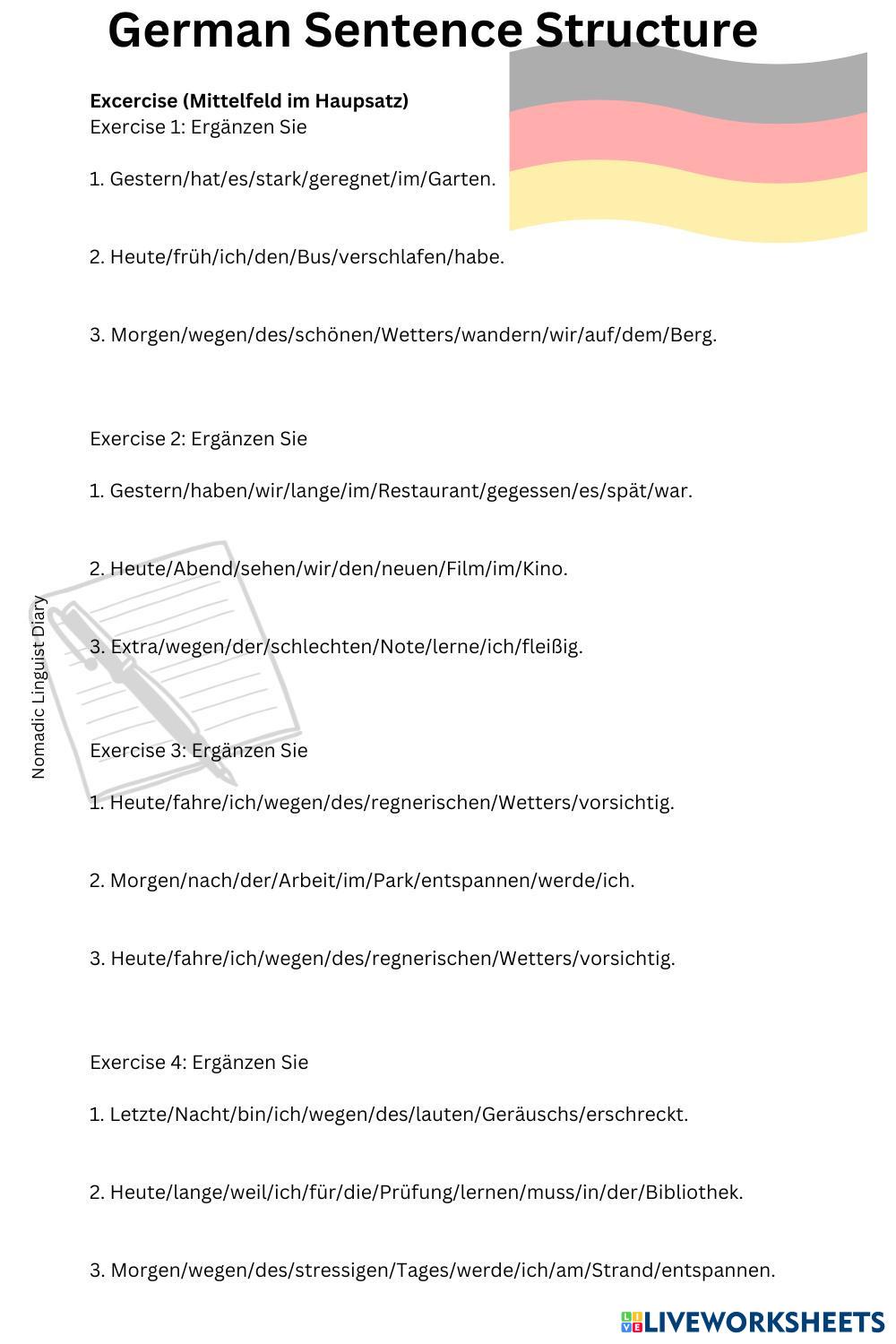
Try to solve exercises 1 through 4. Write down your answers and then check them against the solutions below.
Click to reveal the solutions for the worksheet
Exercise 1
Ich gehe heute mit meinen Freunden ins Kino.ORHeute gehe ich mit meinen Freunden ins Kino.Wir fahren nächste Woche nach Deutschland.ORNächste Woche fahren wir nach Deutschland.Du musst morgen deine Hausaufgaben machen.ORMorgen musst du deine Hausaufgaben machen.
Exercise 2
Ich habe gestern einen interessanten Film gesehen.ORGestern habe ich einen interessanten Film gesehen.Er kann sehr gut Deutsch sprechen.Sie will am Wochenende ihre Oma besuchen.ORAm Wochenende will sie ihre Oma besuchen.
Exercise 3
Ich lerne seit zwei Jahren Deutsch.ORSeit zwei Jahren lerne ich Deutsch.Wir haben am Montag eine wichtige Prüfung.ORAm Montag haben wir eine wichtige Prüfung.Du sollst mehr Wasser trinken.
Exercise 4
Mein Bruder spielt gern Fußball.ORGern spielt mein Bruder Fußball.Meine Schwester liest oft Bücher in ihrem Zimmer.OROft liest meine Schwester Bücher in ihrem Zimmer.Meine Eltern arbeiten beide in der Stadt.ORIn der Stadt arbeiten meine Eltern beide.
Activity 2: Rewriting for Emphasis
Now, let's practice actively changing the emphasis of a sentence. For each sentence below, rewrite it so that it begins with the bolded element. Remember to adjust the word order accordingly!
Example:
- Original:
Ich spiele am Nachmittag Tennis. - Rewritten:
Am Nachmittag spiele ich Tennis.
Now, your turn:
-
Ich fahre **morgen** nach München.- Your answer: ________________________
-
Wir essen **im Restaurant** Pizza.- Your answer: ________________________
-
Sie lernt **jeden Tag** Deutsch.- Your answer: ________________________
-
Er kauft **im Supermarkt** ein.(Remember what happens with separable verbs!)- Your answer: ________________________
Click to reveal the solutions
Morgen fahre ich nach München.Im Restaurant essen wir Pizza.Jeden Tag lernt sie Deutsch.Im Supermarkt kauft er ein.(The separable prefixeinstill goes to the end of the clause.)
Conclusion
Excellent work! You have now mastered one of the most defining features of German sentence structure. By understanding that the verb is the fixed anchor in the second position, you can flexibly arrange other sentence elements to create emphasis and variety in your speaking and writing.
Key Takeaways:
- In a German main clause, the conjugated verb is always the second element.
- The first element can be the subject, but it can also be a time expression, a place, an object, or another adverbial phrase.
- When a non-subject element is in position 1, the subject moves to position 3, immediately after the verb. This is called inversion.
- A "position" can be a single word (
heute) or a multi-word phrase that represents a single idea (am Wochenende).
Preview of the Next Lesson:
We've spent a lot of time on the skeleton of German sentences—the grammar and word order. In our next lesson, we'll start adding more flesh to those bones. We will begin Module 6, "Expressing Yourself: Hobbies and Preferences," by learning the vocabulary for common hobbies and leisure activities. This will give you the tools to start talking about your own interests.