Hallo! Willkommen zurück.
Introduction
In our last lesson, you mastered the declension of articles and pronouns in the accusative case. You learned how to change words like der to den or ich to mich when they function as the direct object of a sentence.
Today, we will explore the second major reason to use the accusative case: after a specific group of prepositions. These prepositions act as a grammatical trigger, automatically requiring the noun or pronoun that follows them to be in the accusative. By the end of this lesson, you will be able to confidently use the common accusative prepositions: durch, für, gegen, ohne, und um. This will add another layer of precision to your German sentences.
1. The Accusative Prepositions
Unlike two-way prepositions, which you will learn about later, this group is straightforward. If you see one of these words, the object that follows is always in the accusative. There is no ambiguity. This makes them a matter of memorization.
The five most important prepositions in this group are:
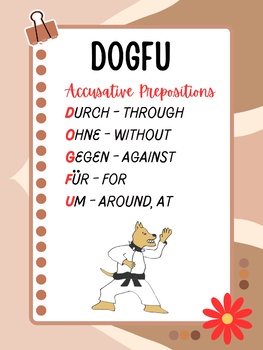
- durch (through)
- ohne (without)
- gegen (against)
- für (for)
- um (around, at)
To make these easier to remember, many learners use a mnemonic. A popular and effective one is DOG-FU.
2. Meanings and Examples
Let's look at the meaning and usage of each preposition. The following resource provides a clear and concise table that serves as an excellent reference.
Accusative Prepositions in German: How to Use Them
Please study the main table in the article 'Accusative Prepositions in German' from Olesen Tuition. It neatly summarizes the five prepositions, their meanings, and provides a clear example for each.
Focus on the table that lists 'durch', 'ohne', 'gegen', 'für', and 'um'. Read each example sentence and notice how the noun following the preposition is in the accusative case (e.g., 'durch die... Innenstadt', 'ohne mein Handy', 'gegen die Idee', 'für dich', 'um den See').
3. Deeper Dive into Usage and Nuances
Now that you have an overview, let's explore some finer points and see more examples in context. The following video provides excellent, detailed explanations for each preposition. We will watch it in short, focused segments.
How to Use Accusative Prepositions in German: für, um, durch, gegen, ohne, bis, wider, & entlang
The video 'How to Use Accusative Prepositions in German' by Learn German with Herr Antrim offers great in-depth explanations. We'll watch specific parts for each preposition to understand their nuances.
Watch the following segments one by one. For each, pay attention to the variety of example sentences and any special uses mentioned.
a) Für (for)
Watch from 01:00 to 03:28. Notice how für is used for transactions ("für 30 Euro") and beneficiaries ("für meine Mutter"). The video also helpfully points out common mistakes where an English speaker might use "for" but a German speaker would use a different preposition.
- Beispiel: Das Geschenk ist für meinen besten Freund. (The gift is for my best friend.)
- Freund is masculine, so mein becomes meinen in the accusative.
b) Um (around, at)
Watch from 03:28 to 04:44. Pay attention to the dual meaning:
- Spatial: um den Tisch (around the table)
- Temporal: um 8 Uhr (at 8 o'clock)
- Beispiel: Die Familie sitzt um den großen Tisch. (The family sits around the big table.)
- Tisch is masculine, so der becomes den.
c) Durch (through)
Watch from 04:44 to 05:34. This preposition is quite literal, meaning "through" a space or object.
- Beispiel: Wir fahren durch den Tunnel. (We drive through the tunnel.)
- Tunnel is masculine, so der becomes den.
d) Gegen (against, around)
Watch from 05:34 to 06:30. Gegen can mean "against" an idea or opponent, physically "against" something, or approximately "around" a certain time.
- Beispiel: Er ist gegen einen neuen Plan. (He is against a new plan.)
- Plan is masculine, so ein becomes einen.
- Beispiel: Wir treffen uns gegen 14 Uhr. (We'll meet around 2 PM.)
e) Ohne (without)
Watch from 06:30 to 06:59. This is perhaps the most straightforward of the group and translates directly to "without."
- Beispiel: Sie geht nie ohne ihre Tasche aus dem Haus. (She never leaves the house without her bag.)
- Tasche is feminine, so its article ihre does not change in the accusative.
4. Practice Exercise
It's time to put your knowledge to the test. In the following exercise, you'll need to use the correct preposition and decline the article that follows. This will combine what you learned today with the skills from our last lesson.
German Accusative Case: Rules, Prepositions, and Practice Examples
This exercise from the article on Preply will help you practice using these prepositions in full sentences.
Find the subsection titled 'Accusative prepositions' and complete the five sentences. Write down your full answers. Think carefully about the preposition's meaning and the noun's gender.
Exercise Sentences:
- Ich gehe ___ ___ Park. (through/the)
- Das Geschenk ist ___ ___ Mutter. (for/the)
- Der Fußball rollt ___ ___ Tisch. (under/the – with movement)
(Note: This sentence actually uses a two-way preposition, which we will cover later. The correct answer is 'unter den', but for this exercise, let's substitute it with an accusative preposition. Let's rephrase: Er tritt den Ball gegen den Tisch. (He kicks the ball against the table). Try to solve the original sentences 1, 2, 4, and 5.) - Sie kann nicht ___ ___ Hilfe arbeiten. (without/your)
- Das Treffen findet ____ 8 Uhr statt. (at)
Once you have your answers, check them below.
Click here for the solutions.
- Ich gehe durch den Park.
- Das Geschenk ist für die Mutter.
- (This question used a preposition we haven't covered, but the principle is the same: 'unter' with motion takes the accusative, so 'unter den Tisch').
- Sie kann nicht ohne deine Hilfe arbeiten.
- Das Treffen findet um 8 Uhr statt.
Conclusion
Excellent work today! You have now learned the five key prepositions that always command the accusative case. By combining this knowledge with your ability to decline articles and pronouns, you can construct a much wider range of grammatically correct and meaningful sentences.
Key Takeaways:
- The prepositions durch, ohne, gegen, für, um always take the accusative case.
- The mnemonic DOG-FU is a simple way to remember them.
- When you use one of these prepositions, you must decline the following article or pronoun according to the accusative rules you've already learned (e.g.,
der->den,ein->einen).
Preview of the Next Lesson:
In our next lesson, we will tackle negation. You'll learn how to use nicht (not) and kein (no/not a). Your understanding of the accusative case will be essential here, especially for using kein correctly. For example, you will soon understand why we say "Ich habe einen Hund" but "Ich habe keinen Hund."