Hallo! In our last lesson, you built a solid vocabulary of German foods and groceries. You learned how to say what you want to buy, like Ich möchte einen Apfel kaufen. Now, we'll take that knowledge from the supermarket to the restaurant.
Today's lesson is all about putting your vocabulary into action in a social setting. Our goal is to learn how to order food and drinks at a restaurant using polite German phrases. This is a fundamental skill for using your German in the real world. We will focus on the most common and courteous ways to place an order, especially the versatile phrase, Ich hätte gern....
1. Essential Restaurant Vocabulary
Before we start ordering, let's learn the basic vocabulary for a restaurant setting. Knowing these words will help you understand the context of the conversations we'll be looking at.
Learn German | Ordering in a Restaurant | das Restaurant | German for beginners | A1 - Lesson 30
The video 'Learn German | Ordering in a Restaurant' from the 'Learn German' channel provides a clear introduction to the key terms you'll need.
Watch the section from 00:28 to 02:15. Listen to the pronunciation and repeat the words aloud. Pay attention to the articles, as always! \nKey vocabulary you will learn: das Restaurant (restaurant) bestellen (to order) der Kellner / die Kellnerin (waiter / waitress) der Gast (guest) die Speisekarte (menu)
2. The Polite Way to Order: Ich hätte gern...
In German, as in English, there are several ways to order, but some are more polite than others. Simply saying Ich will ein Bier ("I want a beer") is grammatically correct but can sound demanding.
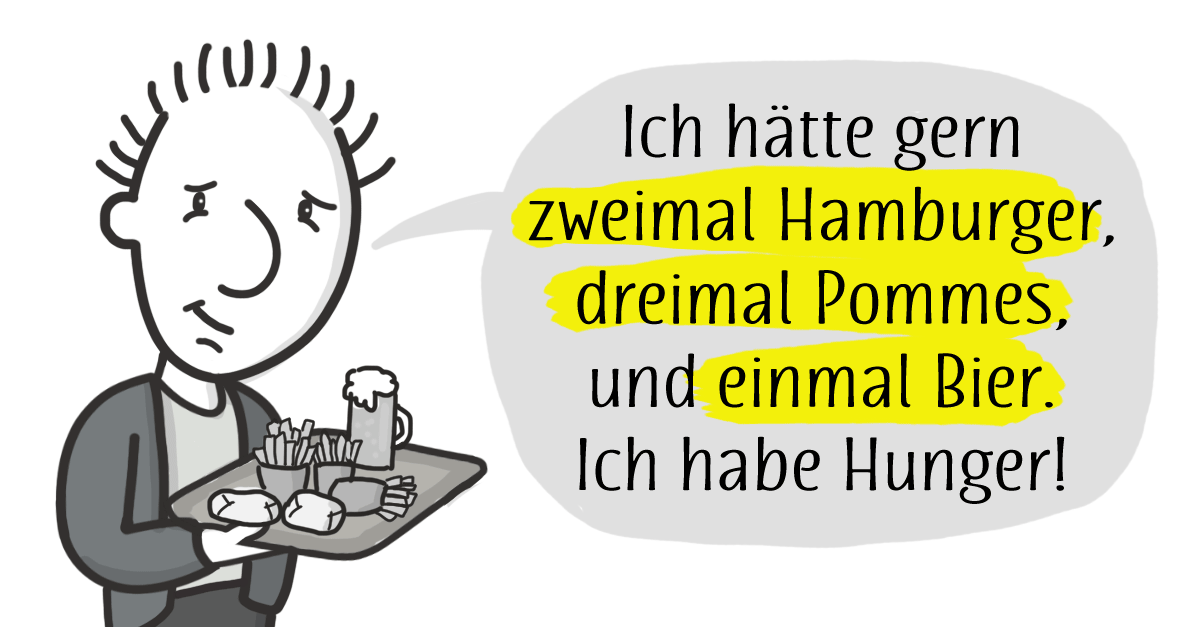
The most common and polite way to order is by using the phrase Ich hätte gern..., which translates to "I would like to have...".
Ich hätte gern...is a form of the verbhaben(to have) in the subjunctive mood, which makes requests sound softer and more polite.Ich möchte...("I would like...") is another excellent and very common alternative. You learned this verb in Module 6.Ich nehme...("I'll take...") is also frequently used and is perfectly acceptable.
Let's dive deeper into these phrases and the etiquette of ordering.
How to Order Food in German: Guide to Dining Out in Germany
The article 'How to Order Food in German' from Olesen Tuition provides a great explanation of polite phrasing and cultural norms.
Read the section titled 'Placing Your Order (Bestellung aufgeben)'. Focus on the paragraphs explaining 'Polite phrasing' to understand the nuances between 'Ich hätte gern...', 'Ich möchte...', and 'Für mich bitte...'.
To help you visualize this key phrase, here is a simple example.
3. Ordering Drinks and Food in Action
Now let's see and hear how these phrases are used in a typical restaurant dialogue. We will first watch how drinks are ordered, and then food.
Notice that when you order something, it becomes the direct object of the sentence. This means you will need to use the accusative case, which you learned about in the previous module. For masculine nouns, the indefinite article changes from ein to einen (e.g., Ich nehme einen Kaffee).
Learn German | Ordering in a Restaurant | das Restaurant | German for beginners | A1 - Lesson 30
Let's return to the 'Learn German | Ordering in a Restaurant' video to see these phrases in action.
First, watch the part about ordering drinks from 03:47 to 05:07. Then, watch the section on ordering food from 05:52 to 07:41. Pay attention to how the customers use 'Ich hätte gern', 'Ich möchte', and 'Ich nehme'.
For another perspective, the following video shows a real, unscripted conversation in a restaurant. The German is spoken more slowly and clearly, which is excellent for listening comprehension.
Ordering in a Restaurant in Slow German | Super Easy German 236
The 'Easy German' channel is fantastic for hearing authentic German. Watch how Cari and Janusz order their food and drinks in this video.
Watch from 01:43 to 04:40. The video has both German and English subtitles. Try listening first with only the German subtitles to test your understanding.
4. Practice Makes Perfect
Now it's your turn to practice.
Exercise 1: Fill in the Blanks
The following image contains a short dialogue in a restaurant. Use the vocabulary provided at the top of the image to fill in the blanks and complete the conversation.

Click here for the solutions.
- Kellner: Guten Tag! Haben Sie reserviert?
- Gast: Ja, einen Tisch für zwei Personen.
- Kellner: Nehmen Sie bitte Platz. Hier ist die Speisekarte.
- Gast: Danke.
- Kellner: Möchten Sie schon etwas trinken?
- Gast: Ja, ich hätte gerne einen Apfelsaft und ein Wasser.
- Kellner: Und was möchten Sie essen?
- Gast: Als Vorspeise nehme ich eine Suppe und als Hauptgericht das Schnitzel.
- Kellner: Guten Appetit!
- Gast: Entschuldigen Sie bitte!
- Kellner: Ja, bitte?
- Gast: Wir hätten gerne noch Salz und Pfeffer.
- Kellner: Sofort.
- Gast: Wir möchten zahlen, bitte. Die Rechnung, bitte.
Exercise 2: Role-Play an Order
This final exercise is a role-play. You will look at a menu and then listen to an audio track where a waitress prompts you. Your task is to respond and place an order.
First, familiarize yourself with the menu from this fish restaurant. You don't need to understand every word, but identify a main dish (Fischgerichte) and a drink you might want to order.
Beginners' German: Food and drink
Take a moment to study this menu from the resource 'Beginners' German: Food and drink' by OpenLearn. This will be the basis for your order in the upcoming audio exercise.
Find the section 'Activity 19' and look at the menu image (Figure 10). Choose one main dish, for example, 'Bratheringe' or 'Lachssteak', and one drink, like 'Erdinger Weißbier' or 'Apfelsaft'.
Now, let's practice ordering. In the following audio exercise (also from Activity 19), you will hear whispered prompts telling you what to say. Respond out loud in the pauses provided.
Beginners' German: Food and drink
This audio exercise will guide you through a complete ordering dialogue. You will play the part of the customer.
Go to 'Activity 19' and play the audio file (Audio 14). Follow the prompts to call the waitress, ask for the menu, and order the main course and drink you selected. For example, when prompted to order 'Bratheringe', you would say: 'Ich möchte Bratheringe, bitte.'
Conclusion
Toll gemacht! (Well done!) You have now learned the essential phrases and cultural context for ordering food and drinks in a German restaurant. This is a significant step towards confident, practical communication.
Key Takeaways:
- The most polite and common way to order is with
Ich hätte gern.... Ich möchte...andIch nehme...are also great alternatives.- Remember to use polite words like
bitte(please) anddanke(thank you). - Ordering an item uses the accusative case, so be mindful of your articles (e.g., einen for masculine nouns).
Preview of the Next Lesson:
We're not leaving the restaurant just yet. In the next lesson, we will complete the transaction by learning how to ask about prices ("Was kostet...?") and how to properly ask for the bill and pay ("Zahlen, bitte!").