Hallo! Welcome back to your German lessons.
In the past few lessons, you've mastered the accusative and dative cases in isolation, learning how they function with specific verbs and prepositions. You can now describe direct objects, locations, and motion towards a destination. Today, we'll combine these concepts to build more complex and natural-sounding sentences.
This lesson addresses the final learning outcome for this module: constructing sentences that contain both an accusative (direct) and a dative (indirect) object. We will explore which verbs allow this structure and, most importantly, the rules that govern the word order of these objects. This skill will significantly expand your expressive range in German.
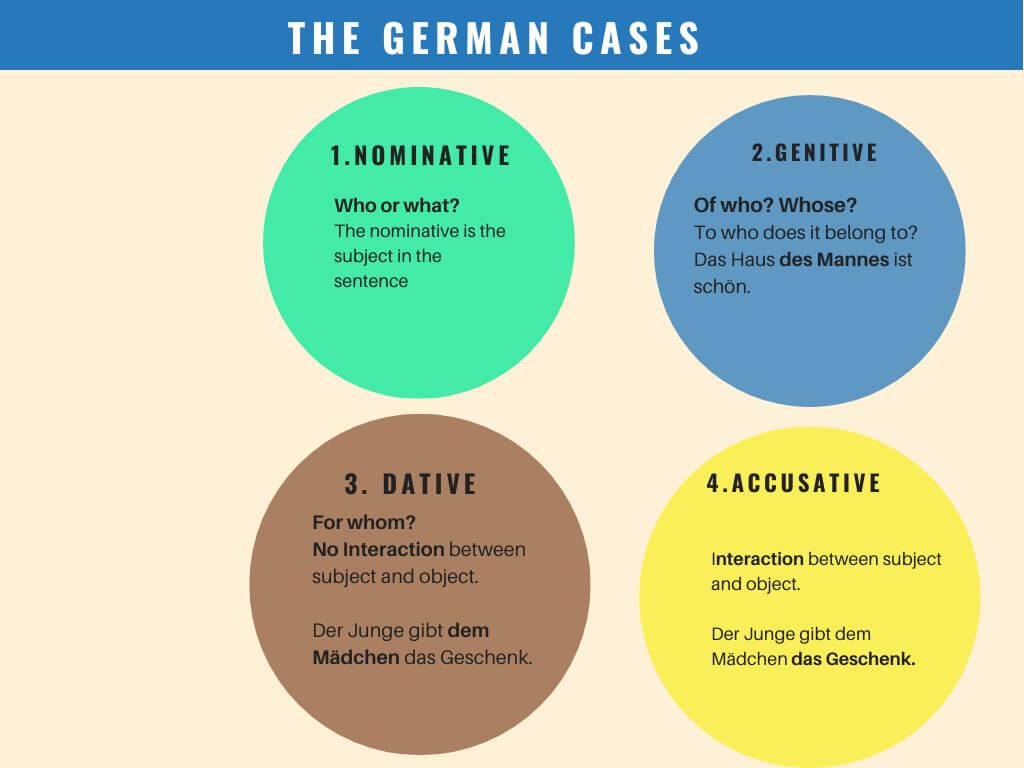
1. Identifying Direct and Indirect Objects
Before we can place objects in a sentence, we need to understand their roles. In English, word order often tells us who is doing what to whom. In German, the case of the noun or pronoun is the primary signal.
A sentence with two objects typically involves an action of giving, sending, showing, or explaining something to someone.
- The thing being acted upon is the direct object and takes the accusative case. You can find it by asking "What?" or "Whom?" (Wen oder was?).
- The person who receives or benefits from the action is the indirect object and takes the dative case. You can find it by asking "To whom?" (Wem?).
To see how this works in practice, let's watch a video that breaks down the concept of building sentences with multiple objects.
German Cases - Get the big picture for a CLEARER understanding | German with Laura
The video 'German Cases - Get the big picture' from the channel 'German with Laura' provides an excellent conceptual foundation. It explains how to identify the roles of the subject, direct object, and indirect object by gradually building up a sentence.
Please watch from 07:08 to 14:41. Focus on these key ideas: How a simple sentence (The woman sings) is expanded first with a direct object (...a song) and then with an indirect object (...her little baby). The roles assigned to each noun: the subject (Nominative), the thing being acted upon (Accusative/direct object), and the recipient (Dative/indirect object). The arrows she uses (12:12) are a helpful mental model: the action goes directly to the accusative object and indirectly to the dative object.
As the video explains, a very useful rule of thumb for many common verbs is:
- The person is in the Dative case.
- The thing is in the Accusative case.
Let's reinforce this with a short article that lists the most frequent verbs that follow this pattern.
Verbs With Two Objects in German
This article from 'Study German Online' clearly defines this sentence structure and provides a handy list of verbs to learn.
Read the sections 'What Are Verbs With Two Objects?' and 'The Main Rule: Dative and Accusative'. Take note of the common verbs listed, such as geben, schenken, schicken, and zeigen.
Here's an image that brings it all together in one sentence.
2. The Rules of Object Word Order
Now that we can identify the dative and accusative objects, we need to know where to place them. The order is not random; it follows a clear set of rules based on whether the objects are nouns or pronouns.
Let's watch a video that explains these rules systematically.
Position of Dativ and Akkusativ Objects | German Sentence Structure Part III | YourGermanTeacher
The video 'Position of Dativ and Akkusativ Objects' by 'YourGermanTeacher' is a comprehensive guide to word order. We will watch it in three parts, each covering one essential rule.
Watch the video from 01:03 to 09:52, paying close attention to the three main scenarios presented. Rule 1: Two Nouns (01:03 - 04:29): The default order is Dative before Accusative. Example: Die Mutter schenkt **dem Kind** (Dat) **einen Teddybär** (Akk). Rule 2: One Pronoun, One Noun (04:29 - 07:23): The Pronoun comes before the Noun, regardless of its case. Example: Die Mutter schenkt **ihm** (Dat-Pro) **einen Teddybär** (Akk-Noun). Example: Die Mutter schenkt **ihn** (Akk-Pro) **dem Kind** (Dat-Noun). Rule 3: Two Pronouns (07:23 - 09:52): The order is Accusative before Dative. Example: Die Mutter schenkt **ihn** (Akk) **ihm** (Dat).
Summary of Word Order Rules
Let's formalize what you just learned. This is one of the most important rule sets for German sentence structure.
| Objects | Rule | Example |
|---|---|---|
| Noun (Dat) + Noun (Akk) | Dative before Accusative | Ich gebe dem Mann das Buch. |
| Pronoun + Noun | Pronoun before Noun | Ich gebe ihm das Buch. (Dative pronoun first) |
| Ich gebe es dem Mann. (Accusative pronoun first) | ||
| Pronoun (Akk) + Pronoun (Dat) | Accusative before Dative | Ich gebe es ihm. |
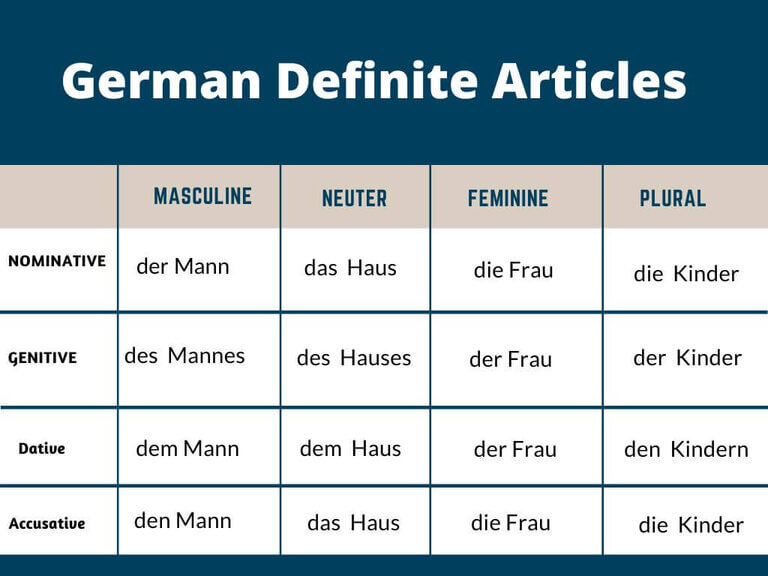
As a quick refresher, here is the declension chart for definite articles. You'll need this to form the sentences correctly.
3. Practice Exercise
Let's apply these rules. For each set of words below, form a complete sentence. Remember to conjugate the verb, put the objects in the correct case, and order them according to the rules you've just learned.
ich / geben / der Mann / das Buchdie Frau / schicken / ihre Freundin / eine E-Mailer / zeigen / ich (dative) / das Fotodu / erklären / es (accusative) / wir (dative)wir / schenken / du (dative) / die Blumen (plural)sie (she) / kaufen / ihr Kind / ein Eisich / geben / sie (accusative, f.) / du (dative)
Click to see the answers
Ich gebe **dem Mann** **das Buch**.(Rule 1: Dative Noun before Accusative Noun)Die Frau schickt **ihrer Freundin** **eine E-Mail**.(Rule 1: Dative Noun before Accusative Noun)Er zeigt **mir** **das Foto**.(Rule 2: Dative Pronoun before Accusative Noun)Du erklärst **es** **uns**.(Rule 3: Accusative Pronoun before Dative Pronoun)Wir schenken **dir** **die Blumen**.(Rule 2: Dative Pronoun before Accusative Noun)Sie kauft **ihrem Kind** **ein Eis**.(Rule 1: Dative Noun before Accusative Noun)Ich gebe **sie** **dir**.(Rule 3: Accusative Pronoun before Dative Pronoun)
Conclusion
Excellent work! You have just learned how to construct some of the most common and useful sentence patterns in German. Mastering this allows you to communicate much more detailed information in a single, fluid sentence.
Key Takeaways:
- Verbs of giving, showing, and sending often take two objects: a dative indirect object (the recipient, usually a person) and an accusative direct object (the thing being transferred).
- Word order is determined by whether the objects are nouns or pronouns.
- Noun + Noun: Dative before Accusative.
- Pronoun + Noun: Pronoun first.
- Pronoun + Pronoun: Accusative before Dative.
- This structure can be remembered by the acronym TeKaMoLo for sentence elements, but for objects specifically, the simple mnemonic Da-Aku (Dative-Accusative for nouns) is a good starting point.
Preview of the Next Lesson:
We are now finished with Module 9. In our next lesson, we will begin Module 10: "Home and Routine." We'll start by learning vocabulary for family members and relationships. This will give you the perfect opportunity to practice what you've learned about cases, as we introduce possessive articles (mein, dein, sein, etc.) and learn how to decline them in the nominative, accusative, and dative cases. For example, you'll soon be able to say "I am giving my brother a book." (Ich gebe **meinem Bruder** ein Buch.).