Introduction
Hallo! In our previous lesson, you learned how to use ordinal numbers to talk about dates, which is a key skill for making appointments. Today, we'll continue building your practical German skills by focusing on a closely related topic.
This lesson addresses the learning outcome: Tell the time in German using both formal (14:30) and informal (halb drei) conventions. Just as English has "two-thirty" and "half past two," German also has distinct systems for formal and informal contexts. Mastering both will allow you to understand train schedules, arrange meetings with friends, and navigate daily life with much more confidence.
1. How to Ask for the Time
Before you can tell the time, you need to know how to ask for it. There are two very common ways to do this in German, and they are used interchangeably.
To learn these phrases, let's consult a helpful article.
Telling the time in German – rules, nach and vor, halb, 12 - Preply
The article 'Telling the time in German' from Preply clearly lays out the two standard questions for asking the time.
Read the section titled 'Ask for the time naturally'. It introduces the two key questions and provides pronunciation guides for essential vocabulary.
As you just read, the two main questions are:
Wie spät ist es?(Literally: "How late is it?")Wie viel Uhr ist es?(Literally: "How much o'clock is it?")
Both simply mean "What time is it?" and are perfectly natural to use in any situation.
2. The Formal Way: The 24-Hour Clock
The formal way of telling time in German uses the 24-hour system, often called military time in English. This is the standard for official announcements, news broadcasts, public transportation schedules, and formal appointments. Its structure is very logical and easy to learn.
The basic formula is: Es ist [hour] Uhr [minutes].
For example:
- 14:30 is
vierzehn Uhr dreißig. - 08:05 is
acht Uhr fünf. - For the full hour, you just state the hour and
Uhr. For example, 15:00 isfünfzehn Uhr.
Let's watch a video that walks through this system with clear examples.
How to Tell Time in German - A1 [with Jenny]
The first part of this video from 'lingoni GERMAN' provides an excellent explanation of the 24-hour clock and its use in formal contexts.
Please watch from 00:23 to 02:49 and then from 07:10 to 07:59. The first segment covers full hours and the 24-hour system. The second segment reinforces this by showing how to state exact times with minutes, which is typical for formal situations.
As the video explained, while this 24-hour system is essential for understanding official information, it's less common in casual, everyday conversation. For that, we use the informal system.
3. The Informal Way: Colloquial Time
In daily conversations with friends, family, and colleagues, Germans use an informal system based on a 12-hour clock. This system is similar to using phrases like "quarter to" and "half past" in English, but with one very important difference.
Let's break it down piece by piece. The following video sections will be our guide.
How to Tell Time in German - A1 [with Jenny]
The next sections of the 'lingoni GERMAN' video break down the components of informal time-telling. We'll watch them one by one.
a) Half Past: halb
This is the most critical and often trickiest part for English speakers. In German, halb refers to the coming hour.
halb neun(half nine) means 8:30, because it is "halfway to nine."halb drei(half three) means 2:30, because it is "halfway to three."
This is the opposite of the English logic ("half past eight"). Internalizing this is key to telling time correctly in casual settings.
How to Tell Time in German - A1 [with Jenny]
Now, watch the segment on using 'halb'. Pay close attention to how the hour mentioned is always the next hour.
Watch from 02:49 to 03:52.
b) Quarters: Viertel
Quarters are more straightforward and follow a logic similar to English.
Viertel nachmeans "quarter past". Example:Viertel nach zweiis 2:15.Viertel vormeans "quarter to". Example:Viertel vor dreiis 2:45.
How to Tell Time in German - A1 [with Jenny]
Let's continue with the video to see how 'Viertel' is used.
Watch from 03:52 to 04:55.
c) Minutes Past and To: nach and vor
For all other times, you use nach (after/past) and vor (before/to). The structure is:Es ist [minutes] nach/vor [hour].
- 2:10 is
zehn **nach** zwei. (ten past two) - 2:50 is
zehn **vor** drei. (ten to three) - Germans typically use
nachfor minutes 1-29 andvorfor minutes 31-59, referencing the nearest full or half hour.
How to Tell Time in German - A1 [with Jenny]
This final clip explains how to use 'nach' and 'vor' for specific minutes. It also touches on some more advanced colloquialisms, like 'fünf nach halb drei' (2:35), which means 'five minutes past half-to-three'.
Watch from 04:55 to 07:10.
This image provides a great visual summary of all the informal time expressions on a clock face.
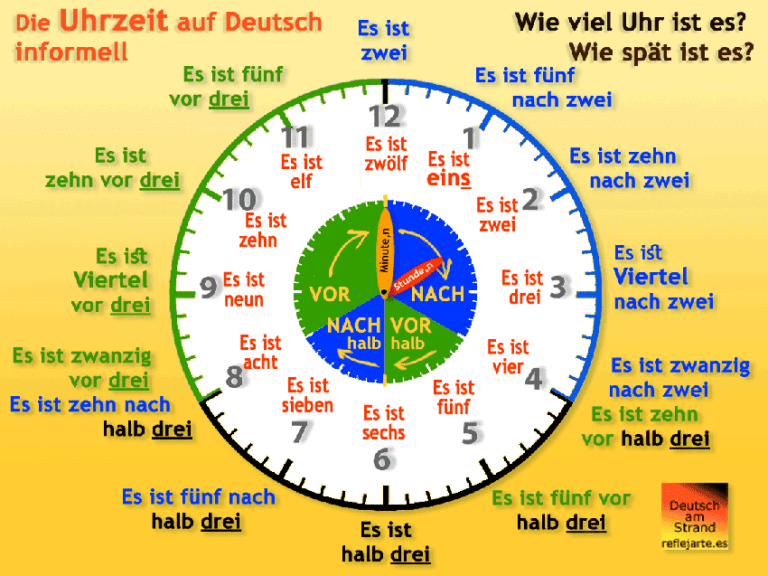
4. Practice Exercises
Now it's time to practice what you've learned. The following resource contains some excellent exercises to test your understanding.
Telling the time in German – rules, nach and vor, halb, 12 - Preply
The 'Telling the time in German' article from Preply that we saw earlier also includes a great practice section at the end.
Scroll down to the section 'Practice telling the time with exercises'. Complete both the 'Fill-in-the-blank conversions' and the 'Multiple choice clock quiz'. After you have tried to answer them, check your work using the 'Answers' section immediately below the exercises.
For a different style of practice, the article from Your Daily German offers another quiz. This one distinguishes between "news speak" (formal) and "street speak" (informal), which you may find helpful. You can find it under the title "Time of Day" in German - Both Versions Explained (resource ID LINK).
Conclusion
Toll gemacht! (Well done!) You now have the tools to understand and express time in both formal and informal German. This is a significant step toward fluency in everyday situations.
Key Takeaways:
- There are two ways to ask for the time:
Wie spät ist es?andWie viel Uhr ist es? - Formal time uses the 24-hour clock (e.g., 16:45 is
sechzehn Uhr fünfundvierzig). It is precise and used in official contexts. - Informal time uses a 12-hour system with special phrases. The most important rule is that
halbrefers to the next hour (e.g.,halb achtis 7:30). - Use
Viertel nachfor quarter past,Viertel vorfor quarter to, andnach/vorfor other minutes.
Preview of the Next Lesson:
In our next lesson, we will complete this module by learning to name the days of the week, months, and seasons. Combining this with your knowledge of numbers, dates, and time will give you a comprehensive ability to discuss schedules and plans in German. Bis zum nächsten Mal