Hallo! Willkommen zurück.
In our last lesson, we focused on describing your daily routine using separable verbs like aufstehen and einkaufen. We ended with a preview of verbs like sich anziehen (to get dressed), which are not only separable but also reflexive.
Today, we'll dive into that topic. This lesson will equip you to talk about another key part of your daily routine: personal care. Our goal is to use reflexive verbs in the accusative case to describe personal care activities, focusing on common verbs like sich waschen (to wash oneself) and sich anziehen (to get dressed). This will add more detail and authenticity to your descriptions of your Tagesablauf (daily routine).
1. What Are Reflexive Verbs?
Reflexive verbs describe an action that the subject performs on itself. The action "reflects" back onto the doer. Think of it like this:
- I see you. (Subject
Iand objectyouare different) - I see myself. (Subject
Iand objectmyselfare the same)
In German, this concept is handled with reflexive pronouns (Reflexivpronomen). While English uses "-self" pronouns, German uses specific pronouns like mich, dich, and, most importantly, sich.
To get a clear and engaging introduction to this idea, let's watch a video.
Understanding GERMAN REFLEXIVE VERBS…do you know THESE?
The video 'Understanding GERMAN REFLEXIVE VERBS' from the 'Bausteine eins' channel clearly explains the logic behind reflexive verbs by comparing sentences where the subject and object are different versus when they are the same.
Please watch the video from the beginning until 04:39. The speaker will explain: The difference between a normal direct object and a reflexive object. Why the special pronoun 'sich' is needed in the 3rd person (for 'he', 'she', 'it', 'they'). How reflexive verbs are often used for daily routines.
2. Accusative Reflexive Pronouns
The learning outcome for this lesson focuses on the accusative case, which you'll remember is used for the direct object of a sentence. When the subject is also the direct object, we use an accusative reflexive pronoun.
Here is a chart showing the personal pronouns and their corresponding reflexive forms. For today, we're focusing on the accusative column.
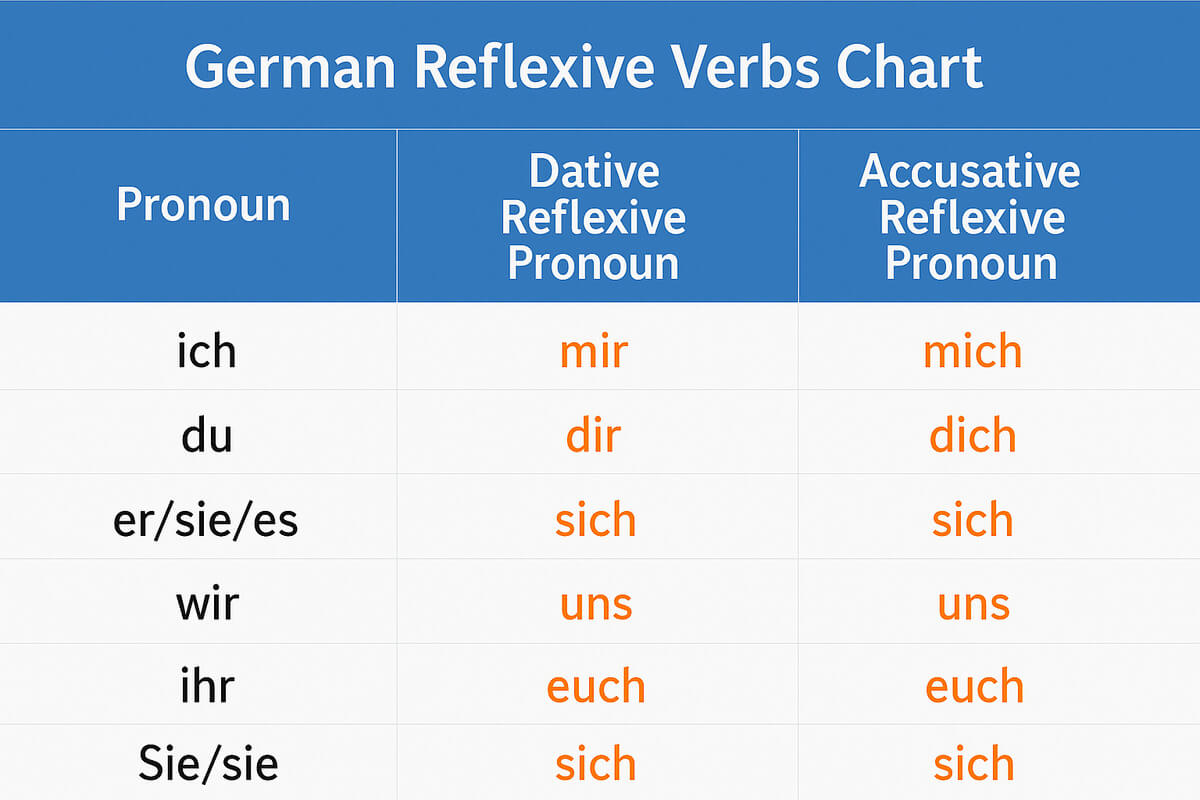
As you can see, the forms for ich (mich), du (dich), wir (uns), and ihr (euch) are the same as the regular accusative pronouns you already know. The key new form is sich, which is used for er, sie, es, and the plural/formal sie/Sie.
| Personal Pronoun | Accusative Reflexive Pronoun | Example Sentence |
|---|---|---|
ich |
mich | Ich wasche mich. (I wash myself.) |
du |
dich | Du wäschst dich. (You wash yourself.) |
er/sie/es |
sich | Er wäscht sich. (He washes himself.) |
wir |
uns | Wir waschen uns. (We wash ourselves.) |
ihr |
euch | Ihr wascht euch. (You (all) wash yourselves.) |
sie/Sie |
sich | Sie waschen sich. (They/You (formal) wash themselves/yourself.) |
The reflexive pronoun typically comes directly after the conjugated verb.
3. Vocabulary: Personal Care Activities
Let's learn some of the most common reflexive verbs used for personal care. Many of these are considered "obligatory reflexives" in German, meaning they are almost always used with a reflexive pronoun.
Reflexive Verben – Deutsch 101-326
The article 'Reflexive Verben' from the University of Michigan provides excellent lists of reflexive verbs. We'll look at the section on verbs for daily routines.
Please read the section titled 'Obligatory Reflexives'. Focus on the table that lists verbs related to 'grooming and one’s daily routine'. Pay attention to verbs like 'sich baden', 'sich duschen', 'sich waschen', and 'sich anziehen'.
Here are the key verbs from that list, plus a few others. Notice that sich anziehen is also separable, just like we learned in the last lesson. The prefix an goes to the end of the sentence.
- sich waschen: to wash oneself
Ich wasche mich am Morgen.(I wash myself in the morning.)
- sich duschen: to shower
Er duscht sich jeden Tag.(He showers every day.)
- sich anziehen: to get dressed
Sie zieht sich schnell **an**.(She gets dressed quickly.)
- sich rasieren: to shave
Mein Vater rasiert sich nicht.(My father doesn't shave.)
- sich kämmen: to comb one's hair
Wir kämmen uns vor dem Spiegel.(We comb our hair in front of the mirror.)
To hear some of these verbs in action, let's watch a few short clips.
ALL A1 German Reflexive Verbs with Prepositions and Example Sentences
The video 'ALL A1 German Reflexive Verbs' by YourGermanTeacher gives clear examples of individual verbs. We will watch the segments for three of our key verbs.
Please watch the following three short clips to hear the pronunciation and see an example sentence for each verb: sich anziehen (to get dressed): Watch from 02:07 to 02:35. sich duschen (to shower): Watch from 04:24 to 04:45. sich waschen (to wash oneself): Watch from 10:00 to 10:18.
4. A Quick Note: Accusative vs. Dative
Since you have already studied the dative case (Module 9), it's useful to see how it interacts with reflexive verbs. This will help you avoid a common pitfall.
The rule is simple:
- If the reflexive pronoun is the only object in the sentence, it is accusative.
Ich wasche **mich**.(I wash myself.)
- If you add another direct object (like a body part), that object takes the accusative case, and the reflexive pronoun switches to the dative.
Ich wasche **mir** die Hände.(I wash my hands. - literally, "I wash for myself the hands.")
Let's clarify this with a reading.
Reflexive Verben – Deutsch 101-326
The same article from the University of Michigan has a great section that explains this rule clearly.
Read the section titled 'Accusative vs Dative Reflexive Pronouns'. Focus on the examples with 'Ich wasche mich' versus 'Ich wasche mir das Gesicht'. This distinction is very important for correct usage.
For today's lesson, we will continue to focus our practice on the accusative case, but keep this dative rule in mind as you progress.
5. Practice Time
Your preference for exercises will serve you well here. Let's put this knowledge into practice.
Exercise 1: Fill in the Blanks
Complete the sentences with the correct accusative reflexive pronoun (mich, dich, sich, uns, euch).
- Ich stehe auf und dann dusche ich _____.
- Beeilst du _____? Der Bus kommt gleich! (sich beeilen = to hurry)
- Er rasiert _____ jeden Morgen im Badezimmer.
- Wir ziehen _____ für die Party an.
- Warum kämmt ihr _____ nicht die Haare? (Oops, tricky one! This one has a direct object, 'die Haare', so the answer would be dative: 'euch'. Let's try another.)
5. Ihr müsst _____ beeilen! (You all must hurry!) - Die Kinder waschen _____ vor dem Abendessen nicht.
Exercise 2: Building Sentences
Create sentences from the following prompts. Remember to conjugate the verb correctly.
- ich / sich anziehen / um 8 Uhr.
- du / sich waschen / am Abend?
- meine Schwester / sich kämmen / im Bad.
- wir / sich duschen / nach dem Sport.
(You can find the solutions at the end of the lesson.)
Conclusion
Sehr gut! You have now learned how to use another essential verb type in German. By mastering reflexive verbs, you can describe your daily personal care routine much more accurately.
Key Takeaways:
- Reflexive verbs are used when the subject performs an action on itself.
- They require a reflexive pronoun (e.g.,
mich,dich,sich). - The reflexive pronoun is accusative if it's the only object in the sentence.
- You learned key vocabulary for personal care, including
sich waschen,sich duschen, and the separable-reflexive verbsich anziehen. - In a simple sentence, the reflexive pronoun comes right after the conjugated verb.
Preview of the Next Lesson:
This was the final piece of new grammar for this module. In our next and final lesson of Module 10, you will write a short text about your family, home, and daily routine. This will be a great opportunity to combine everything you've learned: possessive articles, vocabulary for home, separable verbs, and now, reflexive verbs.
Solutions to Exercises:
Exercise 1:
- Ich stehe auf und dann dusche ich mich.
- Beeilst du dich? Der Bus kommt gleich!
- Er rasiert sich jeden Morgen im Badezimmer.
- Wir ziehen uns für die Party an.
- Ihr müsst euch beeilen!
- Die Kinder waschen sich vor dem Abendessen nicht.
Exercise 2:
Ich ziehe mich um 8 Uhr an.Wäschst du dich am Abend?Meine Schwester kämmt sich im Bad.Wir duschen uns nach dem Sport.