Hello! Welcome back to the course.
In our last lesson, we introduced the core concept of System 1 and System 2 thinking. We established that while most digital products are designed for the fast, intuitive System 1, your goal is to design experiences that purposefully engage the slower, more deliberate System 2. We concluded that engaging System 2 is inherently effortful.
Today, we will dissect what that "effort" really means by exploring Cognitive Load Theory. This lesson will equip you with a precise vocabulary to understand and manage the mental workload a user experiences. Our learning outcome is to explain the three types of cognitive load (intrinsic, extraneous, and germane) and their impact on a user's capacity for System 2 engagement.
By the end of this lesson, you'll be able to see an interface not just as a collection of visual elements, but as a system that either supports or drains a user's limited mental energy—the very energy needed for deep thought.
The Bottleneck of the Mind: Working Memory
Before we can talk about cognitive load, we must first understand the "space" where this load is processed: working memory. Think of it as your brain's RAM. It's the mental workspace where you hold and manipulate information you're actively thinking about.
The crucial thing to know is that working memory is extremely limited. It can only handle a few new pieces of information at once. In contrast, your long-term memory is like a vast hard drive, with nearly unlimited storage for knowledge you've already integrated. The process of learning is essentially about successfully transferring information from the temporary workspace of working memory into the permanent structures (called "schemas") of long-term memory.
The following video provides an excellent overview of this process and sets the stage for why cognitive load is such a critical concept.
Cognitive Load Theory (Definition + Examples)
This video from Practical Psychology explains the relationship between sensory input, working memory, and long-term memory. Pay close attention to the idea that overwhelming working memory is what prevents learning and retention.
Please watch from the start (00:00) until the timestamp 03:13. This will cover the definitions of sensory, working, and long-term memory, and explain why working memory is the bottleneck.
As the video highlights, when we design an interface or a task that bombards a user's working memory, we're not just making things difficult; we're actively preventing them from thinking clearly and learning effectively. This is what cognitive load theory is all about.
The Three Flavors of Mental Effort
Cognitive Load Theory, developed by psychologist John Sweller, proposes that the total load on our working memory is composed of three distinct types. They all add up, and if their sum exceeds our capacity, we experience cognitive overload.
Let's start with a quick, high-level overview of these three types.
Cognitive Load Theory 3 - intrinsic, extraneous, germane.
This very short video from 3 Minute Ed Theory offers a concise introduction to the three types of cognitive load and how they relate to each other.
Watch the entire video (it's less than 3 minutes). It will give you a clear, foundational definition of intrinsic, extraneous, and germane load, which we will then explore in more detail.
Now that you have a basic definition of each, let's connect them directly to your work in product design. For a deep dive into how these concepts apply to UI/UX, we'll turn to a detailed article.
Cognitive Load Theory in UI Design | Aufait UX
The article 'Cognitive Load Theory in UI Design' from Aufait UX is an excellent resource that translates this psychological theory into practical terms for designers. It breaks down each type of load with specific UI pain points and solutions.
Please read the section 'Types of Cognitive Load That Affect User Experience,' including its three subsections on Intrinsic, Extraneous, and Germane load. Focus on how the article defines each type and links it to concrete design problems and solutions.
Let's consolidate what you've just read and watched.
-
Intrinsic Cognitive Load: This is the inherent, unavoidable difficulty of a task or topic. Learning a new language, filing taxes, or understanding a complex data visualization all have high intrinsic load. You cannot eliminate it, but you can manage it by breaking down complex information into smaller, sequential steps.
-
Extraneous Cognitive Load: This is the "bad" load. It is any mental effort that is not necessary for completing the task. It's caused by poor design: a cluttered interface, confusing navigation, inconsistent terminology, or distracting animations. As a designer, your primary goal is to ruthlessly minimize this.
-
Germane Cognitive Load: This is the "good" load. It's the effortful mental work that leads to deep understanding and the creation of new schemas in long-term memory. This is the cognitive work of System 2—comparing concepts, making connections, and constructing a mental model. Your goal is to promote and maximize this type of load.
This diagram provides a useful visual summary of the designer's role in managing these three loads.
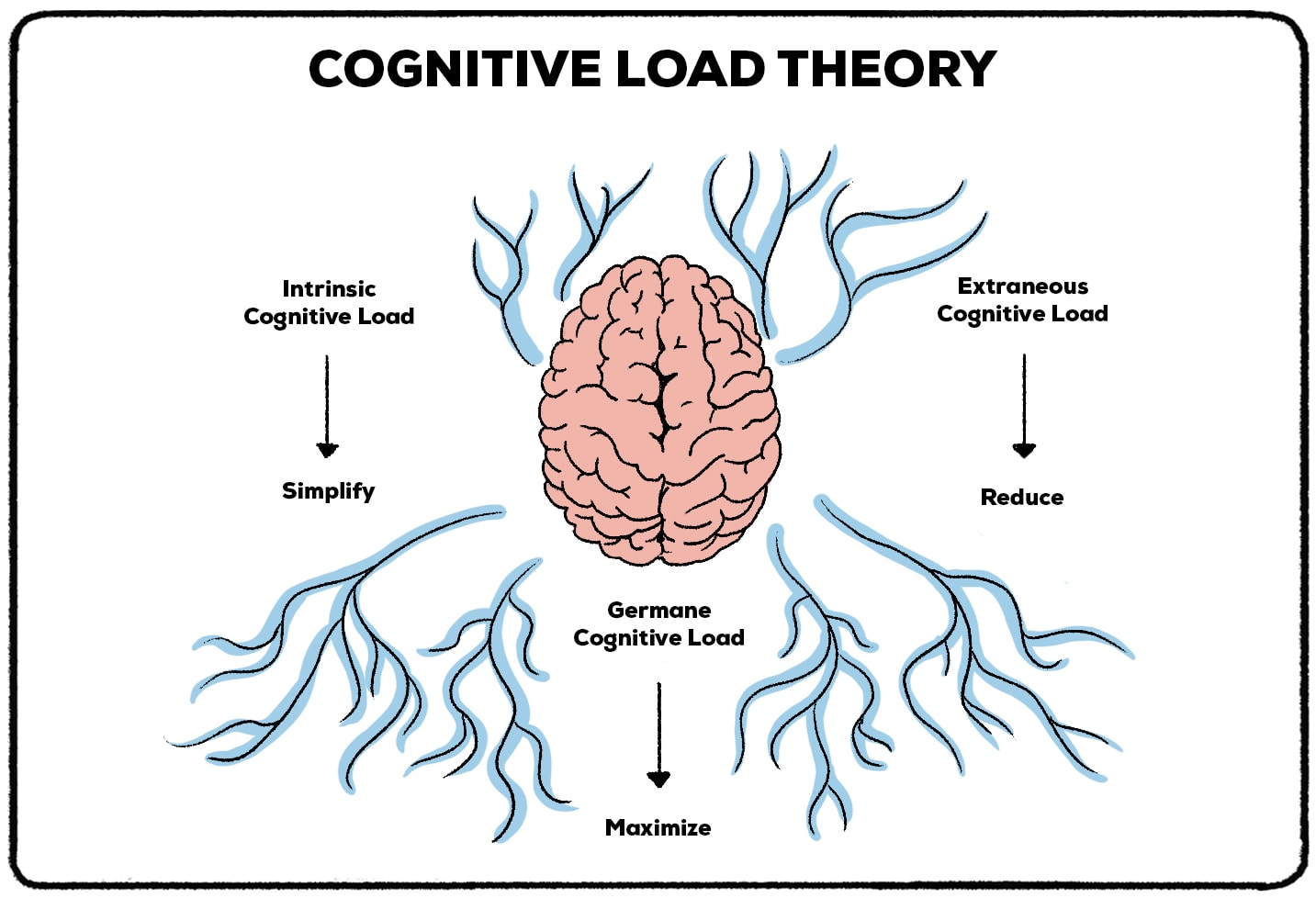
Balancing the Load to Engage System 2
The relationship between the three loads is the key to everything. Think of it as an equation:
Your user's working memory has a fixed capacity. If the combination of Intrinsic and Extraneous load is too high, it consumes all available mental resources. There is simply no capacity left for Germane load. The result? The user can't think deeply, can't learn, gets frustrated, and either gives up or reverts to mindless System 1 behavior.
This is the core challenge of designing for deep engagement:
To facilitate the effortful thinking of System 2 (Germane Load), you must first manage the task's complexity (Intrinsic Load) and eliminate all unnecessary mental friction from the interface (Extraneous Load).
When you successfully minimize extraneous load, you create the mental space necessary for users to tackle the intrinsic complexity of a task and engage in the productive, germane processing that leads to learning and mastery.
From Theory to Practice
Let's look at how this plays out in real-world products. The Aufait UX article you read earlier provides excellent examples of both good and bad design through the lens of cognitive load.
Cognitive Load Theory in UI Design | Aufait UX
Let's revisit the 'Cognitive Load Theory in UI Design' article to see these principles in action.
Please read the sections 'Good UI Examples That Apply Cognitive Load Principles' and 'Examples of High Cognitive Load in UI.' As you read about each example (like Duolingo or a cluttered dashboard), try to identify which types of cognitive load are being managed well or poorly.
Duolingo, for instance, is a masterclass in managing cognitive load for learning:
- Manages Intrinsic Load: It breaks down language learning into tiny, bite-sized exercises (e.g., match a word, translate a short sentence).
- Minimizes Extraneous Load: The interface is clean, focused on a single question at a time, with no distracting elements.
- Maximizes Germane Load: With all mental capacity freed up, the user can focus 100% of their effort on the actual learning task—connecting a word to its meaning, understanding a grammatical rule, and building those crucial long-term memory schemas.
This careful balancing act is precisely how you create an environment where a user can comfortably engage their "second brain."
Conclusion
In this lesson, we moved from the general concept of "effort" to a specific, actionable framework for managing it.
Key Takeaways:
- Working memory is limited. Overloading it prevents deep thinking and causes frustration.
- Cognitive load comes in three forms:
- Intrinsic: The inherent difficulty of the task. Your job is to manage it.
- Extraneous: The difficulty caused by the interface design. Your job is to minimize it.
- Germane: The effort that leads to learning and understanding. Your job is to maximize it.
- Engaging System 2 requires freeing up mental capacity for germane load. This is achieved by simplifying complex tasks and designing clean, intuitive interfaces.
Preview of the Next Lesson:
Now that you have the theoretical framework of System 1/2 and Cognitive Load Theory, it's time to put it to use. In the next lesson, we will analyze real-world digital products to identify design choices that deplete or preserve users' attentional resources. You'll act as a critic, applying what you've learned today to evaluate interfaces and articulate exactly why certain designs feel effortless while others feel frustrating.