Hello! Welcome to the fourth lesson in our course, "Framework for Individual Reflection on Corruption."
In our last lesson, we drew a crucial distinction between art as activism (seeking an external Effect) and art as contemplation (provoking an internal Affect). We concluded that for your goal of fostering individual reflection, a contemplative approach is the most potent strategy. This approach creates an internal shift in perception, bypassing the psychological defenses that direct accusation often raises.
Introduction
Approximate time to complete: 60 minutes
Today, we transition from the why to the how. If the goal is to create contemplative art, what are the tools an artist uses to achieve this? This lesson addresses the following learning outcome:
Analyze the role of allegory and metaphor in communicating nuanced critiques of power that encourage introspection over accusation.
Allegory and metaphor are foundational techniques for crafting the kind of subtle, layered critiques that invite an audience to think and feel, rather than simply react. They are tools for asking questions, not shouting answers. Understanding them is essential for building the practical guidance your framework will offer to creators.
In this lesson, we will cover:
- Clear definitions of allegory and metaphor, linking them to your design vocabulary.
- Why these tools are uniquely suited to critiquing power in a way that fosters reflection.
- Practical examples from literature and visual art that demonstrate these concepts in action.
Let's begin.
Part 1: Defining Our Tools: Allegory and Metaphor
At their core, both allegory and metaphor are ways of speaking about one thing in terms of another. This act of translation is where their power lies.
- Metaphor: A direct comparison between two unlike things. It says A is B. For example, "corruption is a cancer." It takes an abstract, complex idea (corruption) and maps it onto a concrete, understood one (cancer), transferring attributes like "insidious," "damaging," and "spreading."
- Allegory: An extended, narrative metaphor. It’s not just a single statement; it's a complete story, poem, or image where characters, events, and settings represent abstract ideas or real-world issues. George Orwell's Animal Farm is a classic allegory for the Russian Revolution.
From your perspective as a product designer, you could think of it this way:
- A metaphor is like a well-designed icon: a simple, instantly recognizable symbol that stands for a more complex action or concept (e.g., a magnifying glass for "search").
- An allegory is like a complete user journey map: a narrative that illustrates a complex process from start to finish, with each step and persona representing a different part of the system.
To get a deeper feel for allegory from a creator's perspective, please spend about 10 minutes reading from the article by author Erika Swyler.
Reading (10 mins):
- Please read the sections "What Is Allegory?" and "Using Allegory for Plot" in Symbolic Drive: Using Allegory in Fiction by Erika Swyler.
- Focus on: How Swyler describes allegory not as a way to create flat, moralizing stories, but as a "scaffold" or "framework" that provides clarity and drives the narrative. Notice how she argues that once this framework is in place, there is "endless room for nuance, character, specificity, and real contemplations."
Part 2: The Strategic Power of Allegory and Metaphor
Why choose these indirect methods to critique a system like corruption? Why not just say what you mean? Because how you deliver a message determines if it's received, rejected, or—most importantly—reflected upon.
1. Bypassing Psychological Defenses
Direct accusations provoke defensive reactions. If you tell someone they are complicit in a corrupt system, their immediate instinct is to deny it. Allegory and metaphor act as a "Trojan horse" for difficult truths.
As Erika Swyler explains in her article Symbolic Drive: Using Allegory in Fiction, allegory provides a "veneer of protection." By setting a story in a fictional world—with talking animals, for instance—the creator gives the audience plausible deniability. "This isn't about me; it's just a story about pigs." This lowers the viewer's guard. The message, as Swyler beautifully puts it, "worms into the mind." The connection between the story and the real world happens as a delayed realization—a moment of personal insight, not forced instruction.
2. Inviting Co-Creation of Meaning
A direct political statement dictates meaning. An allegorical work invites the audience to become an active participant in discovering it.
The paper The Allegory and Metaphor in Visual Arts highlights this perfectly. It explains that allegorical art "raise[s] questions and stir[s] minds searching for interpretations." An artist can create a work like Botticelli's Primavera, which has been interpreted in mythological, philosophical, and historical ways for centuries. There is no single "correct" answer.
This is crucial for fostering introspection. When a person connects the dots on their own, the resulting insight feels earned and personal. It's the difference between being told what to think and being given the tools to think for yourself. This empowers the individual and makes the resulting transformation more profound and durable.
3. Making the Abstract Concrete
Corruption is often a vast, systemic, and abstract force. It's hard to grasp emotionally. Metaphor and allegory give it a tangible form. They turn an abstract concept into something we can see, feel, and relate to.
Let's analyze an example.
 A modern allegory based on Plato's 'Allegory of the Cave,' critiquing humanity's relationship with technology and social media.
Plato's original allegory used the image of prisoners in a cave mistaking shadows for reality to explore the nature of truth and enlightenment. Look at how this modern version adapts that structure:
- What are the "shadows on the wall" here? The Facebook logo, digital interfaces.
- Who are the "prisoners"? The figures with monitors for heads, chained and watching the projections.
- What is the "reality" outside the cave? A world bathed in natural light, where one figure has escaped.
This image doesn't need to write a long essay on the isolating and reality-distorting effects of social media. It uses the allegorical framework of the cave to make its point in a powerful, visual, and deeply unsettling way. It encourages us to ask: "Am I one of those prisoners? What are the shadows I'm mistaking for reality?" This is introspection in action.
Part 3: Allegory and Metaphor in Practice
Let's look at a few more examples of how artists use these tools to provoke thought without being preachy.
The Dual Image in Visual Art
Surrealist artists were masters of using visual metaphors to challenge perception.
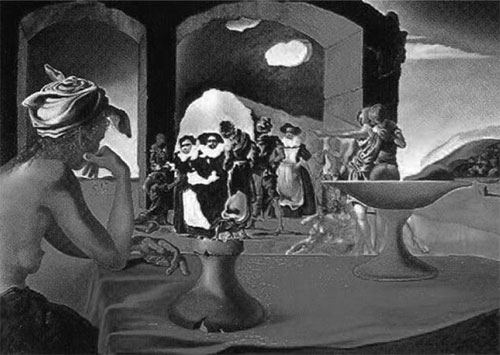 Salvador Dalí, "Slave Market with the Disappearing Bust of Voltaire" (1940). The arrangement of figures and objects creates an optical illusion of a bust of the philosopher Voltaire.
This painting is a brilliant metaphor for the act of interpretation itself. At first glance, you might see one scene (a market with several figures). But with a shift in perspective, another image emerges: the bust of Voltaire, a philosopher who championed reason and challenged the dogmatic power of the establishment.
Dalí isn't telling you what to think about Voltaire. Instead, he embeds the critique within the very act of looking. He forces the viewer to work, to look deeper, and to question their own perception to find the hidden meaning. The "aha!" moment of seeing the bust is a moment of personal discovery, mirroring the kind of enlightenment Voltaire himself advocated.
Material as Metaphor
Sometimes, the material an artwork is made from is the most powerful metaphor.
The paper The Allegory and Metaphor in Visual Arts discusses the artist Mona Hatoum. In her work Divan Bed (1996), she creates what looks like a bed, an object we associate with comfort, rest, and privacy. However, she constructs it from cold, hard steel plates.
The material completely subverts the object's expected meaning. The bed is no longer a place of comfort; it is one of anxiety, pain, and institutional coldness. Hatoum uses this powerful metaphor to comment on themes of displacement, political oppression, and the loss of home. She doesn't need a label explaining this; the clashing metaphor of a hard bed does all the affective work, creating a visceral feeling of discomfort in the viewer that invites them to reflect on the source of that feeling.
Conclusion
In this lesson, we've unpacked how allegory and metaphor serve as essential techniques for the kind of contemplative art your framework aims to foster.
Key Takeaways:
- Allegory and Metaphor as Strategic Tools: They are not just decorative but are strategic choices for communicating complex critiques of power.
- Encouraging Introspection: They achieve this by bypassing psychological defenses, inviting the audience to participate in creating meaning, and making abstract concepts like corruption tangible and relatable.
- Moving Beyond Accusation: Instead of pointing a finger, these techniques create a space for self-implication and personal discovery, which is the heart of genuine reflection.
By incorporating guidance on allegory and metaphor into your framework, you will be equipping creators with powerful methods to craft work that prompts quiet reflection rather than loud, and often futile, accusation.
Preview of Next Lesson:
We've explored how to reframe a critique using symbolic language. In the next lesson, we will examine a related but distinct technique: defamiliarization. We will learn about Viktor Shklovsky's concept and how making the familiar systems of corruption appear strange and new can shock an audience out of their complacency and force them to re-evaluate what they take for granted.