Hello! Welcome to your sixth and final lesson in the first module, "Foundations of Art, Power, and Reflection."
In our last lesson, we explored 'defamiliarization,' a technique for making the familiar, everyday aspects of corruption seem strange and unsettling. We focused on disrupting our perception of the present.
Introduction
Approximate time to complete: 55 minutes
Today, we'll explore a methodology that is a natural fit for your background in product design and systems thinking: Speculative Design. Instead of just making the present strange, we will learn how to design and prototype tangible pieces of possible futures to provoke reflection on where we are today.
This lesson directly addresses the learning outcome:
Explain 'Speculative Design' as a methodology for prototyping and reflecting on alternative futures shaped by corruption.
For your goal of creating a framework, this is a powerful, process-driven approach. It moves beyond critique into the realm of creation, using the design skills you already possess to build provocative "what if" scenarios.
In this lesson, we will cover:
- The core purpose of Speculative Design: shifting from problem-solving to problem-finding.
- The methodology: a concrete process for ideating and prototyping alternative futures.
- How to apply this methodology to explore the potential evolution of corruption.
Let's explore how designing for the future can change how we think about today.
Part 1: A Different Kind of Design
In your work as a Product Design Lead, you excel at solving complex problems. You frame challenges, conduct research, and design elegant, actionable solutions. This is often called "affirmative design"—it affirms the world as it is and seeks to improve it.
Speculative Design operates on a different axis. It's not about solving problems but about finding them. It's not about providing answers but about asking better questions. The goal isn't to create a commercial product, but to spark debate and critical reflection.
The pioneers of this field, Dunne and Raby, capture this distinction beautifully in their "A/B manifesto." 'A' is the commercial design world you know well; 'B' is the critical, speculative space.
Reading (10 mins):
- Please read the Abstract and Section 2.1 "SCD features and background" from (PDF) Speculative and Critical Design — Features, .... This is an academic paper, so focus on the high-level concepts.
- Pay close attention to Table 1, the "A/B manifesto." Think about how the 'B' column (Critical) contrasts with your daily work.
- Also, note the connection to science fiction and "social dreaming."
As the reading suggests, Speculative Design doesn't aim to predict the future. Instead, it creates tangible artifacts from possible futures to make us question the path we are on. A famous pop-culture example is the Black Mirror episode "Nosedive," which speculates on a future where social credit dictates life outcomes. The episode isn't a prediction; it's a provocation designed to make us reflect on our current relationship with social media and validation.
This approach is perfect for tackling a systemic issue like corruption. Instead of just saying corruption is bad, you can design a compelling, unsettling artifact from a future where today's corrupt tendencies have been taken to their logical, and perhaps absurd, conclusion.
Part 2: A Methodology for Prototyping Futures
This isn't just abstract philosophy; there is a clear methodology that should feel familiar to you as a designer. It involves exploring possibilities, defining a scenario, and then creating a tangible "prototype" from that future.
Step 1: Exploring the Future Landscape
First, we need to understand the different kinds of futures we can explore. The "Cone of Possibilities" is a foundational model for this.
 This diagram shows how from the present moment, futures diverge. Speculative Design intentionally moves beyond the 'probable' to explore the wider realms of the 'plausible' and 'possible' in order to challenge our assumptions.
Speculative design focuses on the plausible—what could happen based on current trends—to create scenarios that feel grounded and therefore more unsettling.
Step 2: A Process for Speculation
The academic paper you read outlines a three-step process. I've mapped it here to a "Double Diamond" model, a framework you're likely very familiar with, to show the parallels.
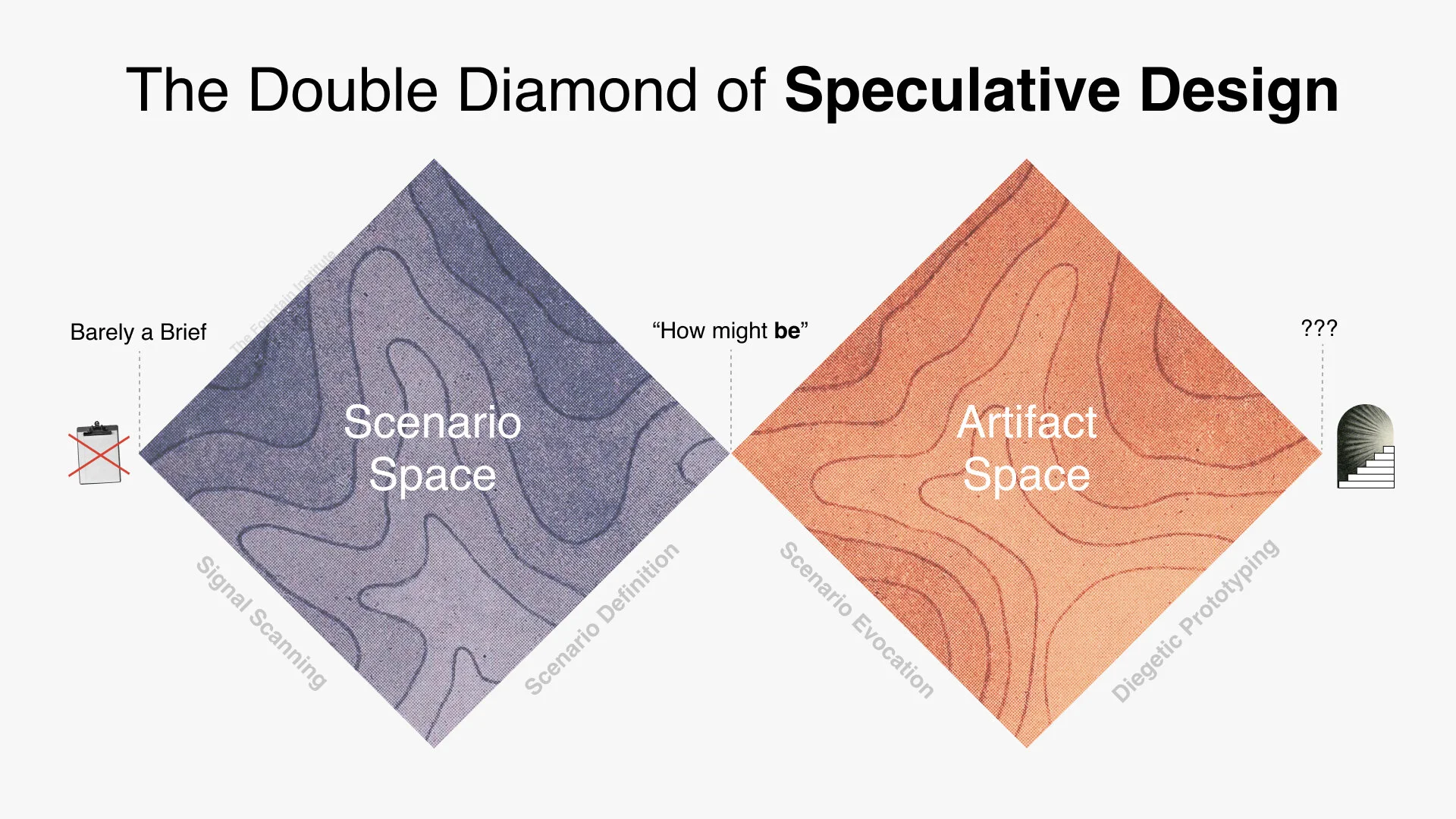 This framework maps the speculative process onto the familiar divergent-convergent model of the Double Diamond, moving from broad signal scanning to a specific "diegetic prototype."
Let's break this down using the three steps from the paper, framed within this Double Diamond:
Reading (7 mins):
- Please read section 2.2 "SCD methods and practice" in (PDF) Speculative and Critical Design — Features, .... This section details the practical steps.
Here’s how we can interpret that process for our purpose:
-
Define a Context (Converge on a Topic): Start by identifying a contemporary trend where technology and corruption might intersect.
- Example: The rise of AI in public services and judicial decision-making.
-
Ideate & Create a Scenario (Diverge & Converge): Use "what if?" questions to explore this topic and define a specific, plausible future scenario. This is the heart of the speculation.
- "What if... an AI system designed to allocate public housing was secretly trained on biased historical data?"
- "What if... this AI could be 'nudged' through back-channels to favor certain applicants, creating a new, deniable form of digital cronyism?"
- Scenario: A near-future city where housing is allocated by a seemingly impartial AI, but which perpetuates and hides deep-seated corruption, creating a new class of digital outcasts.
-
Materialize the Scenario (Prototype an Artifact): This is where your design skills come in. Create a tangible artifact from that future world. This is often called a "diegetic prototype"—a prototype that exists within the fictional world (the diegesis). The goal is to make the future feel real and personal.
- Artifact Idea 1: A designed rejection letter from the "FairHousing AI" that uses opaque, jargon-filled language to deny an applicant, with subtle clues that the system is flawed.
- Artifact Idea 2: A user interface for a "black market" service that promises to "optimize your profile" for the AI for a fee.
- Artifact Idea 3: A short, scripted "unboxing" video of a device that helps you cheat the system.
This process transforms a vague concern about "AI and corruption" into a concrete, emotionally resonant story told through a designed object. It's no longer a lecture; it's an experience.
Part 3: Integrating Speculative Design into Your Framework
Speculative Design offers a powerful, hands-on methodology that you can build directly into your framework for individual reflection. It gives creators a structured process for generating art that critiques systemic issues.
Here are some guiding questions, inspired by this methodology, that you could include in your framework to prompt a creator:
- Signal Scanning (Research): What emerging technology, social trend, or political shift could radically change how corruption operates in the next 10-20 years? (Think AI, biotech, climate change, digital currencies).
- World-Building (Scenario): Choose one signal. If this trend continues, what is a plausible but unsettling future it could lead to? Don't aim for utopia or dystopia, but a future that is uncomfortably believable. Frame it with a powerful "What If?" question.
- Prototyping (Artifact): What object from this future would tell its story most effectively?
- Is it a mundane object (a receipt, a form, a user manual)?
- Is it a piece of media (a news clip, a commercial, a social media post)?
- Is it a personal item (a letter, a diary entry, a child's toy)?
- Reflection (Discourse): How does this artifact make you feel about our present trajectory? What small decisions are we making today that could lead to this future?
By embedding this process into your framework, you empower artists to act as designers of possible worlds. You give them a tool to move beyond commentary and into the creation of provocative experiences that invite personal reflection on our collective future.
Conclusion
This lesson completes our survey of foundational theories and methods for your framework. We've moved from the symbolic worlds of allegory, to the perceptual shifts of defamiliarization, and now to the tangible futures of speculative design.
Key Takeaways:
- Speculative Design is a critical practice that uses prototypes of possible futures to provoke debate and reflection about the present.
- It operates by asking "what if?" rather than "how to," shifting the designer's role from problem-solver to provocateur.
- The methodology involves researching trends (signals), defining a plausible future (scenario), and creating a tangible artifact from that future (diegetic prototype).
- For your framework, this provides a structured, creative process to help artists explore the future consequences of corruption in a way that is concrete and emotionally engaging.
Preview of the Next Module:
We have now assembled a powerful theoretical toolkit. In our next module, "Analyzing Reflective Critiques in Practice," we will move from theory to application. We'll begin by deconstructing the work of real-world artists and collectives, starting with a case study on Forensic Architecture or Ai Weiwei, to see how they use aesthetics, data, and critical methods to challenge power and provoke reflection.