In our last lesson, we focused on how to formally construct a Bayesian game to represent situations where partners in a vee relationship have private information. We learned to model this uncertainty using player "types" and "beliefs," and we saw how to calculate expected utilities in a combined game matrix. That framework, however, leaves a crucial question unanswered: How can a partner with private information credibly communicate it?
This lesson addresses that question directly. Your learning outcome is to analyze signaling games where partners communicate commitment or intent. We will explore how actions, not just words, can serve as signals to convey hidden information, like a partner's true level of commitment. This moves us from a static view of incomplete information to a dynamic one, where communication—strategic and otherwise—takes center stage.
Signals, Credibility, and Cost
At the heart of any relationship, partners are constantly trying to understand each other's intentions, preferences, and commitment levels. Much of this is communicated explicitly, but game theory provides a powerful lens for understanding when words are believable and when they are not. This brings us to the crucial distinction between "cheap talk" and "costly signals."
The following article from Behavioral Scientist offers a very clear and practical introduction to these concepts in the context of dating, which serves as a perfect entry point.
How to Date Like a Game Theorist - By Christina Gravert
This article provides an accessible explanation of signaling and its role in revealing information.
Please read the section titled "Cheap talk versus signaling". Pay close attention to the definition of a signal as a costly message. Then, read the subsection "Crafting a profile", which introduces the related ideas of separating and pooling strategies.
As the article highlights, cheap talk is communication that is costless to send. A partner saying, "I'm serious about this relationship," is cheap talk. They can say it whether they are truly a "Serious" type or a "Casual" type. Because both types have an incentive to say it (it might elicit more investment from the Hinge), the statement itself carries little informational weight.
A costly signal, however, is an action that is more expensive for one type to take than another. This cost is what gives the signal credibility.
Consider our ongoing scenario:
- A High-Commitment Partner (let's call this the "Strong" type) genuinely wants to build a future within the vee.
- A Low-Commitment Partner (the "Weak" type) is enjoying the relationship for now but is not interested in long-term entanglement.
An action like co-signing a lease or moving to be closer to the Hinge is a costly signal.
- For the Strong type, this cost is offset by the large future benefit of a deeply integrated relationship.
- For the Weak type, the cost is substantial, and the future benefit is low or non-existent, making the action prohibitively expensive.
By taking the costly action, the Strong type can "separate" themselves from the Weak type, sending a credible signal of their true intentions. This is the essence of a signaling game.

The Structure of a Signaling Game
Formally, a signaling game is a type of dynamic Bayesian game where the informed player moves first, sending a signal that the uninformed player observes before making their move.
The sequence is as follows:
- Nature chooses the type of the informed player (Player 1, the "Sender"). For example, Nature determines if the partner is Strong (probability ) or Weak (probability ). The Sender knows their type, but the "Receiver" (Player 2) only knows the probabilities.
- The Sender (informed player) observes their type and chooses an action, the "signal" (e.g., 'Make Costly Gesture' or 'Make No Gesture').
- The Receiver (uninformed player) observes the signal (but not the Sender's type) and updates their beliefs about the Sender's type. They then choose a response action (e.g., 'Invest' or 'Wait').
- Payoffs are received by both players, depending on the Sender's type, the signal sent, and the Receiver's response.
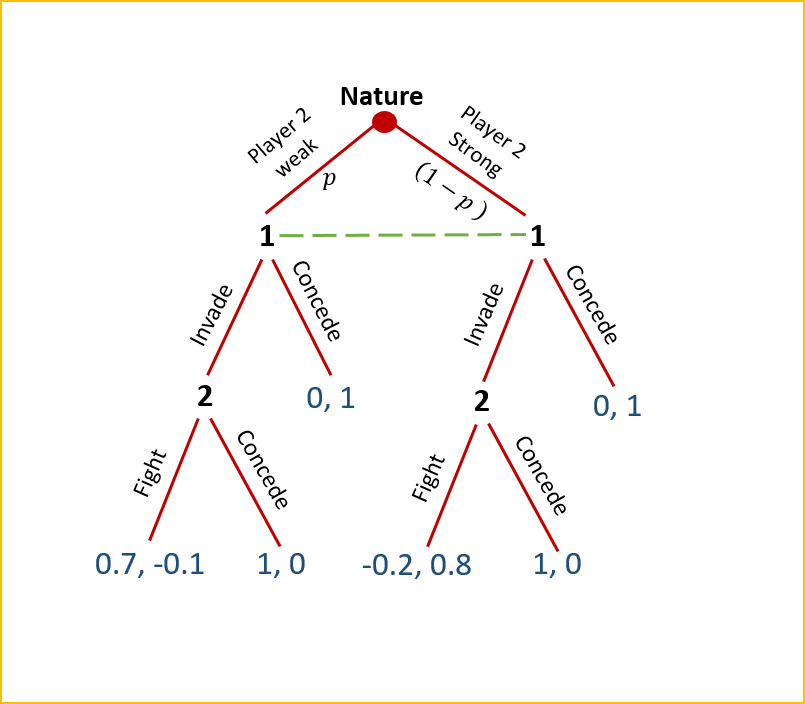
A better representation would show Player 1 (the informed one) moving after Nature, and Player 2 responding.
Types of Equilibria: Separating, Pooling, and Semi-Separating
The strategic interaction in a signaling game can result in different kinds of outcomes, or equilibria. These equilibria are distinguished by how much information the signal reveals. The following video provides an excellent overview of the three main types.
Game Theory 101 (#77): Signaling Games
This video from William Spaniel's "Game Theory 101" series introduces the fundamental concepts of signaling games and their equilibria.
First, watch the general introduction to understand what a signaling game is. Then, observe the employment game example to see the structure in an extensive-form tree. Most importantly, understand the definitions of the three types of equilibria: separating, pooling, and semi-separating. Finally, see the brief explanations of what happens in a separating strategy, a pooling strategy, and a semi-separating strategy.
To summarize the video's key points in our vee context:
- Separating Equilibrium: Each type sends a different signal. The Hinge observes the signal and knows the partner's type with certainty.
- Example: The Strong type always proposes meeting the extended family; the Weak type never does. Seeing the proposal, the Hinge concludes the partner is Strong.
- Pooling Equilibrium: All types send the same signal. The Hinge learns nothing from the signal and their beliefs about the partner's type do not change.
- Example: Both Strong and Weak types say "I'm falling for you" early in the relationship. The statement is uninformative.
- Semi-Separating Equilibrium (or Hybrid): One type always sends a certain signal, while the other type randomizes between signals. The Hinge gains some information but is not left with certainty.
- Example: The Strong type always suggests a weekend getaway. The Weak type sometimes suggests it (perhaps just for fun) and sometimes doesn't. If the Hinge hears the suggestion, they become more confident the partner is Strong, but can't be 100% sure.
Analysis of a Separating Equilibrium
To "analyze" a signaling game, we must check if a proposed set of strategies and beliefs constitutes a stable equilibrium. This means verifying that no player has an incentive to unilaterally deviate. Let's walk through an example of a separating equilibrium. Your background in Bayesian decision theory is relevant here, as players' actions are based on maximizing expected utility given their beliefs, and those beliefs are updated via Bayes' rule.
The next video provides a clear, four-step process for verifying a separating equilibrium. We will adopt this method for our vee scenario.
Game Theory 101 (#78): Separating Equilibrium
This video, also from William Spaniel, provides a detailed, step-by-step walkthrough of how to solve for and verify a separating equilibrium.
Focus on the methodology. First, understand the four-step path to finding separating equilibria. Then, watch how he applies these steps to the first potential equilibrium, from proposing strategies to checking deviations. Note how beliefs are updated and why players might or might not want to bluff. Finally, see why the second proposed equilibrium fails this check.
Let's apply this 4-step process to our scenario.
Scenario: A Partner (Sender) is either Strong (High-Commitment) with probability or Weak (Low-Commitment) with probability . The Partner can Signal (e.g., make a costly public commitment) or send No Signal. The Hinge (Receiver) observes this and decides to Invest or Wait.
Let's define payoffs (Hinge, Partner):
- If Partner is Strong:
- Signal -> Invest: (2, 1) (Good outcome, but signal cost the Partner 1 utility point)
- Signal -> Wait: (0, -1) (Bad outcome, paid cost for nothing)
- No Signal -> Invest: (2, 2) (Best for Strong Partner, but Hinge won't do it without a signal)
- No Signal -> Wait: (0, 0) (Status quo)
- If Partner is Weak:
- Signal -> Invest: ( -1, 0) (Hinge is unhappy, Partner got investment but paid the signal cost)
- Signal -> Wait: (0, -1) (Bad outcome)
- No Signal -> Invest: (-1, 1) (Best for Weak Partner, Hinge is unhappy)
- No Signal -> Wait: (0, 0) (Status quo)
Step 1: Propose a Separating Strategy
Let's propose the intuitive strategy: Strong type Signals, Weak type sends No Signal.
Step 2: Solve for the Receiver's (Hinge's) Best Response
The Hinge must form beliefs based on the observed signal.
- If Hinge sees Signal: According to the proposed strategy, only the Strong type Signals. So, the Hinge's updated belief is:
Prob(Strong | Signal) = 1. Given this certainty, the Hinge compares payoffs from Investing (2) vs. Waiting (0). They choose to Invest. - If Hinge sees No Signal: Only the Weak type sends No Signal. The Hinge's updated belief is:
Prob(Weak | No Signal) = 1. Given this certainty, the Hinge compares payoffs from Investing (-1) vs. Waiting (0). They choose to Wait.
Step 3: Check for Profitable Deviations by the Sender (Partner)
Now, we check if either type of Partner would want to deviate, given the Hinge's response.
- Does the Strong type want to deviate?
- Equilibrium action: Signal. The Hinge will Invest. Partner's payoff is 1.
- Deviation: No Signal. The Hinge will Wait. Partner's payoff would be 0.
- Since 1 > 0, the Strong type does not want to deviate.
- Does the Weak type want to deviate?
- Equilibrium action: No Signal. The Hinge will Wait. Partner's payoff is 0.
- Deviation: Signal. The Hinge would think they are Strong and Invest. Partner's payoff would be 0.
- Since 0 is not better than 0, the Weak type does not have a profitable deviation. They are indifferent. For a strict equilibrium we might want to adjust payoffs, but for our purposes this holds. They have no incentive to pretend to be Strong because the cost of the signal perfectly cancels out the benefit of securing investment.
Step 4: Conclude
Since neither type has a profitable deviation, this is a valid separating equilibrium. The full Perfect Bayesian Equilibrium (PBE) consists of the strategies and the beliefs:
- Partner's Strategy: If Strong -> Signal; If Weak -> No Signal.
- Hinge's Strategy: If Signal -> Invest; If No Signal -> Wait.
- Hinge's Beliefs:
Prob(Strong | Signal) = 1;Prob(Strong | No Signal) = 0.
This analysis shows how costly signals can create a stable outcome where information is credibly revealed, allowing partners to overcome the uncertainty of incomplete information.
From Signals to Shared Codes in Triads
While these simple signaling models are powerful, relationship communication is more complex. It's not about single signals but about developing a whole system of meaning—a "communication code." A fascinating experimental paper explores how such codes emerge in triads, a structure directly analogous to the vee relationship.
When three's a crowd: how relational structure and social history ...
This paper studies how three-person groups develop shared communication. It's conceptually rich and links our game theory models to more complex social dynamics.
First, read the subsection "Process of code emergence" to understand the challenge of moving from dyadic codes to a shared group code. Next, read about "Common ground". This highlights the importance of a shared history and mutual understanding. Then, read the section on "Communication structure". Pay special attention to the comparison between acyclic (hierarchical, like a vee) and cyclic triadic structures. Finally, read the Discussion section. It introduces the crucial concepts of "behavioral common ground" and "strategic uncertainty," which perfectly frame the problem that signaling aims to solve.
The paper finds that acyclic structures—like a vee where the hinge communicates with two partners who do not communicate with each other—can make it harder for "strangers" (new partners) to develop a shared group-level code. They face higher "strategic uncertainty" and lack the "behavioral common ground" to navigate the differentiated roles.
This provides a profound insight for our analysis. The costly signals we've modeled—proposing to meet family, co-signing a lease—are not just isolated events. They are foundational acts in building that very "behavioral common ground." They are attempts to reduce strategic uncertainty and demonstrate a willingness to play by the "rules" of a high-commitment game. For a new partner entering a vee, sending such credible signals can be the mechanism by which they overcome the structural challenges described in the paper and help harmonize the "dyadic code" they have with the hinge into a stable, "triadic code."
Conclusion
In this lesson, we have moved from simply identifying incomplete information to analyzing how it can be strategically resolved. We've seen that communication is not just about words, but about credible, often costly, actions.
Key Takeaways:
- Signaling games model how an informed player can send a signal to an uninformed player to reveal private information.
- The credibility of a signal depends on its cost. Costly signals can reliably distinguish different player types, whereas cheap talk often cannot.
- The outcome of a signaling game can be a separating equilibrium (information is fully revealed), a pooling equilibrium (no information is revealed), or a semi-separating equilibrium (information is partially revealed).
- Analyzing these equilibria involves a four-step process of proposing strategies, determining best responses based on updated beliefs, and checking for profitable deviations.
- In the context of a vee, signaling is a key mechanism for building "behavioral common ground" and reducing the "strategic uncertainty" that can inhibit the formation of a stable, shared relationship culture.
In our next lesson, we will focus more deeply on the contrast between successful and failed signaling. We will directly compare separating and pooling equilibria to understand why some attempts at communication are credible while others remain ambiguous, and how to tell the difference in the context of a vee relationship.