Welcome to our final lesson. In our last session, we worked through a detailed case study, the "Ambitious Vee," applying an integrated game and network theory lens to assess its sustainability. That exercise was a practical demonstration of the analytical power we've built over this course. Now, in our capstone session, we will distill that process into a formal, repeatable procedure.
The goal of this lesson is to provide you with a step-by-step framework that you can apply to any new vee relationship scenario. This procedure is the culmination of our entire course, synthesizing the concepts from all twelve modules into a single, powerful toolkit. By the end of this lesson, you will be able to systematically deconstruct, model, and analyze complex relationship dynamics, fulfilling the core objective of our work together.
An Integrated Framework for Relationship Analysis
Analyzing a complex social scenario like a vee relationship requires a structured approach. A haphazard application of models can lead to confusing or contradictory insights. The following six-step procedure provides a systematic path from initial observation to strategic recommendation.
Step 1: Define the Problem and Scope
Before any analysis can begin, you must clearly articulate the problem. What is the central question? Is it about resolving a specific conflict, evaluating a proposed change, or assessing long-term stability?
- Identify the Core Scenario: Describe the situation in plain language. Who are the individuals involved? What are their histories and current roles? What is the specific event, decision, or tension point to be analyzed?
- Frame the Analytical Question: Translate the scenario into a precise question. For example, in our "Ambitious Vee" case, the question was: "Is the transition from parallel polyamory to kitchen-table polyamory a stable and sustainable move for the network?"
- Determine the Time Horizon: Is this a one-shot decision (e.g., disclosing a secret), a repeated interaction (e.g., ongoing time allocation), or a problem of long-term structural evolution (e.g., adding a new partner)? This will heavily influence your choice of model.
Step 2: Model the Actors and Network
Once the problem is defined, the next step is to formalize the relationship structure as a network.
- Identify Players and Roles: Label the individuals involved. In a vee, this is typically the Hinge (H), Partner 1 (P1), and Partner 2 (P2). Note any significant power asymmetries based on resources, tenure, or emotional investment.
- Map the Network Graph: Draw the network. The simplest vee is a path graph: P1 — H — P2. This visually represents the hinge's central role. If there are other connections (e.g., a friendship between P1 and P2), the graph becomes a triad.
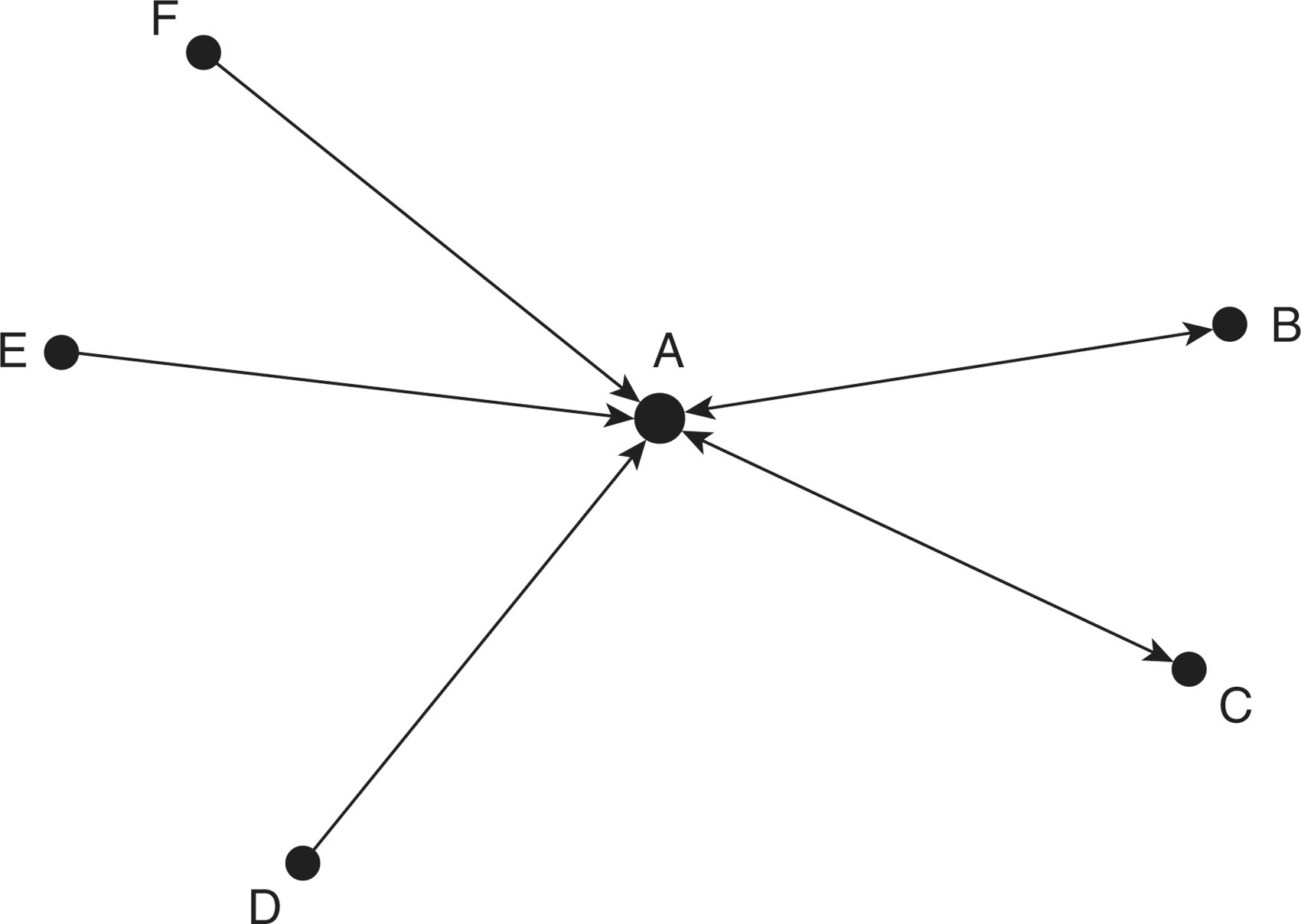
- Characterize the Initial Structure: Use network concepts to describe the starting positions. In a standard vee, the hinge occupies a structural hole and has high betweenness centrality, giving them brokerage power but also creating a bottleneck. The non-hinge partners have low structural power and depend on the hinge for information about the wider relationship system.
Step 3: Define the Game
With the network mapped, you can now define the strategic interaction playing out upon it.
- Pinpoint the Strategic Choices: What are the key actions available to each player? These should be the choices that directly impact the problem you defined in Step 1. For example:
Cooperatevs.Defectin a trust game, or choosing how much time to demand from the hinge. - Formulate Utility Functions: What does each player want? Define their preferences and payoffs. Utility can encompass emotional security, time, material resources, social validation, etc. Your background in Bayesian decision theory and utility modeling is central here. Payoffs are often interdependent—one partner's utility might depend on the actions of the other two.
- Characterize the Game: Classify the interaction based on its payoff structure.
- Strategic Complements vs. Substitutes: Does one person's action increase or decrease the incentive for others to take the same action? (e.g., building trust is a game of complements; competing for a fixed pool of time is a game of substitutes).
- Information Structure: Is information complete or incomplete? Do players have private information about their "type" (e.g., their true level of jealousy or their outside options)? This points toward Bayesian games.
- Game Type: Is it a coordination game, an anti-coordination game, or a mixed-motive game like the Prisoner's Dilemma?
The flowchart below provides a helpful decision-making guide for classifying a scenario based on its core characteristics.

Step 4: Select Analytical Tools
Your characterization of the game in Step 3 dictates which models from our course are most appropriate. It is rare that a single tool will suffice; an integrated analysis often requires several.
- For static, one-shot decisions with complete information: Use Nash Equilibrium analysis (Module 1).
- For negotiations and resource division: Apply the Nash Bargaining Solution or Rubinstein's model (Module 2).
- For long-term relationships and trust: Use Repeated Game theory, analyzing strategies like Tit-for-Tat and the impact of discount factors (Module 3).
- For situations with uncertainty and private information: Employ Bayesian Games, Signaling Games, or Screening models (Module 4).
- For designing relationship agreements: Use principles of Mechanism Design to create incentive-compatible and strategy-proof rules (Module 5).
- For analyzing potential alliances: Model the game as a Cooperative Game and use tools like the Shapley Value or the Core to assess coalition stability and fair payoffs (Module 6).
- For analyzing network evolution: Use Strategic Network Formation models and concepts like Pairwise Stability (Module 10).
Step 5: Analyze and Predict Outcomes
With your tools selected, you can now perform the analysis. This involves solving for the equilibria of the models you've constructed.
- Calculate Equilibria: Find the Nash Equilibria, Pairwise Stable networks, or other relevant solution concepts.
- Interpret the Equilibria: An equilibrium is not just a mathematical result; it is a prediction about a potentially stable social outcome. Describe what each equilibrium means in the context of the relationship. For example, a Nash Equilibrium in a time-allocation game might represent a stable, albeit potentially suboptimal, schedule that no one has a unilateral incentive to change.
- Consider Dynamics: How might the system move toward an equilibrium? Think about best-response dynamics. Are there multiple equilibria? If so, which one is more likely to be reached, and why?
To formalize this step, we can draw from the concept of a Bayesian game, which you are familiar with from your studies.
This paper by Galeotti et al. provides a rigorous framework for analyzing games where payoffs depend on network position, especially under incomplete information.
First, read the section "Networks and Payoffs" (Section 3.1). This formally defines how a player's payoff, v_k(x_i, x_{N_i(g)}), depends on their own action x_i, the actions of their neighbors x_{N_i(g)}, and their degree k. This is the mathematical language for the utility functions we discussed in Step 3. Next, read "The Bayesian Game" section (Section 3.3). This defines a symmetric Bayesian equilibrium. It formalizes the idea of an equilibrium as a strategy profile where each player's action is a best response, given their beliefs about their neighbors' actions. This is precisely what we mean by finding a stable outcome in a game with incomplete information.
Step 6: Synthesize, Evaluate, and Recommend
The final step is to bring all the pieces together into a coherent assessment and, if applicable, actionable advice.
- Synthesize Insights: Combine the findings from your game-theoretic and network-theoretic analyses. Do they reinforce or contradict each other? For example, a Nash equilibrium might look stable in isolation, but a network analysis might show that it relies on a structurally weak link that is not pairwise stable.
- Assess Sustainability: Based on your synthesis, make a holistic judgment about the sustainability of the situation or the proposed change. Is the current state stable? Is the desired state achievable and stable? What are the key risks?
- Formulate Strategic Recommendations: If the goal is to guide the players, what advice would you give? Your recommendations should be grounded in your analysis. For instance, instead of advising a risky, direct move, you might recommend a series of smaller steps that gradually change the game from non-cooperative to cooperative, as suggested in our case study.
Advanced Analysis: Computational Simulation
For highly complex or dynamic scenarios, a purely analytical approach may be insufficient. Your background in simulations and operations research makes you perfectly suited to take the analysis a step further with computational methods like Agent-Based Modeling (ABM). This extends the six-step framework into a more powerful, empirical direction.
In an ABM, you create a virtual "society" of agents who follow the rules and strategies you've defined. You can then run simulations to observe emergent, macro-level patterns from micro-level interactions.
The following resource outlines a sophisticated framework for just such a simulation in the context of polyamory.
AI-Driven Multi-Agent Simulation of Stratified Polyamory Systems
This paper details a computational framework for simulating complex relationship systems. It provides a blueprint for how you could implement the analysis from our six-step procedure.
Please review the following sections in the "Computational Framework" (Section 10): Start with Section 10.1, "Agent-Based Model Architecture." This outlines exactly how to build an agent by defining its attributes, preference function, strategy, and state. This is the computational implementation of Steps 2 and 3 of our framework. Next, look at Section 10.4, "Graph Neural Network Analysis of the Mating Network." This explains how to analyze the network that emerges from the simulation, connecting the simulation results back to network theory concepts like link prediction and community detection. Finally, briefly read Sections 11.1 and 11.2 on simulation design and preliminary results. This provides a concrete example of setting simulation parameters and interpreting the output, such as welfare improvement and network structure changes.
By using simulation, you can test the sensitivity of outcomes to different assumptions, model stochastic events, and explore the long-term evolutionary paths of a relationship network in a way that is intractable with purely analytical models.
Course Conclusion
This step-by-step procedure provides you with the capstone to your studies. It integrates the entirety of this course—from defining a game to analyzing network power—into a practical and robust methodology. You began this journey with a goal to understand the intricate dynamics of vee relationships through a formal lens, and you now possess a comprehensive toolkit to do just that.
You have learned to model the players, strategies, and payoffs that define relationship dilemmas; to analyze the seen and unseen structures of power and influence within networks; and to predict the stability and evolution of these complex systems. You are equipped not just with individual theories, but with an integrated framework to apply them systematically and effectively.
Congratulations on completing this course. You have mastered a unique and powerful approach to analyzing the complex and fascinating world of polyamorous relationships.