Welcome back. In our previous lesson, we analyzed the hinge's pivotal role as a network broker, a position derived from spanning the structural hole between their partners. We saw how metrics like centrality and network constraint can quantify this brokerage power at the individual level.
Today, we elevate our analysis from the individual to the entire relationship structure. This lesson directly addresses the learning outcome: Compare vee, triad, and quad configurations using network metrics. We will move beyond analyzing the role of a single person and start evaluating the properties of the whole network. By applying network-level metrics, you will gain a systematic way to compare these fundamental polyamorous structures and understand their inherent trade-offs regarding power distribution, communication efficiency, and structural stability.
Defining the Core Structures
Before we can compare them, let's establish clear definitions for the vee, triad, and quad. While we have focused heavily on the vee, understanding its distinction from a triad is crucial, as it represents a fundamental shift in network topology.
Understanding Vee and Triad Polyamory: The Key Differences | Find Poly
This article from Find Poly provides clear, non-technical definitions that distinguish the vee and triad structures.
First, read the section "Defining Vee vs. Triad Polyamory" to get a high-level overview. Then, for a more direct comparison, read the section "Relationship Architecture Comparison". Focus on how the authors describe the difference in connections—a "branching structure" for the vee versus a "fully interconnected unit" for the triad.
To summarize and expand on this, let's visualize the three structures we'll be comparing.
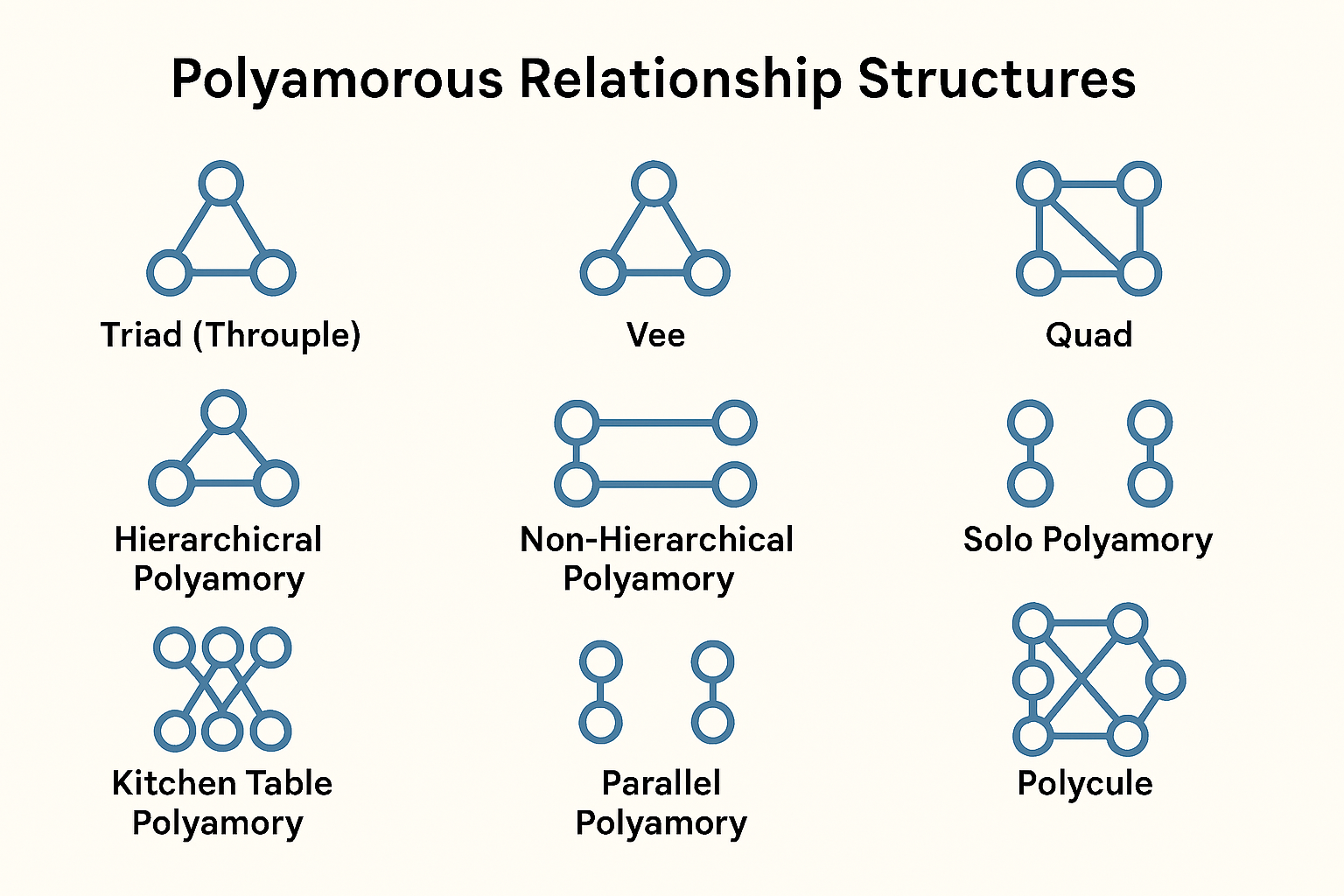
Based on these diagrams and definitions:
- Vee (N=3): Consists of three individuals where one person (the hinge) is in a relationship with two others, but those two are not in a relationship with each other. This forms an open triangle, or a line graph of length two.
- Triad (N=3): Consists of three individuals who are all in relationships with each other. This forms a complete, closed triangle.
- Quad (N=4): A relationship involving four people. The structure can vary. The diagram shows a common form: four people arranged in a square with an additional diagonal link, creating a mix of connection levels. For our analysis, we'll consider both a simple "square" quad and this more complex version.
The critical difference is the presence or absence of links. A vee becomes a triad with the addition of one link. This single change fundamentally alters the network's properties.
From Node Centrality to Network Centralization
So far, we've used centrality to describe a node's position (e.g., "the hinge has high betweenness centrality"). But to compare entire networks, we need a network-level metric. This is network centralization.
Given your background in statistics, you can think of network centralization as analogous to a measure of inequality, like the Gini coefficient. It doesn't measure the total amount of "centrality" in the network, but rather how unequally that centrality is distributed among the nodes.
- A network with high centralization has its centrality concentrated in one or a few nodes (e.g., a star-shaped network where one hub is connected to many spokes).
- A network with low (or zero) centralization has centrality distributed evenly among its nodes (e.g., a circle where everyone has the same position).
To formalize this, we'll turn to a resource that breaks down the concept.
These lecture notes from Duke University provide the mathematical foundation for network centralization. We will use the concepts here to perform our comparison.
First, read the sections "Network centralization" to understand the general formula. It calculates the sum of differences between the most central node and all other nodes, then normalizes it. Next, review the section on Degree centralization. Pay attention to the logic: the maximum possible centralization occurs in a star graph. This is the benchmark against which other graphs are measured.
A Quantitative Comparison of Structures
With the concept of centralization in hand, we can now perform a structural comparison of the vee, triad, and quad. We will also include network density, which measures the proportion of present ties to all possible ties: , where is the number of links and is the number of nodes.
The Vee (N=3)
- Structure: A line graph (P1—H—P2). 2 links.
- Density:
- Node Centralities: The hinge has degree 2 and betweenness 1. The partners have degree 1 and betweenness 0.
- Network Centralization:
- Degree Centralization: The degrees are {1, 2, 1}. The maximum degree is 2. The sum of differences is . For N=3, the maximum possible sum of differences (achieved in a star graph, which is what a vee is) is . Thus, .
- Betweenness Centralization: This is also 1. The hinge concentrates all the betweenness.
- Interpretation: The vee is a maximally centralized structure. Power, information flow, and responsibility are concentrated in the hinge. It's an efficient but hierarchical and fragile system.
The Triad (N=3)
- Structure: A complete graph or triangle. 3 links.
- Density:
- Node Centralities: All nodes have degree 2. All nodes have betweenness 0 (as there are no nodes that lie on the shortest path between any other two).
- Network Centralization:
- Since all nodes have identical centrality scores (for both degree and betweenness), the sum of differences is 0. Thus, and .
- Interpretation: The triad is a perfectly decentralized structure. It is non-hierarchical, or egalitarian. Communication responsibility is distributed, and the structure is more resilient; the removal of any one link turns it into a vee, but doesn't dissolve the network.
The Quad (N=4)
Let's consider two cases for the quad.
Case 1: Simple Quad (Square)
- Structure: A 4-cycle or square. 4 links.
- Density:
- Network Centralization: All nodes have a degree of 2. All nodes have an equal betweenness score of 1. As all nodes are structurally identical, centralization is zero (, ). This structure is also decentralized and egalitarian.
Case 2: Complex Quad (Square + Diagonal)
This matches the "Quad" in the image LINK. Let's label the nodes A, B, C, D in a square, with links A-B, B-C, C-D, D-A, and a diagonal A-C.
- Structure: A square with one diagonal chord. 5 links.
- Density:
- Network Centralization:
- Node degrees are not equal: deg(A)=3, deg(B)=2, deg(C)=3, deg(D)=2. This immediately means degree centralization is greater than 0.
- Betweenness scores are also unequal. For instance, the shortest path between B and D is B-A-D or B-C-D, both of length 2. A and C lie on these paths, while B and D do not lie on any shortest paths. This means betweenness centralization is also greater than 0.
- Interpretation: This quad is a moderately centralized structure. It introduces a hierarchy. Nodes A and C are more powerful and influential than B and D. They act as local brokers. This creates a hybrid structure, more complex than a vee's simple hierarchy but not as flat as a triad's egalitarianism.
Summary of Structural Properties
This table summarizes our comparison:
| Metric | Vee (N=3) | Triad (N=3) | Simple Quad (N=4) | Complex Quad (N=4) |
|---|---|---|---|---|
| Links (L) | 2 | 3 | 4 | 5 |
| Density | 0.67 | 1.0 | 0.67 | 0.83 |
| Degree Centralization | 1 (Maximal) | 0 (Minimal) | 0 (Minimal) | > 0 (Moderate) |
| Betweenness Centralization | 1 (Maximal) | 0 (Minimal) | 0 (Minimal) | > 0 (Moderate) |
| Structural Implication | Hierarchical, Fragile | Egalitarian, Resilient | Egalitarian, Resilient | Moderately Hierarchical |
The analysis reveals clear structural trade-offs. The vee is simple and efficient from the hinge's perspective but creates dependency and power imbalance. The triad is robust and egalitarian but requires higher communication overhead and universal compatibility. Quads and larger structures can introduce further complexity, creating intermediate levels of hierarchy and subgroup dynamics.
Conclusion
In this lesson, we have moved from analyzing individual roles to comparing whole relationship configurations. By using network-level metrics like centralization and density, we can quantitatively describe the fundamental structural differences between vees, triads, and quads.
- Key Takeaways:
- Network metrics provide a powerful, objective language to compare different relationship structures.
- Vees are characterized by maximal centralization, creating a hierarchical structure centered on the hinge. This leads to efficiency but also fragility and power concentration.
- Triads (and simple cycles like a square quad) are characterized by zero centralization, creating an egalitarian and resilient structure with distributed responsibility.
- More complex quads and larger polycules can exhibit moderate centralization, creating intermediate power structures and subgroup dynamics.
- The choice of structure involves inherent trade-offs between hierarchy, efficiency, resilience, and communication complexity.
Preview of the next lesson:
Having compared these static network snapshots, our next step is to explore the dynamic processes that unfold on these networks. In the next lesson, we will analyze how network topology affects information flow between partners in a vee. We will investigate how the vee's centralized structure shapes the speed, fidelity, and control of information compared to more densely connected configurations like the triad.