Welcome to the next lesson in our module on bargaining and fair division. In our previous discussions, we focused on negotiations between two parties, such as the hinge and one partner, analyzing how threat points and outside options shape the balance of power. We saw that even in a dyad, the presence of the third person in the vee acts as a powerful outside option.
Today, we broaden our scope from two-person bargaining to the more complex challenge of dividing shared resources among all three members of the vee. Your learning objective is to model fair division of shared resources using envy-free and equitable allocation criteria. We will explore two fundamental, and sometimes competing, notions of fairness. The first, envy-freeness, asks: "Is everyone satisfied with their own share, or would they rather trade with someone else?" The second, equitability, asks: "Is everyone equally happy with what they received, regardless of what the items are?"
What is a "Fair" Share? Introducing Envy-Freeness
When dividing a resource, from something tangible like a financial budget to something intangible like weekend time, the most intuitive standard of fairness is that no one should feel that someone else got a better deal. This idea is formally captured by the criterion of envy-freeness.
The video below introduces the "cake-cutting problem," a classic metaphor for dividing any continuous resource, and explains how mathematicians think about fairness.
The Mathematically Correct Way to Cut a Cake
This video from the channel Up and Atom provides an excellent introduction to the core concepts of fair division.
Please watch the following segments: Cut and choose: This explains the simple, envy-free method for two people. Proportionality: This introduces a weaker form of fairness and shows why it might not be enough. Envy freeness: This provides a clear and concise definition of the central concept for this section.
As the video explains, an allocation is envy-free if no person would prefer to have another person's share instead of their own. It's crucial to remember that this is based on each individual's own subjective valuation. I don't envy your share if, according to my preferences, my share is at least as good as yours.
For a more formal definition, let's turn to this tutorial on fair division.
[PDF] Tutorial on Fair Division - UvA
These slides by Ulle Endriss provide precise mathematical definitions for various fairness criteria.
Please read the definition of envy-freeness on slide 29. Let A(i) be the bundle of goods allocated to agent i, and u_i be their utility function. The allocation is envy-free if for any two agents, i and j, we have u_i(A(i)) \ge u_i(A(j)).
In a vee relationship with a Hinge (H), Partner 1 (P1), and Partner 2 (P2), an envy-free division of a resource (e.g., shared vacation days) means:
- P1 is content with their vacation days and wouldn't trade their allocation for H's or P2's.
- P2 feels the same way about their own allocation.
- H is also satisfied with their portion and doesn't envy the time P1 or P2 received.
Achieving this for three people is more complex than the simple "cut and choose" method for two. One of the classic solutions is the Selfridge-Conway protocol, which guarantees an envy-free division for three parties.
The infographic below illustrates how this protocol works.

Let's walk through this protocol, applying it to a vee scenario. Imagine H, P1, and P2 are dividing a jointly-owned art collection.
- Step 1-2: P2 (Charlie in the diagram) is asked to cut the collection into three bundles that P2 values equally.
- Step 3: H (Alice) and P1 (Bob) identify their most preferred bundle. If they choose different ones, the problem is simple: let them take their preferred bundle, and P2 takes the last one. Since P2 valued all three equally, P2 is not envious. H and P1 got their top choice, so they are not envious.
- Step 3-4 (The tricky case): H and P1 both want the same bundle. P1 is asked to "trim" this contested bundle until its value (in P1's eyes) is equal to P1's second-choice bundle. The small "trimming" is set aside.
- Step 5: Now, there's an order for choosing from the three main bundles: H chooses first, then P2, then P1. However, P1 is constrained to take the trimmed bundle if no one else does. The logic ensures that no matter who picks what, each person gets a bundle they value as either their first or second choice, preventing envy over the main pieces.
- Step 6-7: The trimming is then divided. A clever sub-procedure (often involving the person who was "disadvantaged" in the first round getting to divide the trimmings) ensures the final allocation of the complete resource is also envy-free.
The key takeaway is that through a structured procedure of cutting, trimming, and choosing, it is possible to arrive at an envy-free allocation for three people, even when their preferences differ significantly.
An Alternative: The Principle of Equitability
Envy-freeness focuses on relative comparisons: "I don't want your bundle more than mine." But what if we wanted to ensure everyone is equally happy in an absolute sense? This brings us to equitability.
An allocation is equitable if every person derives the exact same amount of utility from their share. This is about equalizing the outcomes (happiness levels), not necessarily the inputs (the items themselves).
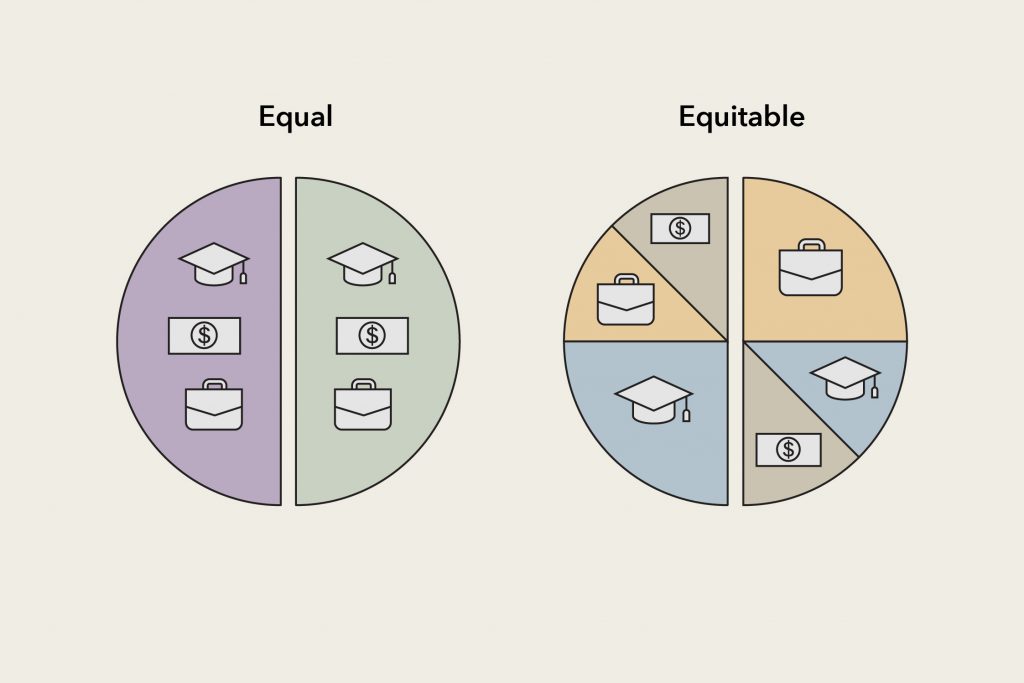
The image above intuits the difference. Equitability isn't about giving everyone the same things; it's about giving each person the right things for them, such that their resulting satisfaction is the same as everyone else's.
Let's get a formal definition.
[PDF] Equitable Allocations of Indivisible Goods - Rohit Vaish
This paper by Freeman et al. provides a clear introduction to equitability and its nuances, especially for indivisible goods.
First, read the introduction to equitability in the first section. This will solidify the core idea. Next, find the "Preliminaries" section and read the precise definition under the heading. Formally, an allocation A is equitable if for every pair of agents i and k, u_i(A_i) = u_k(A_k).
Notice the crucial difference:
- Envy-Freeness: for all . The comparison of bundles and is done using a single utility function, .
- Equitability: for all . The comparison is between two different utility values, and .
An allocation can be one without being the other. For instance, imagine H gets a small apartment they love (utility = 100), and P1 gets a large mansion they feel lukewarm about (utility = 100). This is equitable. But if H would have adored the mansion (utility = 1000 for H), H will envy P1. The allocation is equitable but not envy-free.
Practical Challenges: Indivisible Goods and Relaxations
In reality, many resources aren't perfectly divisible like a cake. Think of a car, a weekend vacation, or decision-making power over a specific issue. With such indivisible goods, achieving perfect equitability might be impossible. If one person gets the car (utility=50) and the other doesn't (utility=0), their happiness levels are unequal.
To handle this, researchers have proposed relaxed fairness criteria.
[PDF] Equitable Allocations of Indivisible Goods - Rohit Vaish
Let's return to the same paper to understand these practical relaxations.
Read the paragraph in the introduction that defines approximate equitability. Then, look again at the "Preliminaries" section for the formal definitions of EQ1 and EQx.
The two most important relaxations are:
- Equitability Up to One Good (EQ1): An allocation is EQ1 if for any two people, the difference in their utility would vanish (or reverse) if you removed just one suitable item from the bundle of the person who is better off.
- Equitability Up to Any Good (EQx): A stricter version, where the utility difference disappears if you remove any single item from the better-off person's bundle.
These concepts are incredibly practical for relationship agreements. Perfect equality of happiness may be unattainable day-to-day, but you can strive for a balance where any perceived inequality is no larger than a single, identifiable "item" (e.g., "P1 is happier this week, but the difference is just that one extra night out they had.").
Conclusion
Today we have distinguished between two primary criteria for fair division in a multi-partner relationship. These concepts move us beyond simple dyadic bargains to a more holistic view of resource allocation in a vee.
Key Takeaways:
- Envy-Freeness is a relative standard of fairness. It ensures that no one would prefer someone else's allocated bundle over their own, according to their personal preferences. The Selfridge-Conway protocol provides a concrete method for achieving this among three people.
- Equitability is an absolute standard of fairness. It aims to equalize the final utility or happiness that each person derives from their allocation, regardless of what the physical items are.
- These two criteria are not the same; an allocation can be equitable but not envy-free, and vice-versa.
- When dealing with indivisible goods, which are common in relationships, perfect fairness may be impossible. Relaxed criteria like Equitability Up to One Good (EQ1) provide a robust and practical goal for "good enough" fairness.
In our next lesson, we will continue this theme by comparing other allocation rules, specifically proportional, egalitarian, and utilitarian frameworks. This will give you a broader toolkit for analyzing and designing fair systems for decision-making within a vee relationship.