Welcome to your next lesson. In our previous session, we performed a step-by-step simulation of influence propagation using the Linear Threshold model. This gave us a dynamic, micro-level view of how a new idea or behavior might spread through a vee relationship, depending on who initiated it and the personalities involved.
Today, we shift our perspective from the dynamics of influence to the statics of power. Instead of asking "how does influence spread?", we will ask "who holds latent power based on their position in the network?". Your learning outcome for this lesson is to apply the Bonacich power index to assess structurally-derived power in extended polyamorous networks. This powerful tool moves beyond simple connection counts to provide a more sophisticated understanding of how network structure creates advantages and dependencies, a concept highly relevant to your work as a relationship analyst.
From Centrality to Power
At a basic level, we intuitively understand that central positions in a network are often powerful. Consider a simple "star" network, common in certain business or social structures.
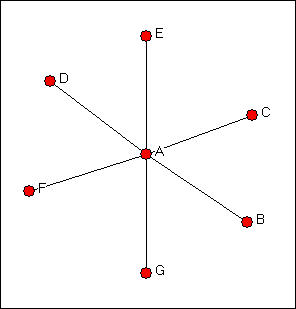
The central actor, A, is clearly in an advantageous position. Why?
- Degree: A has the most connections. If one partner is unavailable, A has other options.
- Closeness: A is just one step away from everyone else, making it an efficient hub for information.
- Betweenness: Any communication between two peripheral nodes (e.g., F and B) must pass through A, giving A brokerage and control.
While these measures are useful, they don't capture the full story. Is it always better to be connected to popular, well-connected people? Not necessarily. This is where the Bonacich power index offers a more nuanced perspective.
The following reading from Hanneman and Riddle's text on Social Network Analysis introduces the foundational concepts of centrality and then explains Phillip Bonacich's crucial extension, which distinguishes between being "central" and being "powerful."
Chapter 10: Centrality and power - UCR ITS
This reading will introduce you to Bonacich's core idea: that an actor's power is a function not only of their own connections, but also of the connections of their neighbors. It critically distinguishes between two types of positional advantage.
Please read the section titled Degree centrality: Bonacich's approach. Start at the heading and read to the end of the section. Pay close attention to the example of Bill and Fred and the distinction between being connected to well-connected others versus poorly-connected others.
As you've just read, Bonacich's key insight is that the nature of power depends on the context of the network.
- Being connected to popular people makes you central and influential, which is valuable for spreading information or gaining prestige. Your message travels far and wide.
- Being connected to dependent people (who have few other options) makes you powerful in a bargaining sense. They need you more than you need them, giving you leverage.
This distinction is fundamental to analyzing relationship networks. A person at the center of a vibrant social circle has influence, while a person in an exclusive relationship with a devoted partner has bargaining power.
Formalizing the Bonacich Index
Bonacich formalized this intuition into a single, flexible measure. Your background in statistics and operations research will make the matrix formulation of this index quite accessible. It allows us to calculate a score for each person in the network that reflects these different types of power.
The reading below is from Bonacich's original 1987 paper. It's more technical, but it lays out the model with precision.
Power and Centrality: A Family of Measures
This reading introduces the formal notation for the Bonacich centrality measure, c(α, β), and explains the roles of its key parameters. This will provide the mathematical foundation for the index.
First, read the introduction, from the beginning of the article until just before the heading "THE MEASURE" (read this section). This part explains the motivation for a new measure. Next, read the section THE MEASURE, focusing on formula (4): the key formula and its explanation.
Let's break down the central formula you just saw:
Here's what each component means in the context of a relationship network:
- is a vector of power/centrality scores, one for each person in the network.
- is the adjacency matrix, where if person and have a relationship, and 0 otherwise.
- is a vector of ones.
- is a scaling constant to normalize the scores. It doesn't change the relative rankings.
- is the most important parameter. It determines how much weight is given to the connections of your partners. It can be positive, negative, or zero.
The term is the matrix equivalent of a geometric series, . This elegantly captures the idea of summing up all direct and indirect paths emanating from a person, with each path being weighted by its length and the parameter.
Interpreting Beta ()
The value of you choose completely changes the kind of power you are measuring:
-
When : You are rewarded for being connected to other well-connected people. This measures influence and prestige. A positive score means your power is amplified by your partners' power. This is useful for modeling the spread of ideas, social norms, or reputation. A person connected to several community leaders would score highly here.
-
When : The formula simplifies to be proportional to degree centrality (the number of direct connections). This is your baseline measure of "popularity."
-
When : You are rewarded for being connected to people who are poorly connected. This measures bargaining power and leverage. Your partners are dependent on you because they lack outside options. This is ideal for modeling situations of exclusive exchange, emotional dependency, or resource control.
Application: Power in an Extended Polyamorous Network
Now let's apply this to an "extended polyamorous network," as required by our learning outcome. A simple vee is a good start, but real-world structures are often more complex.
Consider the following network, which represents a "vee feeding into another vee":
- Priya is in a vee with Hitesh (the hinge) and Ana.
- Ana is also a hinge in her own vee with Priya and Charles.
The structure looks like this: Hitesh — Priya — Ana — Charles
Let's analyze the power dynamics using the Bonacich index.
Case 1: Influence and Prestige ()
Imagine we're measuring the potential to spread a positive idea, like organizing a group holiday. Here, being connected to well-connected people is an asset.
- Priya and Ana are in the strongest positions. They are each connected to two people, and crucially, they are connected to each other. Their central positions in the chain allow them to reach everyone in the network quickly. They would have the highest Bonacich scores.
- Hitesh and Charles are on the periphery. They each have only one connection. Their influence is limited; to reach anyone other than their direct partner, they must go through them. They would have the lowest scores.
In this context, Priya and Ana are the network's key influencers.
Case 2: Bargaining Power ()
Now, let's change the context. Imagine we are modeling leverage, where exclusivity and dependency matter more. For instance, who has more leverage when negotiating one-on-one time? With a negative , you gain power from your partners' lack of options.
- Hitesh and Charles now appear more powerful in a specific sense. Hitesh's power comes from Priya's dependence on him for that particular dyadic relationship (assuming Priya has no one else besides Ana). Similarly, Charles's power comes from Ana's dependence on him within their dyad. They each have an "exclusive" link to a more central person.
- Priya and Ana are in a more complex situation. Their connection to each other, which was an asset for influence, is now a liability for bargaining power. Priya is not wholly dependent on Hitesh because she has Ana. Ana is not wholly dependent on Charles because she has Priya. Their mutual connection provides them with outside options, thus reducing their individual bargaining power relative to their peripheral partners.
- The model would likely show that Hitesh and Charles have significant localized power over their respective partners, while Priya and Ana's power is tempered by their mutual connection. The person with the highest bargaining power might be Hitesh or Charles, as they are connected to central players (Priya, Ana) who are themselves constrained by their other ties. This is a non-obvious insight that simple centrality measures would miss.
This application demonstrates how changing the parameter allows you to model fundamentally different social dynamics within the same network structure, providing a rich, multi-faceted view of power.
Conclusion
In this lesson, we moved beyond simple centrality to a more sophisticated model of network power. The Bonacich power index provides a formal and flexible tool for assessing structurally-derived power, which is critical for analyzing complex relationship networks.
- Key Takeaways:
- The Bonacich power index extends degree centrality by considering the connections of an actor's neighbors.
- It distinguishes between two types of power through the
beta() parameter. - A positive measures influence and prestige, rewarding connections to other well-connected individuals.
- A negative measures bargaining power and leverage, rewarding connections to dependent individuals with few outside options.
- Applying this index to extended polyamorous networks can reveal non-intuitive power dynamics that simple connection counts would overlook.
Preview of the next lesson:
Now that we have a quantitative tool to assess an individual's power based on their network position, the next logical question is: what would they do with this information? In the next lesson, we will evaluate the strategic incentives for partners to add or sever ties based on resulting changes in network power. This will connect our understanding of network structure directly back to the strategic decision-making at the heart of game theory.