Welcome back. In our previous lesson, we explored how strategies like cooperation and defection compete within a population, focusing on the concept of invasion resistance. We saw that for a strategy to be evolutionarily stable, it must not only be effective when common but also capable of invading when rare. This can lead to stable mixtures of strategies or even cyclical dynamics.
Today, we will take this analysis one step further. Instead of looking at the stability of individual behavioral strategies, we will assess the stability of the relationship structure itself. Your goal for this final lesson of the module is to assess the evolutionary stability of the vee configuration by analyzing conditions under which the structure persists or dissolves. We will treat different relationship configurations—monogamy, polyandry, etc.—as competing outcomes in a larger evolutionary game. By identifying the conditions that make a vee-like structure an Evolutionarily Stable Strategy (ESS), we can understand what makes it a persistent and viable form of relationship.
Mating Systems as Competing Structures
From an evolutionary standpoint, any relationship structure is just one of several possibilities. The vee, a form of polyandry, competes with other configurations. To visualize these alternatives, consider the standard classification of mating systems based on the number of partners for each sex.
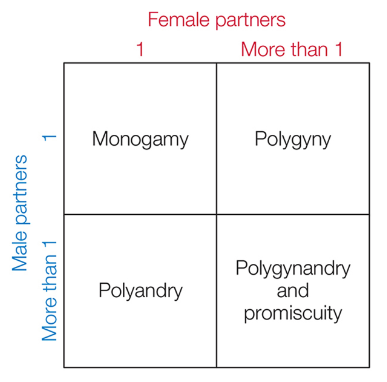
The core question is: under what conditions will natural selection favor polyandry over the other three systems? If we can define these conditions, we can understand the environmental and strategic factors that support the stability of a vee structure.
A classic model developed by John Maynard Smith provides a powerful framework for this analysis. It examines how the conflict between male and female parental care strategies shapes the evolution of these mating systems.
The Maynard Smith Model: Conditions for Stability
Maynard Smith's model frames the problem as a game where each sex can choose to either "care" for offspring or "desert" them. The combination of these choices, along with environmental factors, determines the fitness payoffs and, ultimately, which mating system emerges as an ESS.
The following reading from an ecology text details the model's parameters and presents its main conclusions. Your expertise in game theory and modeling will make the logic here quite accessible.
[PDF] mating systems and parental care
This reading introduces Maynard Smith's game theory model of parental care and derives the conditions under which different mating systems, including polyandry, become evolutionarily stable.
Begin with the Introduction to grasp the fundamental conflict between male and female reproductive strategies. Next, read the subsection on Mating Strategies to see how the model links parental care choices (Care vs. Desert) to the four primary mating systems. Then, carefully study the model parameters, paying close attention to the variables P_0, P_1, P_2 (offspring survival), p, p' (male remating probability), and V, v (female reproductive output). Understanding these variables is key to interpreting the results. Finally, focus on Table 2 in the section on ESS Conditions. This table is the central payoff of the model, presenting the specific inequalities that must be met for each mating system to be an ESS.
The model reveals that for a particular structure to be stable, a specific set of inequalities must hold true for both sexes simultaneously. Let's analyze the conditions for polyandry, the category that includes the vee relationship. According to Table 2, polyandry is an ESS when:
- Female Deserts:
- Male Cares:
Let's translate these from the biological context of "offspring" and "clutch size" to the socio-emotional context of a vee relationship:
- Variables for the Hinge (Female):
- : The hinge's total capacity for relationship investment (time, energy, emotional bandwidth) when she diversifies across multiple partners.
- : The hinge's investment capacity when she concentrates on a single partner ().
- Variables for Relationship Success (analogous to offspring survival):
- : The success/stability of a relationship where both partners are fully dedicated (analogous to monogamy with two caring parents).
- : The success of a relationship where one partner is dedicated (the non-hinge partner in a vee).
- : The success of a relationship with no dedicated parental care (a purely casual or uncommitted interaction).
- Variables for Non-Hinge Partners (Males):
- : The probability of a non-hinge partner finding a new, equally viable primary relationship after "deserting" the vee.
- : The (lower) probability of finding a new primary relationship while remaining committed within the vee.
With these analogies, the conditions for a stable vee become clear:
-
Hinge's Incentive: The payoff for the hinge from maintaining multiple relationships with singly-dedicated partners () must be greater than the payoff from a single, mutually-dedicated relationship (). This captures the scenario where diversification is the hinge's optimal strategy for maximizing her overall relationship utility.
-
Non-Hinge Partner's Incentive: The payoff for a non-hinge partner from "caring" (investing in the vee), which yields success level plus any outside opportunities , must be greater than the payoff from "deserting" to seek a new relationship, which has a low baseline success and a higher chance of finding another mate . This means the partners must find it more rewarding to stay and invest in the vee than to leave and start over.
If either of these conditions fails, the vee structure is not an ESS. For example, if the benefits of mutual dedication are extremely high ( is large) or if good alternative partners are plentiful for the non-hinge partners ( is high), the vee structure will be unstable and tend to dissolve or transition into another form, like monogamy.
Dynamics of Structural (In)stability
An ESS is a stable equilibrium point. As you know from your study of dynamic systems, this means that if the system is slightly perturbed, it tends to return to that point. The following video provides a good refresher on this concept, explaining how to test for stability by examining what happens when a population deviates from its equilibrium mix.
Evolutionarily Stable Nash Equilibrium (vs. Unstable)
This video by Ashley Hodgson offers a clear, practical demonstration of how to determine if a Nash equilibrium is evolutionarily stable or unstable.
Watch the entire video. Focus on the core method: Start with the concept of a population spectrum and the Nash equilibrium point. See how a random deviation from equilibrium creates an advantage for one strategy over another, pushing the population either back toward the equilibrium (stable) or away from it (unstable). Follow the calculation from this point, where the payoffs for each strategy are calculated at a point away from equilibrium to determine the direction of evolutionary pressure.
Applying this logic, if the conditions for the vee are almost met, but a small change in the environment (e.g., a change in the availability of alternative partners) tips the balance, the structure will begin to dissolve. The strategic incentives will shift, causing partners to change their behavior in a way that pushes the system toward a different stable state, such as monogamy or promiscuity.
A Network Perspective on Structural Stability
The Maynard Smith model treats mating systems as discrete categories. We can gain a more granular and powerful perspective by viewing the vee as a specific network structure and analyzing its stability in those terms. This approach connects directly to your broader goal of integrating game and network theory.
A vee is a 3-node star graph. Structural change corresponds to adding or severing links:
- Dissolution: A non-hinge partner leaves, severing a link.
- Transformation: The two non-hinge partners form a relationship, adding a link and turning the vee into a triangle (a fully connected triad).
A recent and more advanced approach in evolutionary game theory analyzes the stability of networks directly. This framework is conceptually demanding, but the core ideas should resonate with your background.
[PDF] “Evolutionarily stable networks” - Toulouse School of Economics
This paper by Péter Bayer introduces a framework for analyzing the evolutionary stability of network structures, fusing concepts from evolutionary game theory and network formation games.
Read the abstract and introduction to understand the motivation for an evolutionary approach to network formation. Skim Section 2, "Evolutionary games on heterogeneous groups." The key idea to grasp is the definition of an m-ESS: a strategy that is stable against "mutant" strategies that differ in up to m positions (see here). A 1-mutation is a unilateral change; a 2-mutation is a coordinated change by a pair. Read the summary of Proposition 2 (see here). This shows that stability against 2-mutations (a 2-ESS) involves analyzing the success of coalitional deviations by pairs. Finally, read the first part of Section 3 on Evolutionary network formation games. Focus on the definitions of one-sided and two-sided link formation, and how stability against link additions/severances can be tied to 1-ESS and 2-ESS concepts. Pay special attention to the concept of a pair-evolutionarily stable network.
This paper proposes that in an evolutionary context, individuals don't act with pure self-interest. Instead, due to assortative matching (the idea that "like begets like"), they behave as if they have a degree of altruism, weighted by a parameter , which can be interpreted as the degree of shared interest, empathy, or relatedness in a group.
This leads to a crucial insight for the stability of the vee against transformation into a triad:
The formation of a link between the two non-hinge partners is a coalitional deviation by a pair (a 2-mutation). The vee structure is stable against this change if the "mutant" strategy (form a link) cannot successfully invade the "resident" strategy (don't form a link).
According to the principles in the paper (Proposition 3), this new link will not form if the joint benefit to the two deviating partners is less than their joint cost. The key is how "benefit" is calculated: it includes their own individual payoff changes, but also the externalities their action imposes on the third person (the hinge), weighted by the assortativity parameter .
Condition for Vee Persistence (vs. Triad Formation):
A vee structure remains stable and does not transform into a triad if:
This provides a formal condition for the persistence of the vee's "open" structure. If the externality on the hinge is highly negative (e.g., creating jealousy and conflict), and the partners have some degree of empathy or shared interest (), they will be deterred from forming the link, even if it might be individually beneficial for them in isolation. The vee structure polices itself through these evolved, other-regarding incentives.
Conclusion
We have examined the evolutionary stability of the vee configuration from two complementary angles. This analysis reveals that the persistence of a vee is not a given, but a dynamic equilibrium dependent on a precise set of conditions.
- Key Takeaways:
- Mating System Perspective: When viewed as a competing mating system, the vee (as a form of polyandry) is stable only when the strategic incentives for both the hinge (to diversify) and the non-hinge partners (to stay and invest) are met. These incentives are functions of relationship payoffs, trade-offs, and outside options.
- Network Stability Perspective: When viewed as a network graph, the vee's stability depends on its resistance to the severing or addition of links. The transformation of a vee into a closed triad is modeled as a coalitional deviation. The structure's stability against this change depends on a joint cost-benefit calculation that includes the externality imposed on the hinge, weighted by the degree of shared interest within the group.
- Dissolution vs. Persistence: Ultimately, a vee configuration persists when the environment and the payoffs make it a better strategy for all participants to maintain the current structure than to unilaterally or jointly deviate from it.
Preview of the next lesson: This lesson concludes our module on evolutionary dynamics. We will now move into the course's second major part, beginning with Module 8: "Modeling Polyamorous Social Networks." Having just analyzed the stability of a single vee network, we will broaden our scope to represent and analyze more complex structures, such as interconnected vees, triads, and larger polycules, using the formal tools of network theory.