Welcome to our next lesson on the strategic formation of relationship networks. In our previous session, we constructed a formal utility model—the connections model—to quantify the costs and benefits for individuals within a polyamorous network. We saw how a player's utility depends not just on their direct partners but also on the wider network structure, creating externalities like compersion.
So far, we have only looked at decision-making from a single player's perspective. Today, we will expand our analysis to consider the network as a whole. We'll explore what makes a relationship structure, such as a vee, a stable outcome when all individuals are simultaneously making their own strategic choices. To do this, we will introduce and apply a key equilibrium concept from network theory: pairwise stability.
From Individual Choice to Network Equilibrium
In game theory, we use equilibrium concepts like the Nash equilibrium to predict stable outcomes. However, network formation has a unique feature: forming a link isn't a unilateral action. It requires mutual consent. A standard Nash equilibrium might not fully capture this dynamic.
To address this, economists Matthew Jackson and Asher Wolinsky proposed the concept of pairwise stability. A network is pairwise stable if it is immune to two types of deviations: no single player has an incentive to sever an existing link, and no two unlinked players have a mutual incentive to create a new one.
Let's look at the formal definition from the MIT OpenCourseWare lecture notes on network formation.
This excerpt from a lecture by Mihai Manea provides the concise, formal definition of pairwise stability, which is the central concept for today's lesson.
Please read the section titled "Pairwise Stability" starting from Definition 3. Focus on understanding the two conditions, (i) and (ii), as we will be applying them directly.
As the reading explains, a network is pairwise stable if two conditions are met:
-
No Incentive to Sever: For any existing link between two players, and , neither player would be better off if that link were removed. Formally, and . A single unhappy person can break a connection.
-
No Mutual Incentive to Add: For any two players, and , who are not currently linked, it is not the case that they would both benefit from adding a link. Formally, if adding the link makes player better off (), then it must make player worse off (). A new link requires two enthusiastic participants.
This concept provides a powerful lens for assessing whether a given relationship structure is likely to persist based on the self-interest of its members.
Is the Vee Pairwise Stable? A Step-by-Step Analysis
Now, let's apply this concept to our primary subject: the polyandrous vee relationship. We will use the connections model utility function we developed in the last lesson to determine the exact conditions under which a vee is a pairwise stable network.
Recall the utility function for player in a network :
where is the benefit parameter (), is the path distance between players, is the number of direct links (degree) for player , and is the cost per link.
Our vee network, , consists of three players—P1, H, and P2—with links {P1, H} and {H, P2}.
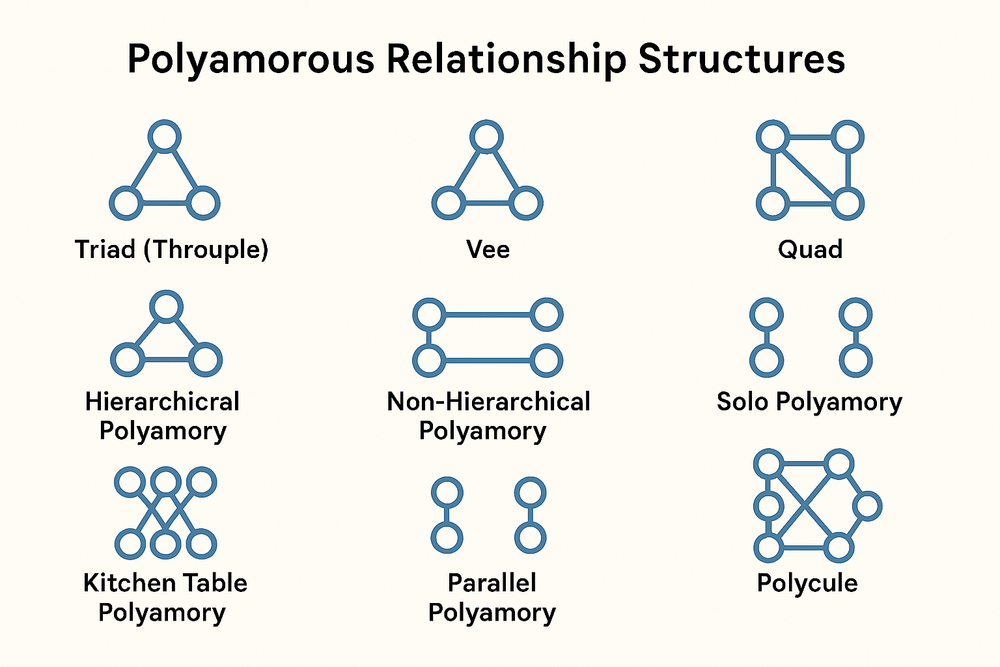
First, let's calculate the utility for each player in the vee:
- P1 (Non-Hinge): Has one link (to H) and is two steps away from P2.
- P2 (Non-Hinge): Symmetrical to P1.
- H (Hinge): Has two links (to P1 and P2).
With these baseline utilities, we can now test for pairwise stability.
Condition 1: Checking for Link Severance
We must ensure no one wants to delete an existing link. Due to symmetry, we only need to check the {P1, H} link.
-
Does P1 want to sever the link with H?
If the link is severed, P1 becomes isolated. The network becomes , and P1's utility is . For stability, P1 must prefer to stay:
This condition means that for a non-hinge partner, the combined direct benefit from the hinge and indirect benefit from the metamour must outweigh the cost of the relationship. -
Does H want to sever the link with P1?
If H severs the link with P1, the network becomes . H's utility would be . For stability, H must prefer to keep P1:
This condition is stricter. The hinge only considers the direct benefit of the link (), not the network effects. This makes intuitive sense: the hinge bears the full cost of the link but only gets the direct benefit from that specific partner. In contrast, P1's utility calculation includes the external benefit of being connected to P2 ().
For the vee to be stable against link severing, both conditions must hold. Since is impossible for , the hinge's condition () is the more stringent one. If it holds, the non-hinge's condition also holds. Thus, for no links to be severed, we require .
Condition 2: Checking for Link Addition
Next, we must ensure that no two unlinked players want to form a new link. The only unlinked pair is {P1, P2}. If they form a link, the vee becomes a triad (a complete triangle), which we'll call .
In , all players are one step from each other and each has two links. The utility for any player would be:
Now, we check if adding the {P1, P2} link is mutually beneficial. Let's look at P1's incentive:
By symmetry, P2 has the exact same incentive. The vee is stable only if this mutual desire to form a triad does not exist. Therefore, for the vee to be stable against this deviation, the opposite must be true:
This condition means that the cost of forming a new link must be high enough to deter P1 and P2 from closing the triangle. If the cost were too low (), the vee would be unstable, as it would naturally tend to evolve into a triad.
The Stability Condition for a Vee
By combining our findings, we arrive at a concise set of conditions for a vee network to be pairwise stable:
- From the link severance analysis:
- From the link addition analysis:
Putting them together, the vee relationship structure is a stable equilibrium in the connections model if and only if the cost-to-benefit ratio falls within a specific range:
This result is powerful. It translates the complex social dynamics of a vee into a simple inequality. It tells us that vees are stable when the cost of maintaining a relationship is:
- Not too high (), so the hinge partner feels each relationship is worth the investment.
- Not too low (), so the non-hinge partners don't have an overwhelming incentive to form their own direct relationship.
Your background in operations research has likely exposed you to many such optimization problems where solutions exist only within a specific parameter space. Here, we see the same principle defining the "solution space" for a stable relationship structure.
Conclusion
In this lesson, we have moved beyond individual utility to analyze the stability of an entire network structure. By defining and applying the concept of pairwise stability, we derived the specific conditions under which a vee relationship can be considered a stable equilibrium.
- Key Takeaways:
- Pairwise stability is an equilibrium concept for networks that requires mutual consent for link formation and allows for unilateral link severance.
- A network is pairwise stable if (1) no player wants to sever an existing link and (2) no two unlinked players both want to add a new link.
- Applying this to a vee using the connections model, we found that the vee is stable if and only if the cost of a link
cis in the range . - This formalizes the intuition that vee structures are most stable when the costs of forming new connections are significant enough to prevent the non-hinge partners from linking up, but not so high that the hinge is incentivized to break things off.
Preview of the next lesson:
The vee might be stable, but is it the best possible structure? In our next lesson, we will explore the concept of network efficiency and analyze the frequent tension between what is stable for individuals and what is optimal for the group as a whole.