Hallo! Welcome back. In our last lesson, you learned to use modal verbs like können and müssen to discuss your current professional abilities and responsibilities. You can now confidently form sentences like, Ich kann skalierbare REST APIs entwickeln or Ich muss Code-Reviews durchführen.
Today, we will shift from the present to the past. Being able to talk about what you've accomplished is fundamental in any job interview or project discussion. We will focus on the Perfekt tense, which is the standard way to talk about past events in spoken German. The goal for this lesson is to learn how to describe past work activities using the Perfekt tense with the auxiliary verbs 'haben' and 'sein'.
Part 1: What is the Perfekt Tense?
In German, there are two primary ways to talk about the past: the Präteritum (simple past) and the Perfekt (present perfect). While they both describe past events, their usage is different. The Perfekt is overwhelmingly used in spoken, conversational German. The Präteritum is mainly reserved for written language like novels and news reports.
For your goal of improving professional conversation, mastering the Perfekt is the top priority.
Perfekt vs. Präteritum 🤔 | Deutsch lernen 🇩🇪|
To start, let's watch a short segment from the video 'Perfekt vs. Präteritum' by the channel Berufsdeutsch. It clearly explains this fundamental difference in usage.
Watch from the beginning to 02:00. Focus on understanding when to use Perfekt (speaking with friends, colleagues) versus when you might see Präteritum (reading a book).
An important exception, which we will cover in a later lesson, involves the verbs haben, sein, and modal verbs. These are often used in their Präteritum forms (hatte, war, konnte, etc.) even in spoken language. For today, however, we will focus entirely on the Perfekt tense with all other verbs.
Part 2: The Structure of the Perfekt Tense
The structure of the Perfekt tense should feel somewhat familiar after our last lesson on modal verbs. It consists of two parts:
- An auxiliary verb (Hilfsverb): either
haben(to have) orsein(to be). This verb is conjugated and placed in the second position of the sentence. - A past participle (Partizip II): This is the past form of the main verb (e.g., gemacht, entwickelt, gegangen). It is placed at the very end of the sentence.
Formula: Subject + [conjugated haben/sein] + ... (other information) + [Past Participle].
- Present Tense:
Ich entwickle eine neue Funktion.(I develop a new feature.) - Perfekt Tense:
Ich **habe** eine neue Funktion **entwickelt**.(I developed a new feature.)
This grammar chart provides an excellent visual summary of the structure. We will refer back to it throughout the lesson.
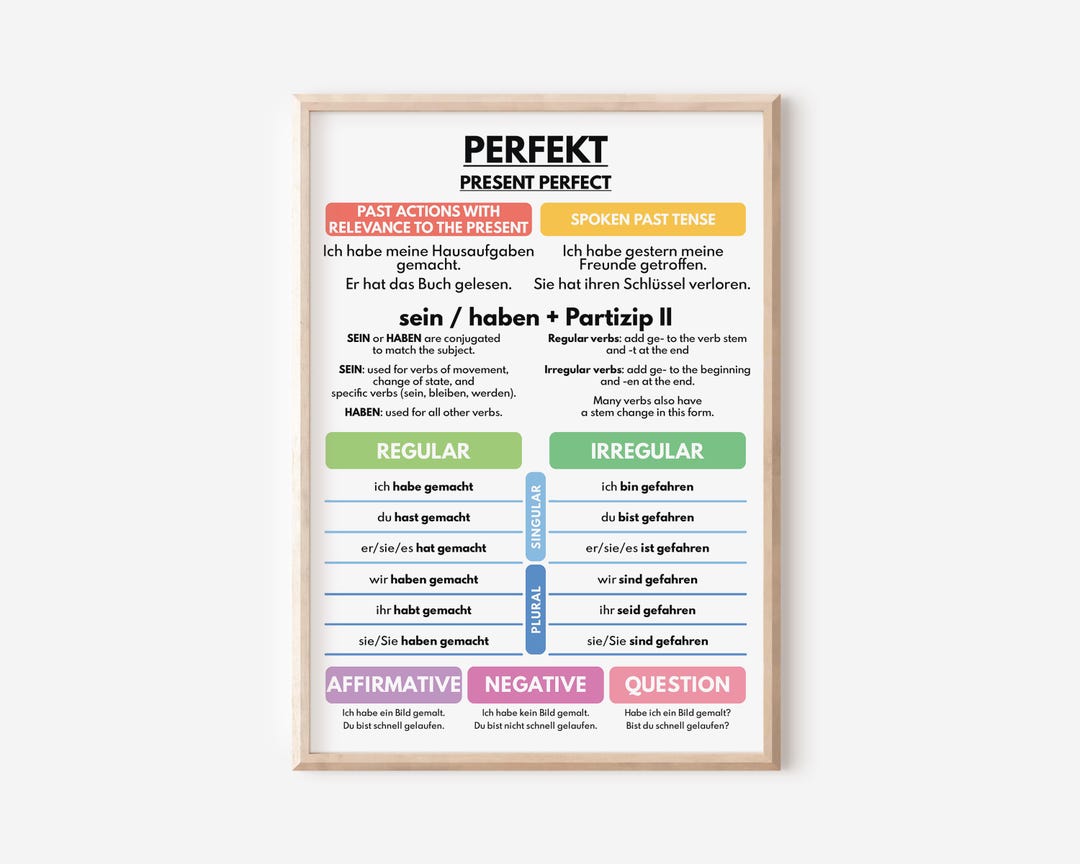
To solidify this concept, please read the following brief explanation.
Decoding the Perfekt Tense in German: Formation and ...
The article 'Decoding the Perfekt Tense in German' provides a clear, concise breakdown of this structure.
Read the section titled 'How to Form the Perfekt Tense'. It reinforces the two-part formula and the crucial word order rule.
Part 3: A Brief Look at the Past Participle (Partizip II)
The Partizip II is the form of the verb that signifies a completed action. We will dedicate the next lesson to mastering its various forms, but for now, you just need to recognize the basic patterns:
- Regular (weak) verbs: These typically form the participle with
ge+ verb stem +t.machen->gemachtentwickeln->entwickelt(verbs ending in-elndrop thee)programmieren->programmiert(verbs ending in-ierendo not addge-)
- Irregular (strong) verbs: These often have a stem-vowel change and end in
en. They must be memorized.schreiben->geschriebensprechen->gesprochengehen->gegangen
- Separable prefix verbs: The
geis placed between the prefix and the verb stem.anfangen->angefangenteilnehmen->teilgenommen
Don't worry about memorizing all these rules now. The key is to understand that the verb at the end of a Perfekt sentence will be in this participle form.
Part 4: The Core Question — haben or sein?
This is the most crucial part of forming the Perfekt correctly. How do you decide which auxiliary verb to use?
The Rule of Thumb
A simple and effective rule is to use:
sein: With verbs indicating movement from A to B (gehen,fahren,fliegen) or a change of state (einschlafen- to fall asleep,wachsen- to grow,sterben- to die). Also, withsein(to be) andbleiben(to stay).haben: With almost all other verbs, especially those that can take a direct object (in the accusative case).
Decoding the Perfekt Tense in German: Formation and ...
Let's read a quick summary of this rule.
Read the section 'Haben or Sein? Choosing the Right Auxiliary Verb!'. It gives clear examples for each category.
A More Precise Rule for an Analytical Mind
Given your background in computer science and mathematics, you'll likely appreciate a more precise, logical rule. The "movement" rule is a good shortcut, but the grammatically accurate distinction is based on whether a verb is transitive or intransitive.
- Transitive verbs are verbs that act upon a direct object. These almost always use
haben.Ich schreibe den Code.(den Codeis the direct object). ->Ich **habe** den Code geschrieben.
- Intransitive verbs do not have a direct object. If they also describe movement or a change of state, they use
sein.Ich gehe ins Büro.(There is no direct object here;ins Bürois a prepositional phrase). ->Ich **bin** ins Büro gegangen.
This video explains why this rule is more reliable.
das Perfekt mit haben oder sein - You're Doing It WRONG!
The video 'das Perfekt mit haben oder sein - You're Doing It WRONG!' from the channel Learn German with Herr Antrim provides an excellent explanation of the transitive vs. intransitive rule.
Watch from 03:21 to 06:15. The presenter first introduces the transitive/intransitive concept and then uses the verb 'fahren' (to drive/go) to show how the same verb can take 'haben' or 'sein' depending on its use. This is a key insight.
Part 5: Applying the Perfekt in Your Professional Context
Let's put this into practice with examples from your work as a Full-Stack Engineer.
Examples with haben (verbs with a direct object):
Ich **habe** eine skalierbare REST API **entwickelt**.(I developed a scalable REST API.)- Direct object:
eine skalierbare REST API
- Direct object:
Wir **haben** Celery für die Hintergrundverarbeitung **implementiert**.(We implemented Celery for background processing.)- Direct object:
Celery
- Direct object:
Letzte Woche **habe** ich ein YOLOv8-Modell **trainiert**.(Last week I trained a YOLOv8 model.)- Direct object:
ein YOLOv8-Modell
- Direct object:
Er **hat** den Bug im Frontend **gefixt**.(He fixed the bug in the frontend.)- Direct object:
den Bug
- Direct object:
Examples with sein (verbs of movement or state change, no direct object):
Ich **bin** im März zu meiner neuen Firma **gewechselt**.(I changed to my new company in March.)- Change of state (from one employer to another).
Die Deployment-Pipeline **ist** erfolgreich **gelaufen**.(The deployment pipeline ran successfully.)- Movement/process.
Nach dem Meeting **bin** ich zu meinem Schreibtisch **zurückgegangen**.(After the meeting, I went back to my desk.)- Movement from A to B.
Test your understanding!
You want to say two things about yesterday:
- You developed a new feature.
- You went to the office.
How would you say these two sentences in the Perfekt tense?
Show answer
Ich **habe** ein neues Feature **entwickelt**.(Useshabenbecauseentwickelnhas a direct object:ein neues Feature).Ich **bin** ins Büro **gegangen**.(Usesseinbecausegehendescribes movement from A to B and is intransitive).
Conclusion
Great job! Today you've learned the essential structure for talking about the past in German. This is a huge step toward being able to discuss your project experience and career history in an interview.
Key Takeaways:
- The Perfekt tense is used for spoken past events.
- Its structure is:
conjugated haben/sein(position 2) + ... +Past Participle(at the end). - Use
habenfor transitive verbs (those that take a direct object). This covers most verbs you'll use to describe what you've built, fixed, or managed. - Use
seinfor intransitive verbs that show movement (A to B) or a change of state.
In our next lesson, we'll build on this foundation. We will focus on memorizing the common irregular past participles used in professional contexts, such as geschrieben, gesprochen, and getroffen, so you can use them fluently without hesitation.