Introduction
In our last lesson, we focused on facilitating effective tollgate reviews, the formal checkpoints that ensure a Six Sigma project stays on track and aligned with business goals. Passing the Improve phase tollgate means you've successfully identified and validated a technical solution. However, a technically brilliant solution that no one uses is a failure. This brings us to the human side of process improvement, which is often the most challenging aspect.
Welcome to your lesson on how to analyze potential sources of resistance and select a suitable change management framework. As an experienced IE professional, you've likely seen well-designed process changes meet with skepticism or outright opposition on the shop floor. This lesson will equip you with a formal structure to anticipate, diagnose, and manage that resistance, a critical competency as you move towards Green and Black Belt leadership roles.
1. Understanding Resistance to Change in Manufacturing
Implementing a change, whether it's a new quality check, a revised workflow, or an updated piece of software, is not just a technical event—it's a social one. Resistance is a natural human reaction to change, and it rarely happens because people are intentionally being difficult. It's your job as a project leader to understand the underlying reasons.
Based on your 11 years in manufacturing, you've probably encountered many of these common sources of resistance. Let's formalize them.
Improve Phase: Understanding Resistance... - Lean 6 Sigma Hub
This article from Lean 6 Sigma Hub provides a great starting point by outlining the common sources of resistance encountered during Lean Six Sigma projects in manufacturing environments.
Read the introductory section and the subsection 'Common Sources of Resistance'. As you read, think about specific examples you've witnessed in your own experience for each source mentioned.
As the article highlights, resistance in a manufacturing setting often stems from:
- Fear of Job Loss: The most basic fear. "Will this new automated system make my job redundant?"
- Loss of Mastery: An experienced operator who is the go-to expert on an old machine may feel incompetent and insecure when a new, unfamiliar system is introduced.
- Increased Workload: "Is this just another check I have to do or another form I have to fill out on top of my existing duties?"
- Skepticism from Past Failures: If previous initiatives were poorly managed or abandoned, employees become cynical. You'll hear comments like, "Here we go again, another 'flavor of the month' idea from management."
- Disruption of Routines: People are creatures of habit. Change disrupts established, comfortable workflows.
- Loss of Control or Authority: A shift supervisor might resist a change if they perceive it as reducing their decision-making power on the floor.
Simply being aware of these potential sources allows you to be proactive. But to manage them effectively, you need a structured approach.
2. The ADKAR Model: A Framework for Individual Change
To move beyond simply identifying resistance, we need a systematic way to guide people through the change process. One of the most practical and widely used frameworks for this is the ADKAR® model, developed by Prosci. Its power lies in its focus on the individual. Organizational change only happens when the individuals within it change.
ADKAR is an acronym for the five sequential outcomes an individual must achieve for a change to be successful.
This video provides a concise and clear introduction to the five stages of the ADKAR model. It explains the purpose of each stage and why the model's focus on individual change is so effective.
Watch the video from the beginning until 06:01. Focus on understanding the goal of each of the five stages: Awareness, Desire, Knowledge, Ability, and Reinforcement. Note how each stage is a necessary prerequisite for the next.
To summarize the video's key points, ADKAR represents the following five building blocks:
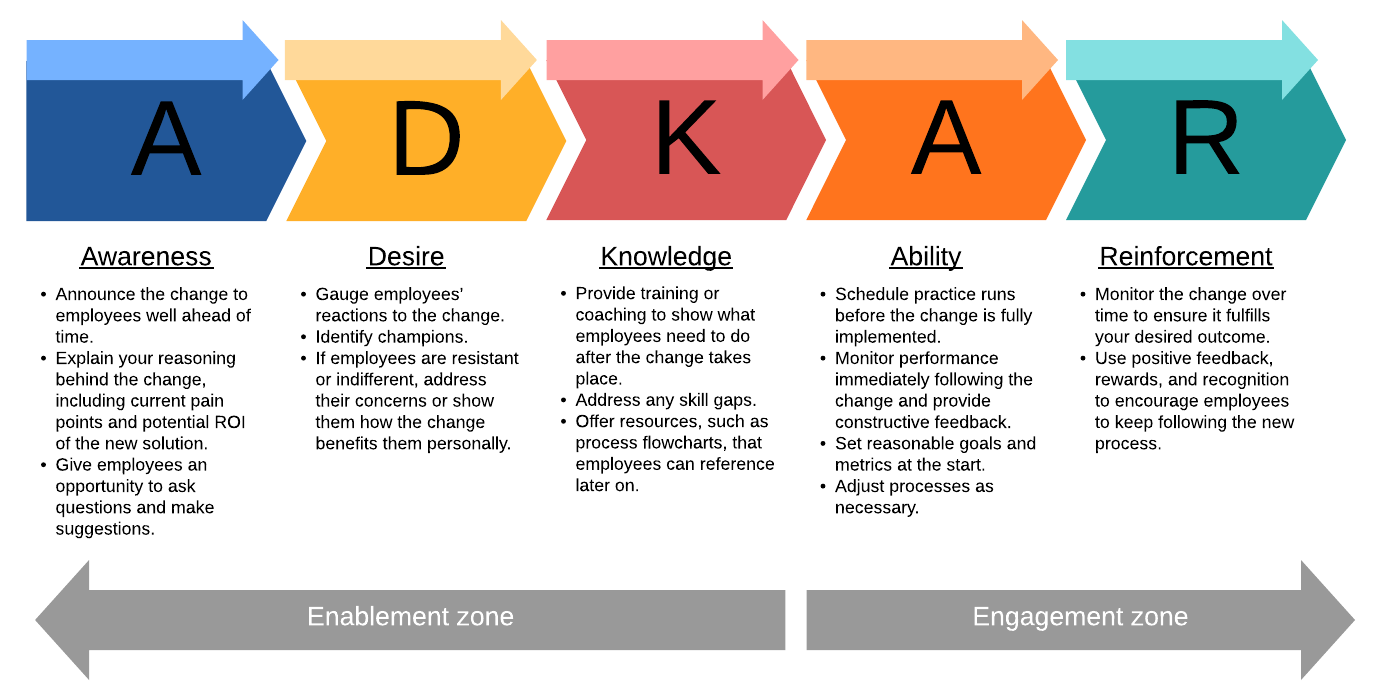
- Awareness of the need for change. (The "why")
- Desire to participate in and support the change. (The "what's in it for me" or WIIFM)
- Knowledge on how to change. (The "how")
- Ability to implement required skills and behaviors. (The "doing")
- Reinforcement to sustain the change. (The "sticking with it")
If any one of these blocks is missing, the change is likely to fail. You can't train someone on a new process (Knowledge) if they don't understand why it's necessary (Awareness) and don't want to do it (Desire).
3. Applying ADKAR in a Six Sigma Project
The true value of ADKAR comes when you integrate it directly into your DMAIC project plan. Change management isn't a separate, final step; it's woven through the entire project lifecycle.
Let's use a practical scenario: Your Six Sigma project aims to implement a new real-time Statistical Process Control (SPC) system on a critical production line to reduce defects. Here’s how you would apply ADKAR:
| ADKAR Stage | Project Leader's Actions | Connection to DMAIC |
|---|---|---|
| Awareness | Conduct meetings with operators and supervisors. Present data from your Measure phase showing the current defect rate, scrap costs, and customer complaints. Explain the business risks of not improving. | Define & Measure |
| Desire | In one-on-one and small group discussions, address their specific concerns. Explain how the SPC system will reduce frustrating rework, help the team meet quality targets (potentially tied to bonuses), and secure a key customer contract, enhancing job security. | Define & Analyze |
| Knowledge | Develop simple Standard Operating Procedures (SOPs). Hold hands-on training sessions where operators use a test version of the SPC software. Ensure supervisors are trained first and can act as coaches. | Improve |
| Ability | After go-live, provide on-the-floor support for the first few weeks. Create a "super user" on each shift who can provide immediate help. Give the team time to practice and get up to speed without penalty. | Improve & Control |
| Reinforcement | In daily stand-up meetings, display the new control charts showing the process improvements. Publicly recognize individuals who master the new system. Update performance metrics to include adherence to the new SPC process. | Control |
As you can see, ADKAR provides the "people" roadmap that runs parallel to your technical DMAIC roadmap.
ADKAR Model: The Guide to Successful Change Management
Now, let's explore how ADKAR and Six Sigma complement each other. This article provides a detailed look at aligning the ADKAR model with the DMAIC framework and includes a relevant manufacturing case study.
Read the section titled 'ADKAR Model And Six Sigma'. Pay close attention to the chart aligning ADKAR with DMAIC and the 'Manufacturing Sector Case Study' to see how this integration drives results.
4. Using ADKAR as a Diagnostic Tool
Beyond planning, ADKAR is also a powerful diagnostic tool. When you encounter resistance, you can use the framework to pinpoint the root cause. Listen to what people are saying:
- "I don't understand why we're changing this. The old way worked just fine for me."
- Barrier: Awareness. You need to go back and better explain the "why."
- "I get that the defect rate is high, but I'm not going to learn this new system. It's just more work and I won't see any benefit from it."
- Barrier: Desire. You need to address the WIIFM ("What's In It For Me?") for this individual.
- "Okay, I'm on board with the change, but nobody has actually shown me how to use the new interface."
- Barrier: Knowledge. The need for training and information is clear.
- "I attended the training, but when I'm on the line and the pressure is on, I can't seem to do it right. I'm afraid of messing up a batch."
- Barrier: Ability. This person needs coaching, practice, and support, not more training slides.
- "We all used the new process for a couple of weeks, but then things got busy and everyone just drifted back to the old way. Nobody seemed to notice."
- Barrier: Reinforcement. The change was not locked in with feedback, recognition, or updated management systems.
By diagnosing the specific barrier point, you can apply a targeted solution instead of a generic one.
Conclusion
In this lesson, we transitioned from the technical side of Six Sigma to the critical human element. You've learned that successful project leaders don't just find solutions; they ensure those solutions are adopted and sustained.
Key Takeaways:
- Resistance to change is a normal and predictable part of any improvement project, stemming from sources like fear of job loss, loss of mastery, and skepticism.
- The ADKAR model is a practical framework for managing change by focusing on the five outcomes each individual must achieve: Awareness, Desire, Knowledge, Ability, and Reinforcement.
- Change management should be integrated into the DMAIC process, not treated as an afterthought.
- You can use ADKAR as a planning tool to proactively manage change and as a diagnostic tool to identify the root cause of resistance when it occurs.
Preview of the Next Lesson:
Now that you have a powerful framework for understanding and managing individual change, the next step is to operationalize it. In our final lesson for this module, you will learn how to develop a change management plan, including communication and reinforcement actions, for a project scenario. We will take the ADKAR model and use it to build a concrete set of deliverables that will guide your team and stakeholders through a successful implementation.