Hello! Welcome to the fifth lesson in our course.
In our last session, we mastered Castigliano's Second Theorem to find beam deflections, using the formula . We saw how to use a "dummy" load P to find deflection at any point.
Today, we make a critical shift. Instead of finding an unknown deflection, we will use the same principle to find an unknown force. Specifically, we will tackle statically indeterminate beams by treating one of the support reactions as an unknown variable. This is the core technique you'll need for your exam.
Our goal for this lesson is to learn how to prepare an indeterminate beam problem for solution with Castigliano's theorem. You will learn to:
- Identify a redundant reaction,
R. - Create a solvable "primary structure" by treating
Ras an unknown load. - Write the bending moment expression,
M(x), as a function ofR. - Find the partial derivative of the moment expression with respect to
R, which is∂M/∂R.
We will focus exclusively on the setup today. The actual integration and solving will come in the next lesson.
1. From Determinate to Indeterminate Structures
So far, we've dealt with statically determinate beams, where the number of unknown reactions is equal to the number of static equilibrium equations (3 for a 2D beam: ).
An indeterminate structure has more unknown reactions than available equilibrium equations. For example, a propped cantilever (one fixed end, one roller end) has 4 unknown reactions (3 at the fixed end, 1 at the roller), but still only 3 equilibrium equations. It is "indeterminate to the first degree".
To solve such a problem, we need an additional equation. This is where Castigliano's theorem comes in. The strategy is to select one of the "extra" reactions and treat it as an unknown load. This extra reaction is called the redundant.
The following resource explains this concept well.
Statically Indeterminate Problems
Please read the following section from Chapter 4 Deflection and Stiffness by Shigley. It formally defines statically indeterminate problems and introduces the procedure we will be following.
Read from the heading 'Statically Indeterminate Problems' to the end of 'Procedure 1 for Statically Indeterminate Problems'. Focus on understanding the terms 'redundant supports' and the three steps of the procedure.
The key takeaway is this: we simplify the problem by removing the redundant support and replacing it with an unknown force (the redundant reaction, which we'll call R). This turns the indeterminate structure into a familiar, statically determinate one, but with an unknown load R acting on it.
This image perfectly illustrates the process for a propped cantilever beam.
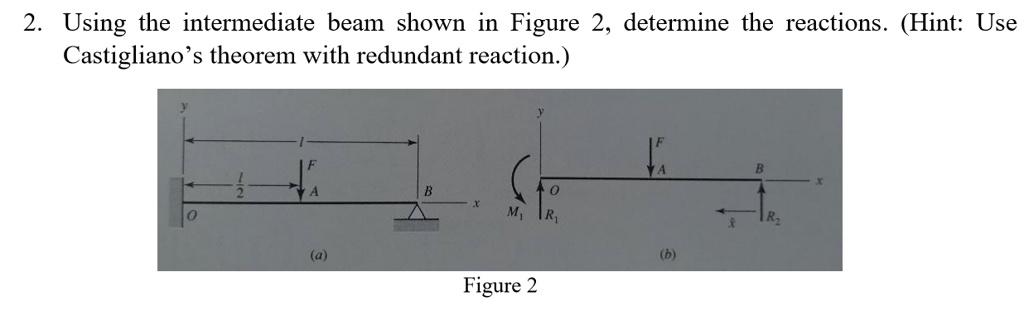
2. Setting Up M(x) and ∂M/∂R for a Redundant Reaction
Once we have our primary structure with the redundant R acting as a load, the process is very similar to what we did in the last lesson. The main difference is that our unknown variable is now R, not a dummy load P.
Let's walk through a classic example: a propped cantilever of length L with a uniformly distributed load (UDL) w.
Step 1: Identify Indeterminacy and Choose the Redundant
- The beam has a fixed support (3 reactions) and a roller support (1 reaction). Total = 4 reactions.
- Since 4 > 3, the beam is indeterminate to the first degree.
- We will choose the vertical reaction at the roller support as our redundant,
R.
Step 2: Define the Primary Structure
- The primary structure is a simple cantilever beam of length
L. - It is subjected to the original UDL
wand an unknown upward point loadRat the free end.
Step 3: Write the Bending Moment Expression, M(x)
- Let's set our origin
x=0at the propped (roller) end. We make a cut at a distancexfrom this end. - The moment at the cut consists of two parts:
- The moment from the redundant reaction
Ris+Rx. (Causes tension at the bottom, so it's positive). - The moment from the UDL
wis-w * x * (x/2) = -wx²/2. (Causes tension at the top, so it's negative).
- The moment from the redundant reaction
- The total moment expression is:
This expression is a function of both the positionxand the unknown redundantR.
Step 4: Find the Partial Derivative, ∂M/∂R
- Now, we differentiate
M(x)with respect toR. We treatxandwas constants.
- The derivative of
Rxwith respect toRisx. - The derivative of
-wx²/2with respect toRis0, since it does not containR. - So, the partial derivative is:
We have now found the two essential components, M(x) and ∂M/∂R, needed to solve for the redundant R.
3. Example with Multiple Segments
For more complex beams, you might need to write multiple moment expressions for different segments. The procedure is the same, but it requires more bookkeeping. A table is an excellent way to organize your work.
Let's look at an example from a set of lecture notes that demonstrates this systematic approach for a continuous beam over two spans.
This document, 'Method of Least Work', contains several worked examples. We will focus on the setup of Example 2, which is a two-span continuous beam.
Study the setup for Example 2, from slide 19 ('Solution') to slide 26. Do not worry about the final integration and solution. Pay close attention to: (1) How they express the other support reactions (Ay and Dy) in terms of the redundant By (slide 22). (2) The table on slides 24-26, which clearly lists the M and ∂M/∂By expressions for each segment of the beam.
In this example, they again choose a vertical reaction (By) as the redundant. The key steps you should have noticed are:
- Express all reactions in terms of
R: Before writing moment expressions, they use the equations of static equilibrium on the whole beam to findAyandDyas functions ofBy(ourR). This is a critical first step. - Divide the beam into segments: The loading and supports create discontinuities, so the beam is divided into segments AB, BC, and CD.
- Systematic setup: The table format is extremely useful. For each segment, it clearly defines the origin, limits of integration, the moment expression
M(x), and the partial derivative∂M/∂R. For segment AB (0 ≤ x ≤ 10), for instance:M = (245 - 0.5By)x - 15x²∂M/∂By = -0.5x
This systematic approach is exactly what is needed for the exam.
The Bridge to the Solution
Why are we doing this? Remember from the last lesson that Castigliano's theorem gives us the deflection at the point of a load: .
In our case, the "load" is the redundant reaction R. We also know something about the deflection at the location of R. For a roller support on a rigid foundation, the vertical deflection is zero. This is our compatibility equation.
So, we can set the deflection equal to zero:
By substituting the expressions for M(x) (which contains R) and ∂M/∂R that we just learned to derive, we get an equation where R is the only unknown. Solving this integral equation gives us the value of the redundant reaction.
Conclusion
Today, we've built the crucial bridge between understanding Castigliano's theorem and applying it to solve indeterminate structures. The ability to correctly set up the problem is the most important part of the process.
Key Takeaways:
- An indeterminate structure has more reactions than static equilibrium equations.
- We make it solvable by choosing one reaction as the redundant (
R) and treating it as an unknown load on a determinate primary structure. - The bending moment expression,
M(x), must be written as a function of the external loads and the unknown redundantR. - The partial derivative,
∂M/∂R, is found by differentiatingM(x)with respect toR. - These two expressions,
M(x)and∂M/∂R, are the key inputs for the compatibility equation , which we will use to find the value ofR.
In our next lesson, we will put this into practice. We will take the M(x) and ∂M/∂R for a propped cantilever, plug them into the compatibility equation, perform the integration, and solve for the numerical value of the redundant reaction.