Welcome to the sixth lesson in our foundational module on Mandarin pronunciation. Having covered the building blocks of Pinyin—initials, finals, and tones—and the rules for writing them down, we now turn to how these sounds interact in connected speech. So far, we have treated tones as fixed properties of a syllable. However, in reality, they can change depending on their neighbors.
This lesson addresses a crucial aspect of Mandarin phonology known as tone sandhi. The term "sandhi" comes from Sanskrit and means "joining," referring to the phonetic changes that occur at the boundaries between words or syllables. These are not optional dialectal quirks; they are mandatory rules of Standard Mandarin pronunciation. Your goal for this lesson is to master the three most important and frequent tone sandhi rules: the change for two consecutive third tones, and the changes for the common words 不 (bù) and 一 (yī). Understanding these rules is the final key to unlocking fluent and natural-sounding Mandarin pronunciation.
Part 1: Third Tone Sandhi—The Rule of the Low Tone
The third tone (ˇ), with its dipping-and-rising contour, is the most phonetically complex tone. As we've learned, it starts mid-low, drops to the bottom of your vocal range, and then rises again. Pronouncing this full contour takes time and effort. Now, imagine doing it twice in a row, for a word like nǐ hǎo (you good). The vocal gymnastics required would make rapid speech almost impossible.
To solve this, Mandarin employs a clever optimization. Before we get to the rule itself, it's helpful to understand how the third tone is most commonly pronounced in natural speech.
The "Half" Third Tone
In most contexts, when a third-tone syllable is followed by another syllable (of any tone except another third tone), native speakers only pronounce the first part of the tone: the drop. The final rise is omitted. This is often called the "half third tone". It's just a low, creaky tone. This is the version of the third tone you will hear and use most of the time.
The following video provides an excellent, in-depth explanation of how the third tone is modified in speech.
The Third Tone in Depth (Tone Change Rules) | Beginner Lesson 17 | CHINESE FAQs
This video from Harbin Mandarin explains the concept of the "half third tone," which is crucial for understanding why third-tone sandhi exists.
Watch the section from this timestamp, which introduces the half third tone. The instructor explains that to make speech flow more smoothly, speakers often only pronounce the initial falling part of the tone, turning it into a simple low tone.
The 3+3 → 2+3 Rule
So, what happens when one third tone is followed by another? The "half third tone" rule doesn't apply. Instead, a different transformation occurs:
When two third-tone syllables appear consecutively, the first syllable changes to a second (rising) tone.
The Pinyin spelling does not change; you will still see two third-tone marks. You are expected to apply the rule automatically during pronunciation.
Let's look at the classic example: 你好
- Written:
nǐ hǎo(third tone + third tone) - Pronounced:
ní hǎo(second tone + third tone)
The next part of the video you were watching explains and demonstrates this specific rule.
The Third Tone in Depth (Tone Change Rules) | Beginner Lesson 17 | CHINESE FAQs
Now, let's see how this understanding leads to the main third-tone sandhi rule.
Continue watching from this segment. It explains that when two third tones are adjacent, the first one changes to a "rising third tone," which for all practical purposes sounds like a standard second tone. Listen carefully to the examples 你好 (nihao) and 水果 (shuiguo).
For a concise written summary of this rule, the following article is very helpful.
Chinese Tones Explained: The Complete Beginner's Guide | HSKLord
This guide from HSKLord clearly defines tone sandhi and its most important rule.
First, read the short definition of Tone Sandhi. Then, focus on Rule 1, which gives more examples like 很好 (hěnhǎo → hénhǎo) and clarifies that Pinyin retains the original tones.
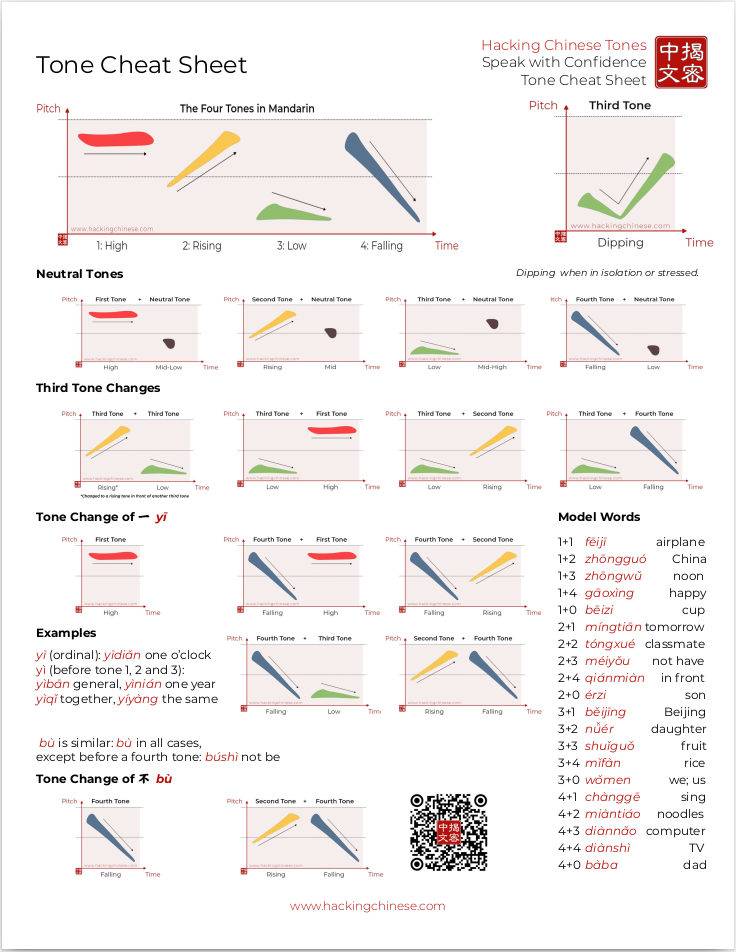
This pitch-contour diagram illustrates the change. Instead of two dips, you get a rise followed by a dip.
Part 2: The Tone Change for 不 (bù)
The next rule applies to the character 不 (bù), the primary word for negation, meaning "not" or "no." Its default, or base tone, is the fourth (falling) tone.
The rule is straightforward:
不 (bù) is pronounced with a second (rising) tone, bú, when it is immediately followed by a syllable with a fourth tone. In all other cases (before a first, second, or third tone, or when used alone), it retains its original fourth tone, bù.
This change is another example of articulatory efficiency. Pronouncing two sharp, falling tones in a row (bù + [4th tone]) is abrupt and requires resetting your pitch high for the second syllable. Changing bù to a rising tone creates a smoother contour.
-
bù(4th) +[4th tone]→bú(2nd) +[4th tone] -
Example: 不是 (is not) is written
bù shìbut pronouncedbú shì. -
bù(4th) +[1st, 2nd, or 3rd tone]→ No change. -
Example: 不好 (not good) is written
bù hǎoand pronouncedbù hǎo.
This video provides clear audio examples of the rule.
Chinese Tone Change Rules | Chinese Pinyin Lesson 12
This video from Everyday Chinese demonstrates the tone change for 不 (bù).
Please watch the segment from the explanation of bù. Listen to the pronunciation of 不对 (bù duì) as bú duì.
Part 3: The Tone Change for 一 (yī)
Our final rule concerns the character 一 (yī), meaning "one." This is the most tonally variable character in Mandarin. Its base tone is the first (high-level) tone, which you hear when counting ("yī, èr, sān...") or when it's the last word in a phrase. However, when it precedes another character, its tone changes based on the tone of that following character.
The rules for 一 (yī) are best thought of as a set of conditions:
-
Before a fourth tone, 一 changes to a second (rising) tone:
yí.- Example: 一共 (altogether) is written
yī gòngbut pronouncedyí gòng.
- Example: 一共 (altogether) is written
-
Before a first, second, or third tone, 一 changes to a fourth (falling) tone:
yì.- Example (before 1st tone): 一天 (one day) is written
yī tiānbut pronouncedyì tiān. - Example (before 2nd tone): 一年 (one year) is written
yī niánbut pronouncedyì nián. - Example (before 3rd tone): 一起 (together) is written
yī qǐbut pronouncedyì qǐ.
- Example (before 1st tone): 一天 (one day) is written
-
When used as a number, in an ordinal, or at the end of a word/phrase, it remains first tone:
yī.- Example: 第一 (first) is pronounced
dì yī.
- Example: 第一 (first) is pronounced
This might seem complex, but there's a pattern. Notice that yī's tone shifts to "get out of the way" of the following tone, creating more melodic contrast. The HSKLord article provides a good summary.
Chinese Tones Explained: The Complete Beginner's Guide | HSKLord
This section clearly lays out the three different tones that 一 (yī) can take.
Read Rule 3 for a full breakdown with examples.
The following infographic is an excellent visual summary of all three rules we've discussed today.

Practice Application
Let's put this into practice. For each of the following two-syllable words, determine how they would be pronounced, applying the sandhi rules we've learned. The Pinyin shows the original, underlying tones.
kě yǐ(can, may)bù duì(incorrect)yī dìng(definitely)yì bǎi(one hundred)bù néng(cannot)
Check your answers:
- Pronounced
ké yǐ(3+3 → 2+3 rule). - Pronounced
bú duì(bù + 4th tone → 2+4 rule). - Pronounced
yí dìng(yī + 4th tone → 2+4 rule). - Pronounced
yì bǎi(yī + 3rd tone → 4+3 rule). - Pronounced
bù néng(No change, asnéngis a second tone).
Key Takeaways
- Tone sandhi is a system of mandatory pronunciation rules. The Pinyin spelling usually shows the original tones, not the changed ones.
- Third Tone Rule: When two third tones are consecutive, the first one is pronounced as a second tone (
3+3 → 2+3). In most other cases, a third tone is pronounced as a "half third tone" (low and falling, without the rise). - 不 (bù) Rule:
bù(4th tone) changes tobú(2nd tone) only when followed by another fourth tone. - 一 (yī) Rule:
yī(1st tone) changes toyí(2nd tone) before a fourth tone, and toyì(4th tone) before a first, second, or third tone. It remainsyīwhen counting or at the end of a word.
With this lesson, you have completed the core phonological and orthographic systems of Mandarin. You now know all the sounds, the four tones, the rules for writing them, and the rules for how they change in context.
In our next lesson, we will put all of this knowledge together. You will practice reading unfamiliar Pinyin text aloud, integrating your understanding of initials, finals, tones, and sandhi to build reading fluency.