Last time, the response was still ahead of you: you could pause, describe the delay, and ask for notice without accusing a friend of bad intentions. This lesson begins when that pause did not happen. You reacted sharply, and now you want to repair the interaction without pretending the original frustration was groundless.
The skill is to separate two things that can both be true: your reaction was yours to take responsibility for, and your need may still deserve attention. Allow about 35–40 minutes for the lesson and its short resources. No reply or submission is needed.
Repair the reaction, not the existence of the feeling
Return to the late-arrival example. A friend arrives 20 minutes after the agreed time without a message. You say sharply, “You never respect my time,” then interrupt when they begin to explain.
The delay and lack of notice may present a real problem. Your frustration is understandable. But “you never respect my time” claims to know a pattern and a motive that this one incident does not establish; interrupting also prevents a useful conversation. Apologizing for those choices does not mean apologizing for wanting notice.
It helps to identify the specific conduct you would change: the accusation, the raised voice, or the interruption. “I shouldn’t have felt angry” aims at an emotion you did not simply choose. “I shouldn’t have interrupted you” identifies an action you can own. Conversely, “I’m sorry you were upset” leaves your action unnamed and can sound as though the other person’s feelings are the problem.
Watch the short segments below for the distinction between taking responsibility and defending a reaction. Notice especially the advice to address your own mistake without making the apology depend on the other person admitting theirs.
How To Apologize Effectively - 4 Steps
In “How To Apologize Effectively - 4 Steps,” Dr. Tracey Marks shows how wording can either acknowledge a harmful action or quietly shift blame. The segments also cover remorse and a practical offer to make amends.
Watch taking ownership for examples of evasive and direct apologies. Continue with context without excuses, paying particular attention to the distinction between apologizing for an insult and discussing what prompted your frustration. Watch expressing remorse, then making amends for the forward-looking part of a repair.
An explanation can be useful later, but its placement matters. “I snapped because you didn’t text” may be factually related to what happened, yet in an apology it makes the other person responsible for your choice to snap. First make your ownership clear. You can then discuss the delay as a separate concern, in the same conversation if both of you are ready or at another time if you are not.
Give the apology a clear shape
A repair statement does not need to be elaborate. It needs enough detail that the other person can tell what you are taking responsibility for and what you intend to do differently. A useful shape has three parts: name your action, acknowledge its impact, and offer a credible change or amends. The concern that remains can follow after those parts; it should not be attached as a condition of the apology.
For the late-arrival incident, that could sound like this:
“I’m sorry I said you never respect my time and interrupted you when you tried to explain. That was an unfair accusation, and I didn’t give you room to speak. Next time I’ll pause and talk about the delay rather than make a claim about your character.”
This statement stays close to what happened. It does not require you to guess exactly how your friend felt, and it does not promise that you will never be frustrated again. It names an achievable change in behavior.
Only after that ownership is established does the original concern return:
“I was frustrated about waiting without knowing whether plans had changed. I still need a message when you know you’ll be late. If I haven’t heard from you after 15 minutes in future, I’ll continue with my plans and we can reschedule.”
The word still matters: the apology has not erased the need. The last sentence is a boundary about your own time, not a punishment. You may choose a different limit, and your friend may have information you have not heard yet. What makes the repair sound is that the request and boundary no longer serve as excuses for the accusation.
The Gottman Repair Checklist offers short phrases that can help when you cannot immediately find polished words. Its “Sorry” and “Stop Action!” groups are particularly relevant after a sharp reaction.
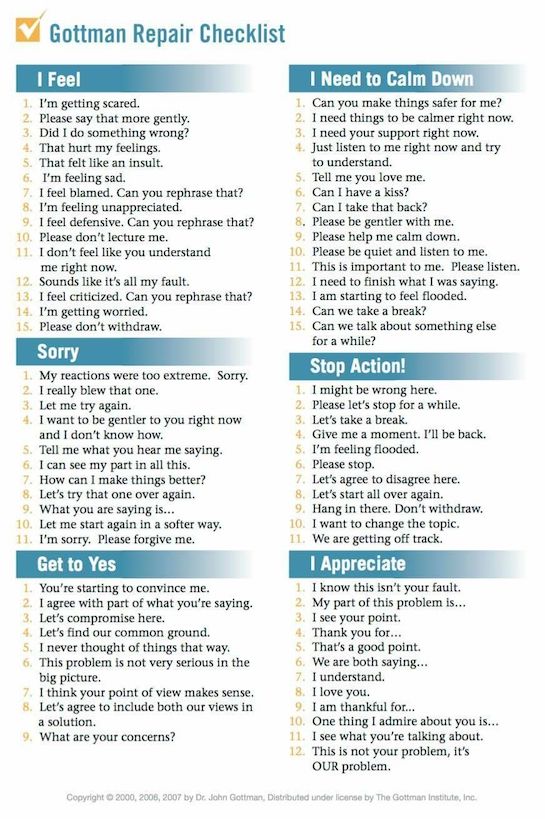
For example, “My reactions were too extreme. Sorry” can open the conversation, but it becomes more useful when followed by which reaction you mean. “Let’s start all over again” can signal a reset, but a reset should not skip responsibility for an insult or silently abandon the issue that led to the argument. Treat these phrases as openers, not complete scripts.
Make amends without making promises you cannot keep
An apology looks backward at what you did; amends also look forward. Depending on the harm, making things right might mean letting the other person finish what you interrupted, correcting an unfair claim made in front of others, or changing how you handle the next delay. A promise is useful only if you can plausibly follow it.
Read the short “Step 3” passage below for examples of reparation and for its caution about overpromising when you feel guilty.
The Three Parts of an Effective Apology - Greater Good
Read the “Make the situation right” portion of this Greater Good article by Christine Carter. It adds an important practical question to an apology: what can you reasonably do to repair the harm or avoid repeating it?
In “Step 3: Make the situation right,” begin at the paragraph opening “Good apologies include a reparation of some kind.” Read the Step 3 passage through the paragraph beginning “Above all, deliver on any promises you make.” Focus on the difference between a concrete, sustainable change and an offer made only to relieve guilt.
In the example, “I’ll never get irritated about lateness again” is neither necessary nor credible. “If I feel myself getting sharp, I’ll take a moment before I speak” is more useful. If you interrupted, a simple immediate amends might be, “I cut you off. I’m ready to hear what you were saying.” That offer does not require you to agree with the explanation you hear.
Avoid turning the apology into a bargain: “I’ll apologize if you admit you were inconsiderate.” The other person may owe you a conversation about the delay, but their response is not a prerequisite for owning your interruption. Likewise, you need not agree to every request made in response to your apology. You can take responsibility for snapping while declining a demand that you always wait, never raise the issue again, or give up a reasonable boundary.
Adjust to the moment without taking back the concern
A repair statement is an attempt to restore the possibility of a useful conversation, not a way to secure immediate forgiveness. The other person may still be upset. If they say, “You shouldn’t have spoken to me like that,” you can answer simply: “You’re right that I shouldn’t have spoken to you like that.” There is no need to defend the accusation a second time. The discussion about future notice can wait until there is space for it.
Sometimes the other person hears an apology as a concession on the entire disagreement: “So you admit the delay was fine.” A precise response keeps the two issues distinct:
“I’m taking responsibility for what I said and for interrupting you. I’m not saying the wait was fine for me. I’d like us to talk about how to handle delays once we’ve had a chance to settle.”
If you are still too worked up to say the first part without adding another jab, take time before attempting the repair. A short acknowledgement can prevent the pause from looking like withdrawal: “I spoke sharply, and I want to address that. I need a little time to settle so I can do it properly.” Return to the conversation when you said you would, if possible. Time to regulate is not time to make the issue disappear.
Finally, repair does not require pursuing a conversation that feels unsafe or accepting mistreatment in exchange for forgiveness. In an ordinary low-stakes frustration, the goal is mutual clarity, not a perfect apology or a guaranteed response. You control the accuracy of what you own, the respectfulness of your request, and whether you follow through on the change you offer; you do not control when the other person is ready to engage.
Carry this forward
After an impulsive reaction, name what you did, acknowledge the impact you can reasonably identify, and offer a realistic way to do better. Then, without a defensive “but,” return to the original need as a separate request or boundary. Both parts matter: responsibility prevents your concern from becoming an excuse for hurtful behavior, while the request prevents repair from becoming self-silencing.
The final lesson will turn these skills into an if–then plan for a recurring trigger, including a way to notice whether your response actually helped.