Introduction
In our last lesson, we explored psychic distance, which is about controlling the flow of information through the point-of-view character by zooming your narrative lens in and out. We treated it as a camera operation, adjusting how closely the reader is tied to a character's direct experience.
Today, we shift from managing information through the character to managing information around them. This lesson focuses on a powerful technique for creating tension and engagement: implementing dramatic irony by giving the reader knowledge that a character lacks.
Your goal is to understand the mechanics of creating and deploying this information imbalance. We will treat dramatic irony not as a vague literary concept, but as a precise narrative engineering tool used to generate specific emotional responses in the reader, from suspense and dread to humor.
1. The Core Mechanism: The Information Gap
At its most fundamental level, dramatic irony is the result of an information gap between the audience and one or more characters. The audience is given privileged information, placing them "ahead" of the character in the story's timeline of knowledge.
To get a clear definition, let's start with a foundational video.
Irony Explained — 3 Types of Irony Every Storyteller Should Know (Verbal, Situational, and Dramatic)
The StudioBinder video, 'Irony Explained', provides a crisp definition of dramatic irony and distinguishes it from other forms of irony. It also introduces a simple, three-stage model that we will use as the basis for our mechanical analysis.
First, watch the section from 01:01 to 02:30 to understand the general concept of irony as a conflict between expectation and reality. Then, watch the section on dramatic irony from 08:22 to 10:13. Pay close attention to the three stages mentioned: Preparation, Suspension, and Resolution.
As the video explains, dramatic irony isn't just a random event. It is a structured technique. The effect—tension, dread, humor—arises because the audience understands the true stakes of a situation while the character operates in ignorance. The audience isn't wondering what will happen (they often know), but rather how and when the character will discover the truth they already possess.
2. The Three-Stage Implementation Process
The StudioBinder video introduced a three-stage process. This provides a systematic framework for constructing dramatic irony, much like an algorithm for generating suspense. Let's formalize this process.
Dramatic Irony: Definition and Examples
The Grammarly article, 'Dramatic Irony: Definition and Examples,' provides a clear, text-based breakdown of this three-stage process. It's a perfect blueprint for implementing the technique.
Read the section 'How does dramatic irony work?' and focus on the three numbered stages: Preparation, Suspense, and Resolution. Note how the 'Romeo and Juliet' example is used to illustrate each stage.
Let's codify this into a repeatable mechanical process:
-
Preparation (The Information Delivery): The writer gives the audience a piece of critical information that a character does not have. This can be achieved in several ways:
- A scene showing the antagonist's plan.
- A flash-forward showing a future outcome.
- A narrator directly telling the audience a fact.
- A scene from another character's POV that the main character is not privy to.
-
Suspension (The Period of Ignorance): The story unfolds with the character acting without the crucial information. Their words and actions take on a second, tragic or comic meaning for the audience. The tension comes from the audience waiting for the inevitable collision between the character's ignorant actions and the reality of the situation. The longer this stage, the higher the tension.
-
Resolution (The Collision): The character finally learns the truth. The gap between the audience's knowledge and the character's knowledge closes. The consequences of the character's actions during the suspension stage are now fully realized.
Think of it as setting up two parallel tracks that are destined to collide. The audience can see both tracks, but the character can only see the one they are on. The suspense is in the anticipation of the crash.
3. A Step-by-Step Guide to Implementation
Now, let's translate that three-stage model into an even more granular, actionable checklist for your own writing.
Dramatic Irony: Definition and Examples
The Grammarly article we just looked at also contains a section that serves as a perfect step-by-step guide for a writer. This turns the theory into a practical workflow.
Read the section titled 'How to use dramatic irony in your writing'. It presents four clear, actionable steps. We will treat this as our implementation protocol.
Here is the protocol, synthesized from that resource:
- Step 1: Decide what information the audience will know. This is the "secret." It must be crucial and directly affect the character's conflict. (e.g., The audience knows the friendly new neighbor is the serial killer the protagonist is hunting.)
- Step 2: Expose the character’s ignorance. Show the character acting in a way that confirms they do not possess the secret. (e.g., The protagonist invites the neighbor over for dinner, confiding in him about the difficult case.)
- Step 3: Build the tension. Allow the character to continue acting on their false assumptions, moving them closer to the danger or revelation. Every ignorant action becomes freighted with meaning for the reader. (e.g., The protagonist shows the neighbor the evidence board, pointing out clues that the audience knows point directly at the neighbor.)
- Step 4: Stage the resolution. The character discovers the truth. The manner of this discovery should be engineered for maximum impact, fitting the story's tone (e.g., a moment of shocking violence, a quiet, dawning horror, or a comedic misunderstanding cleared up).
Test your understanding!
You are writing a fantasy story. The protagonist, a young knight, has been given a "blessed sword" by his king to slay a dragon.
Using the four-step protocol, how would you implement dramatic irony in this scenario to create tension?
Show answer
Here is one possible implementation:
- Decide on the secret: The sword is not blessed; it is cursed. The king, fearing the knight's growing popularity, wants him to fail.
- Expose ignorance: In a prior scene (the Preparation stage), the reader sees the king conspiring with a dark mage to curse the blade. Now, we see the knight polishing the sword, speaking of his trust in the king and his faith in the "blessed" weapon.
- Build tension: The knight travels to the dragon's lair, confidently facing challenges along the way. He might narrowly survive a situation and attribute his survival to the sword's "blessing," while the reader knows it was dumb luck or his own skill.
- Stage the resolution: In the climactic battle, the knight strikes the dragon, and the sword shatters or turns against him, revealing the betrayal at the worst possible moment.
4. Technical Constraints: Point of View
The ability to create an information gap is directly tied to the narrative architecture you've chosen, specifically your Point of View (POV).
Use These 10 Literary Devices to Tell an Awesome Story
Let's read a short, focused analysis of how POV choice enables or restricts your ability to use dramatic irony.
Read the section 'How POV relates to dramatic irony'. It clearly explains the limitations of first-person and the flexibility of third-person for this technique.
As the article explains:
- First-Person POV: It is difficult to create dramatic irony where the protagonist/narrator is the ignorant party. Since the reader only knows what the narrator knows, there can't be a gap. However, you can still create dramatic irony where the narrator (and thus the reader) knows something that other characters in the story do not.
- Third-Person POV (Limited or Omniscient): This POV is ideal for dramatic irony. It allows the narrative to show the reader things the protagonist doesn't see. You can cut away to a scene with the villain, follow a secondary character who holds a secret, or simply have an omniscient narrator state a fact. This gives you complete control over the information landscape.
This isn't to say one POV is better than another, but that the choice of POV is a structural engineering decision with direct consequences for which narrative tools are available to you.
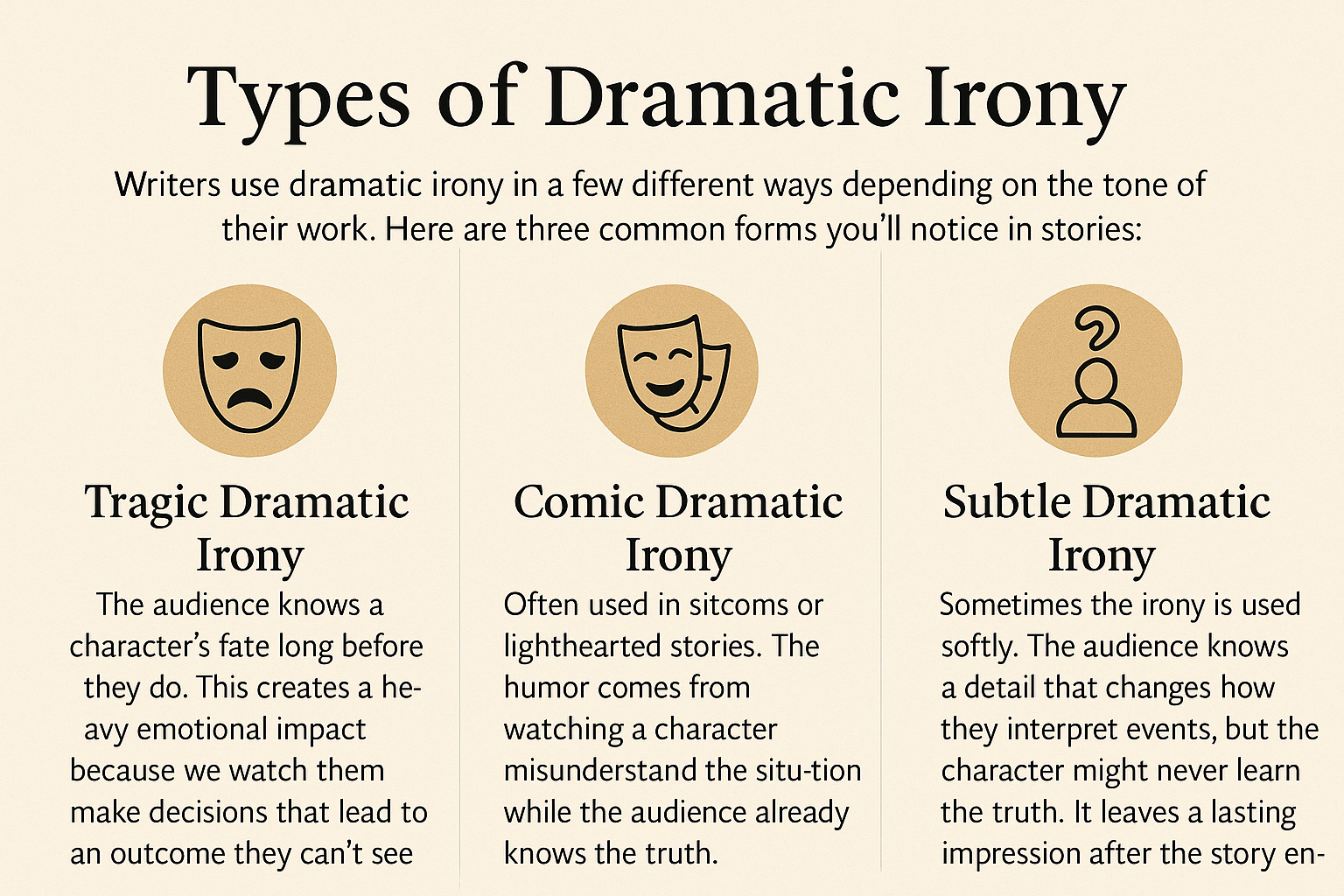
5. Categories of Effect: Tragic, Comic, and Subtle Irony
The same mechanical setup—an information gap—can produce wildly different emotional outputs depending on the context. We can categorize these outputs to better understand their function.
-
Tragic Irony: The audience knows a character is marching toward a disastrous outcome. The character's hopes and efforts seem poignant or foolish in the face of their known fate.
- Example: In Titanic, the audience knows the ship will sink. Every scene of passengers celebrating their new life in America is layered with a sense of impending doom.
-
Comic Irony: The audience knows the truth of a situation that a character misunderstands, leading to humorous actions or dialogue. Mistaken identity plots are a classic example.
- Example: In a sitcom, Character A is hiding in a closet to plan a surprise party for Character B. Character B enters with a friend and starts complaining loudly about all of Character A's flaws, while the audience knows A is hearing every word.
-
Subtle Irony: The audience is aware of a detail that adds a layer of meaning to a scene, even if it doesn't lead to a dramatic confrontation. It enriches the theme and characterization.
- Example: A detective interviews a seemingly grieving widow. The audience knows from a prior scene that she was having an affair, and this knowledge re-frames her every word and gesture as a calculated performance.
Conclusion
You have now analyzed dramatic irony as a mechanical system for controlling information and generating specific emotional responses. This is a core technique in managing the reader's experience, moving beyond simply telling a story to engineering how that story is perceived.
Key Takeaways:
- Dramatic irony is a structured information gap between the reader and a character.
- It is implemented using a three-stage process: Preparation, Suspension, and Resolution.
- A four-step protocol can be used to construct it: decide the secret, expose ignorance, build tension, and stage the resolution.
- Your ability to use dramatic irony is constrained by your choice of POV, with third-person being the most flexible.
- The same mechanism can produce different effects, which can be categorized as tragic, comic, or subtle.
Preview of the Next Lesson:
We have just focused on giving the reader more information than a character. However, writers must also manage situations where they deliberately give the reader less information. In the next lesson, we will distinguish between strategically withholding information from the reader versus teasing its existence, two techniques that create mystery and suspense by manipulating what the reader doesn't know.