Introduction
In our last lesson, we focused on character agency, establishing the protagonist as the primary actor who drives the plot through their choices. We now shift from the actor on the stage to the camera filming them. Point of View (POV) is the narrative camera—the technical system you choose to frame the action, control information, and situate the reader's consciousness within the story.
This lesson marks our entry into Module 6, "Point of View and Narrative Control." Our objective is to differentiate between first-person, close third-person, and omniscient points of view by analyzing examples. We will break down each POV into its core mechanics, examining how each choice of "camera lens" fundamentally alters the reader's access to information, character thoughts, and the overall narrative voice.
1. The Core Parameters of Point of View
Think of POV not as an artistic whim, but as a system defined by a set of technical parameters. The most critical parameter is the source of the narration: is it a character within the story, or an entity outside of it? This single choice creates a cascade of effects on how the story is told.
To get a high-level overview of the primary POV systems and the criteria we can use to evaluate them, let's begin with a video.
How to Choose a Point of View (feat. @ManCarryingThing)
The video 'How to Choose a Point of View' from the channel Around the Campfire provides an excellent, structured introduction to the main POVs. It evaluates them based on four useful technical criteria: Connection, Voice, Information, and Ease of Use.
Please watch from the beginning to 01:32 to get an introduction to the different types of POV and the analytical framework we'll be using.
As the video outlines, your choice of POV is a strategic trade-off. Let's now dissect the mechanics of each system, starting with the most intimate.
2. First-Person POV: The Internal Narrator
In this system, the narrator is a character participating in the story. The narrative is filtered entirely through their consciousness.
Definition: The story is told from the perspective of a character using first-person pronouns like "I," "me," and "we."
Let's examine the mechanics and trade-offs of this approach.
How to Choose a Point of View (feat. @ManCarryingThing)
Let's return to the 'How to Choose a Point of View' video to analyze the specific properties of first-person narration.
Watch from 01:32 to 04:48. Pay close attention to the strengths (strong connection, distinct voice) and weaknesses (information constraints, potential for 'telling' over 'showing') of this POV.
Key Mechanics of First-Person:
- Information Access: The reader can only know what the narrator knows, sees, and thinks. This is a powerful tool for creating mystery and suspense but can make conveying world-building details challenging.
- Voice: The narrative voice is inseparable from the character's personality, biases, and vocabulary.
- Connection: It offers the highest potential for creating a strong emotional bond (or connection) between the reader and the narrator.
Here is an example from a published novel:
Point of View Examples: A Quick Reference Guide
The article 'Point of View Examples' from The Novelry provides concise examples from well-known books. Let's look at a classic first-person narrator.
Read the first example under the 'First-person singular' heading, the excerpt from Suzanne Collins's The Hunger Games.
Notice how every piece of information—the coldness of the bed, the texture of the mattress, the search for Prim—is a direct sensory or mental experience of the narrator, Katniss. We are locked inside her perspective.
3. Third-Person POV: The External Narrator
Now we switch from an internal narrator to an external one. The storyteller is no longer a character in the events but an observer telling the story about the characters. This is distinguished by the use of third-person pronouns: "he," "she," and "they."
This external position allows for two major subsystems, differentiated by the narrator's level of access to character consciousness.

3.1. Close Third-Person (or Third-Person Limited)
This is the most common POV in modern fiction. It combines the external narrator of third-person with the tight psychic focus of first-person.
Definition: The narrator tells the story from outside, but confines the reader's perceptions, thoughts, and feelings to a single character at a time.
Point of View (P.O.V.): Third Person Omniscient, Limited-Omniscient, and Objective
The video 'Point of View (P.O.V.)' by Mr. Armstrong Teaches gives a very clear, academic definition of third-person limited, complete with an excellent example demonstrating its constraints.
Please watch from 03:15 to 05:07. Focus on the example of Yuki and Toby. Note how we have full access to Yuki's thoughts and fears, but we can only observe Toby's external actions (frowning, looking at his hands). We do not know why he is frowning.
Key Mechanics of Close Third-Person:
- Information Access: Limited to what the POV character knows, thinks, and perceives. We can't know what other characters are thinking unless they show it through action or dialogue.
- Flexibility: While limited within a scene or chapter, many novels use multiple third-person limited POVs, switching to a different character's perspective in a new chapter (e.g., George R.R. Martin's A Song of Ice and Fire).
- Voice: The author's narrative voice dominates, but it is often "colored" by the POV character's mood and perspective.
3.2. Third-Person Omniscient
This is the "god's-eye" view, where the narrator is unbound by the limitations of any single character.
Definition: The narrator is outside the story and has complete, unrestricted access to the thoughts and feelings of any character, as well as to information that no character may know.
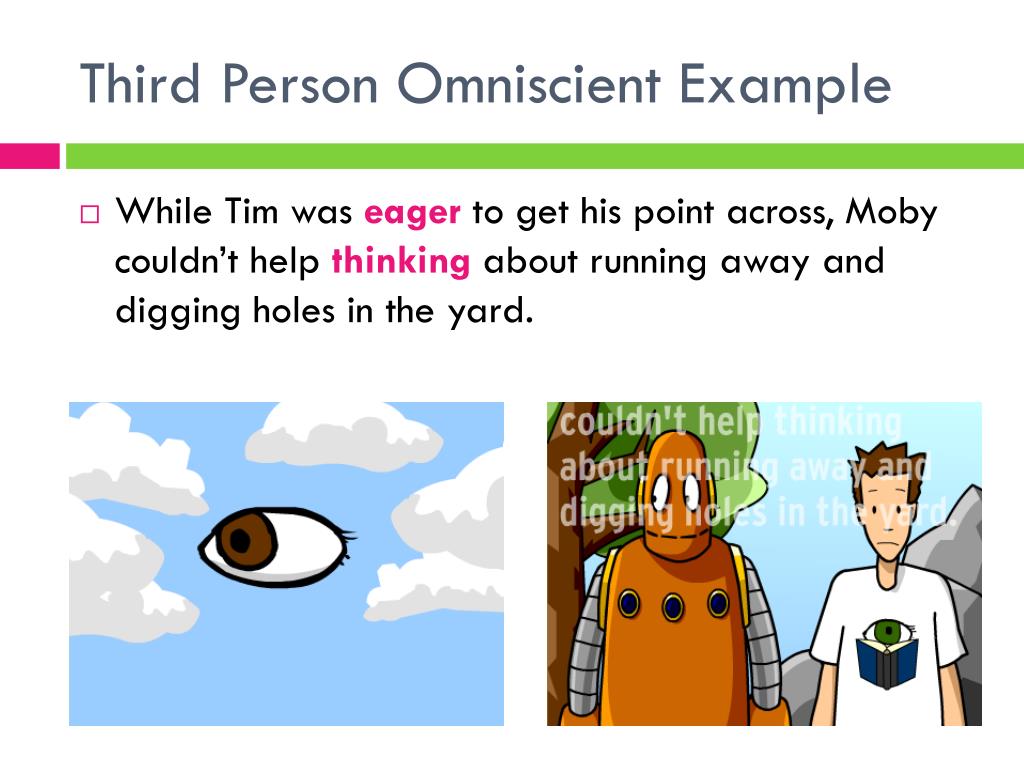
Let's see a more detailed breakdown.
Point of View (P.O.V.): Third Person Omniscient, Limited-Omniscient, and Objective
Returning to Mr. Armstrong's video, let's look at his definition and example for third-person omniscient.
Watch from 01:07 to 02:45. Pay special attention to the line 'it wouldn't rain for another three weeks.' This is a key tell for omniscience: the narrator knows something that is impossible for any character in the scene to know.
Key Mechanics of Third-Person Omniscient:
- Information Access: Total. The narrator knows everything about everyone, everywhere, at any time (past, present, or future).
- Voice: There is a strong, distinct narrative voice that is clearly separate from any of the characters. This voice guides the reader and provides commentary.
- Connection: This POV risks creating more distance between the reader and any single character, as the focus is broad rather than deep.
4. Differentiating POVs in Practice
Understanding the definitions is the first step. The second, more crucial step is being able to correctly identify the system being used in a piece of writing. A common error is to confuse true, controlled omniscience with an undisciplined, chaotic perspective often called "head-hopping."
Let's use an article and a practical exercise to solidify the difference.
Third person omniscient vs. limited vs. head jumping
The article 'Third person omniscient vs. limited vs. head jumping' by author and former literary agent Nathan Bransford offers a fantastic, practical breakdown of these concepts from a professional's perspective.
Please read the three short sections titled 'What is third person omniscient?', 'What is third person limited?', and 'What is head jumping in a novel?'. This will establish clear, working definitions for our exercise.
Now that you have the definitions for omniscient, limited, and the error of head-jumping, let's test your ability to differentiate them.
Test your understanding!
In the same article, scroll down to the section titled "Third person pop quiz." Read the three passages labeled Entry A, Entry B, and Entry C.
Based on the definitions you've just learned, identify which passage corresponds to:
- Third-Person Omniscient
- Third-Person Limited
- Head-Jumping
Write down your answers before proceeding.
Show answer
Now, continue reading the article from the section titled "The answers" to the end. The article confirms:
- Entry A is Third-Person Omniscient. It moves between two locations (Brooklyn and California) and shows events the other character isn't aware of, all guided by a consistent, external narrator.
- Entry B is Third-Person Limited. The entire scene is filtered through Nathan's perspective. We know his thoughts ("he believes this time he's finally published one without a typo") but we only see his mother's actions through a text message he receives.
- Entry C is Head-Jumping. The perspective shifts abruptly and confusingly, often within the same sentence ("Nathan hits 'publish' ... and believes... Nathan's mother hears a notification ... and wonders..."). It lacks the controlled, guiding voice of true omniscience.
This exercise highlights the core mechanical difference: control. Both limited and omniscient POVs are controlled systems. Head-jumping is a loss of control that disorients the reader.
Conclusion
You have now analyzed the three primary points of view as distinct mechanical systems for managing information and reader perception.
Key Takeaways:
- First-Person: Narrator is a character ("I"). The reader is locked inside one character's head, providing high intimacy but restricted information.
- Close Third-Person (Limited): Narrator is external ("he/she"), but perception is tied to one character at a time. This is the modern default, balancing intimacy with narrative flexibility.
- Third-Person Omniscient: Narrator is external and all-knowing ("he/she"). It offers maximum information and a broad scope but can create emotional distance from characters.
- The Litmus Test: To differentiate the third-person modes, ask: Can the narrator tell me the thoughts of more than one character in the same scene? Can the narrator tell me something no character could possibly know? If yes, it's likely omniscient. If no, it's limited.
Preview of the Next Lesson:
Now that we have established the main POV "camera setups," our next lesson will focus on a technique for operating that camera. We will learn how to control psychic distance by deliberately 'zooming in' for emotional intensity or 'zooming out' for summary. This will give you a finer degree of control over the reader's experience within your chosen point of view.